
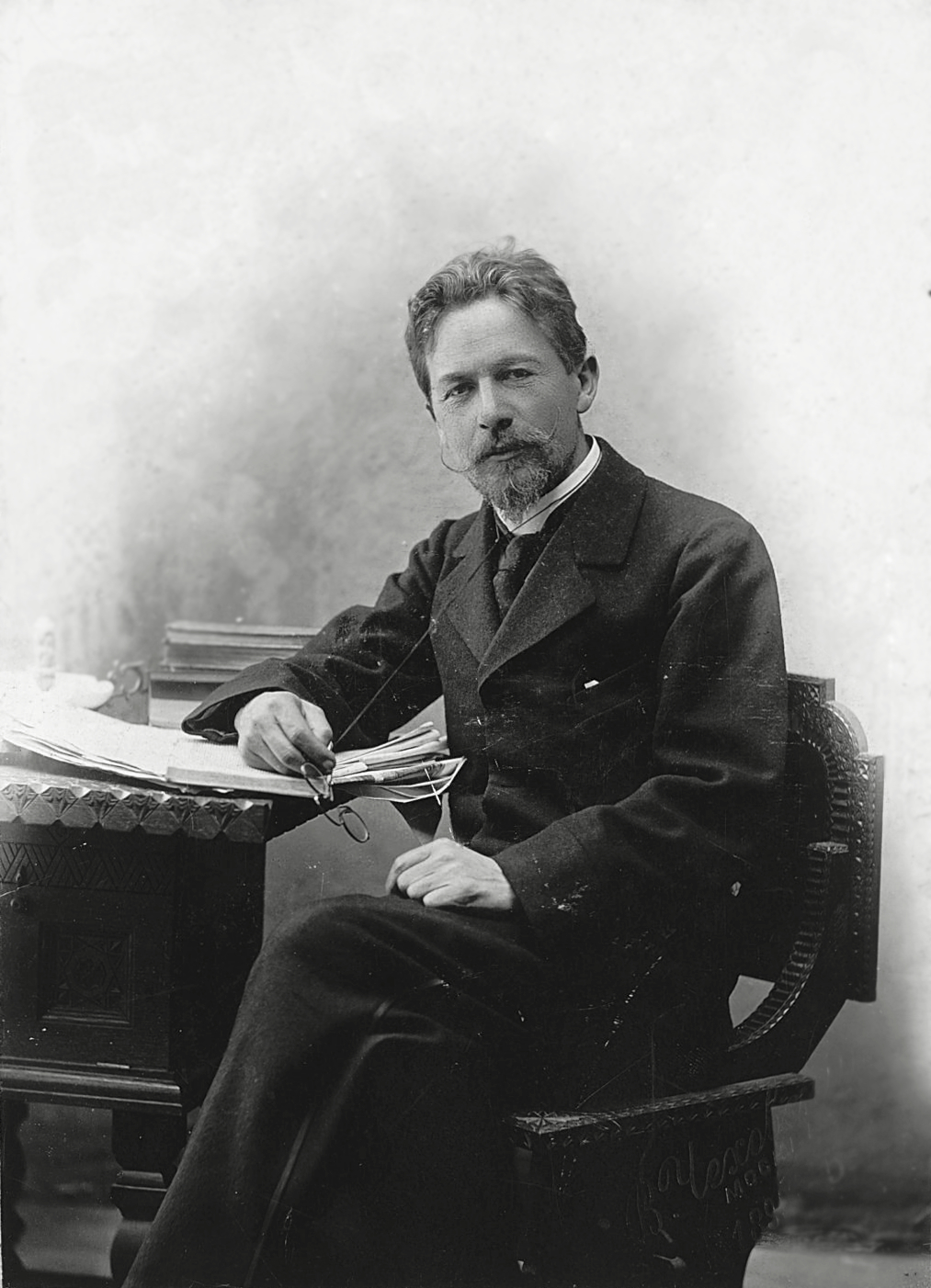
Anton Chekhov
Author · Russian · 1860 – 1904
Realism / Short story / Modern drama
The Doctor Who Listened
He was born in January 1860 in the port town of Taganrog on the Sea of Azov, the third of six children of a grocer who beat his sons and sang in the church choir. His grandfather had been a serf — had, in fact, bought his own freedom. Anton Chekhov grew up behind the counter of the family shop, working ten-hour days as a child, learning to observe the customers who came in for tea and cheap vodka because his father required it and because he found, early, that he had nothing else to do.
The grocery failed. The father fled to Moscow to avoid his creditors. The sixteen-year-old Anton stayed behind alone in Taganrog for three years to finish school, supporting himself by tutoring and selling off the family's remaining possessions. When he finally rejoined the family in Moscow he was nineteen, and already the effective head of the household. He enrolled in medical school and, to feed his parents and siblings, began writing short comic sketches for cheap weeklies under the pseudonym Antosha Chekhonte. He wrote hundreds of them. Most are throwaway. A few are among the finest short stories ever written.
By twenty-six he was the most popular young fiction writer in Russia. By twenty-seven he was coughing blood — the tuberculosis that would eventually kill him had already begun its patient work. In 1890, for reasons that no one has fully explained, he traveled by horse and river across Siberia to Sakhalin Island, the tsar's prison colony in the Pacific, and spent three months conducting a one-man census of every convict and settler on the island. He interviewed ten thousand people. The resulting book, The Island of Sakhalin, is a document of prison conditions so precise and so unbearable that it contributed directly to reforms in the Russian penal code. He never explained why he had gone. He was thirty.
The stories and plays that followed are the heart of modern fiction. Chekhov invented, almost alone, the short story as we now understand it — not a joke or a parable or a tightly plotted anecdote, but a slice of time in which nothing quite happens and yet a life is exposed. The Lady with the Dog, Ward No. 6, The Student, Gooseberries, The Bishop: each is a few pages long, each is about people who cannot quite see their own lives, and each ends on a note so quiet it is almost inaudible. He told other writers to cut the first and last paragraphs of everything they wrote, on the principle that most people explain too much. He followed his own advice.
In the theatre he did the same thing to drama. The Seagull, Uncle Vanya, Three Sisters, and The Cherry Orchard abolished the well-made play. There are no villains. There are no reveals. People sit on verandas and fail to say what they mean and watch their estates be sold and their loves slip past them. The Moscow Art Theatre, under Stanislavski, learned how to stage this almost-nothing, and in doing so invented modern acting. Half of the twentieth-century theatrical canon — Beckett, Miller, Albee, Pinter — descends directly from Chekhov's four late plays.
He married the actress Olga Knipper in 1901, when he was already very ill. He moved to Yalta on doctor's orders and wrote to her constantly. In the summer of 1904, in the spa town of Badenweiler in the Black Forest, he sat up in bed one night, said "Ich sterbe" — I am dying — to the attending German doctor, drank a glass of champagne the doctor had ordered as a last courtesy, lay back down, and died. He was forty-four. His body was returned to Moscow in a refrigerated railway car labeled For Oysters.
Don't tell me the moon is shining; show me the glint of light on broken glass.
Notable Works
- The Cherry Orchard
- Three Sisters
- Uncle Vanya
- The Seagull
- Ward No. 6
- The Lady with the Dog