
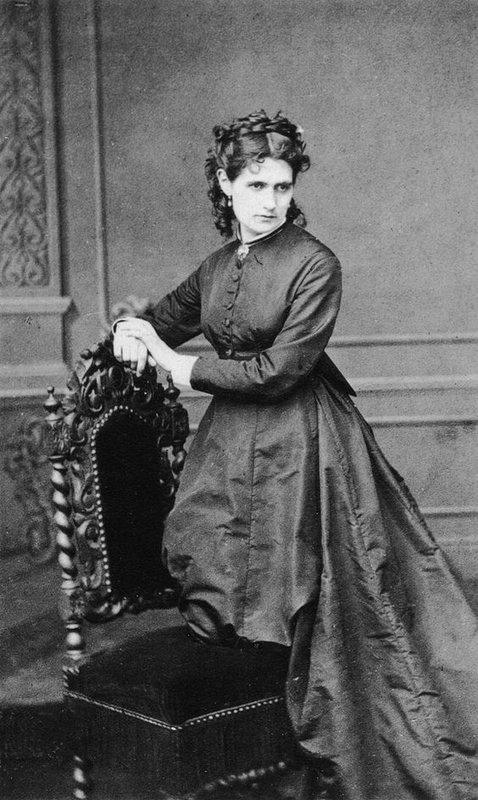
Berthe Morisot
Painter · French · 1841 – 1895
Impressionism
The Painter They Pretended Not to See
She was born into the kind of family where a young woman was expected to paint watercolors as a genteel accomplishment, not as a vocation. Her father was a high-ranking prefect of the French civil service, her mother was descended from the Rococo painter Fragonard, and Berthe Morisot and her sister Edma both showed real talent at an early age. They were given the best private tutors Paris could offer. They were also, like all women of their class, barred from the Ecole des Beaux-Arts, from life-drawing classes with male models, from most of the professional networks that made a career possible.
Edma married and stopped painting. Berthe did not stop.
In 1868 she met Edouard Manet in the Louvre, where she was copying an old master. He was already notorious, already the artist behind Olympia and the Luncheon on the Grass. She was twenty-seven, serious, dark-eyed, mordantly intelligent, and utterly unimpressed by his reputation. They became friends, then painter and model -- she appears in more than a dozen of his portraits, most famously in Berthe Morisot with a Bouquet of Violets, a small canvas of almost frightening psychological intensity -- and eventually, in 1874, she married his younger brother Eugene, a quiet man who understood that her work came first.
That same year she exhibited with the first Impressionist exhibition at Nadar's studio. She was the only woman in the group. She would remain a member, and a central one, of every Impressionist show thereafter except the one she missed while recovering from childbirth. Renoir, Degas, and Monet all considered her an equal. The critics, when they noticed her at all, called her the most gifted of the "feminine Impressionists" -- a category they invented specifically so they would not have to compare her to the men.
Her subjects were what her life permitted her to observe closely: her sister nursing a baby, her husband reading in a garden, her daughter Julie at every stage of childhood, women in their own rooms combing their hair or gazing out of windows at the world they were allowed to watch but rarely to enter. What she did with those subjects was nothing like the sentimental domesticity the label "woman painter" implied. Her brushwork was as loose and slashing as Manet's. Her compositions cropped figures against bright empty grounds with an almost photographic boldness. Her whites -- on aprons, bonnets, wedding dresses, cradles -- were the whites of broken ice, streaked through with blue and lilac, alive with the movement of air.
She died at fifty-four of pneumonia contracted while nursing her daughter through the same illness. On her death certificate, in the space marked profession, the clerk wrote "no profession." Her friends were appalled. She had shown in every Impressionist exhibition. Her work hung in museums. Her canvases sold for prices comparable to Monet's. And still, officially, she had no profession.
Her daughter Julie would grow up to marry a nephew of the poet Mallarme and to preserve her mother's work and papers with ferocious devotion. In the twentieth century Morisot slipped briefly out of the canon and then, slowly, was dragged back in. She is now understood as what she always was: a founder of Impressionism, the painter who showed that the interior world of women was as vast and as worthy of serious seeing as any battlefield or cathedral.
I do not think any man would ever treat a woman as his equal. It is all I ask, because I know my worth.
Notable Works
- The Cradle
- Summer's Day
- Woman at Her Toilette
- The Harbor at Lorient