
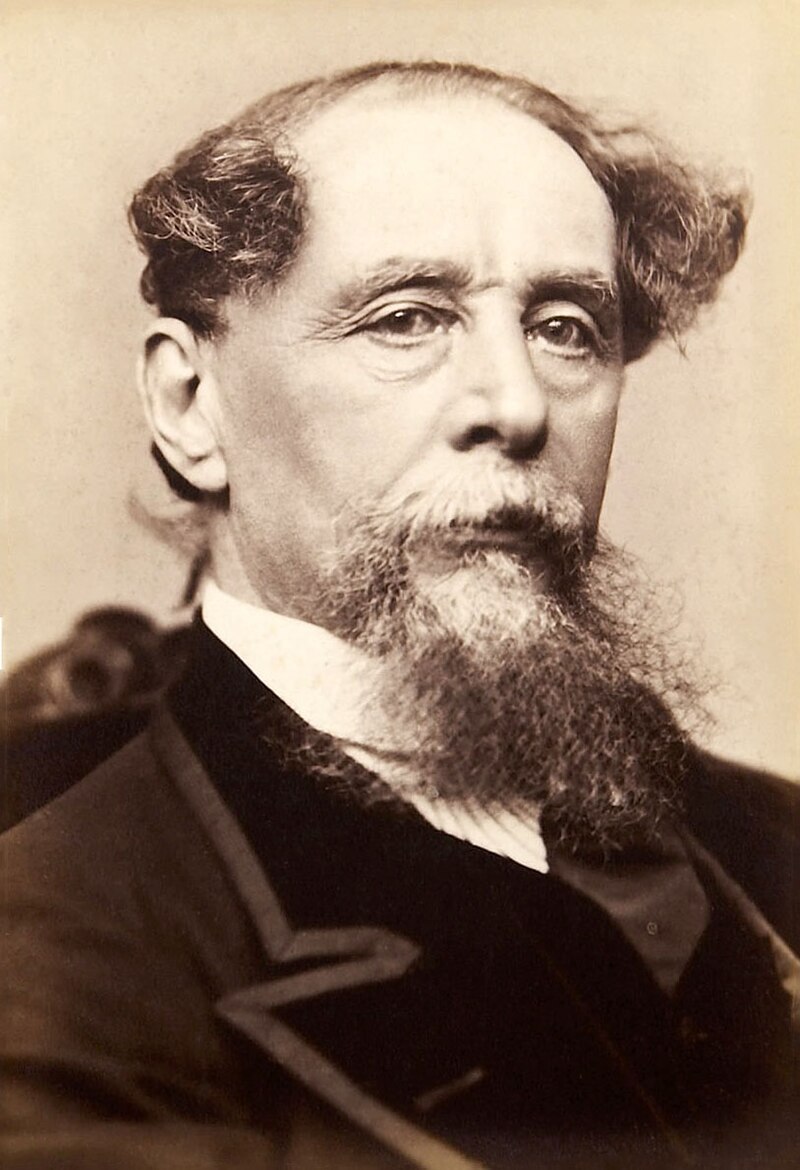
Charles Dickens
Author · English · 1812 – 1870
Victorian / Social realism
The Boy from the Blacking Factory
He was born in Portsmouth in February 1812, the second of eight children of a navy clerk named John Dickens who was warm, improvident, and constantly on the edge of ruin. When Charles was twelve his father was arrested for debt and sent to the Marshalsea prison, where the rest of the family joined him — an arrangement that was, astonishingly, normal for the period. Charles alone was sent out to work. He lived in a boarding house and pasted labels onto pots of boot-blacking at Warren's factory near the Thames, ten hours a day, six days a week, for six shillings. He was there for perhaps four months. He did not speak of it for thirty years.
That interval — the silence between the shame of the factory and the first time he told anyone about it, in an autobiographical fragment given to his friend John Forster — is the engine of nearly everything he wrote. Every orphan in Dickens, every abandoned child, every young man making his way in a cold London of indifferent adults, is a variation on the twelve-year-old who had to understand, without warning, that his family had disappeared and he was on his own. Oliver Twist, David Copperfield, Pip in Great Expectations — they are the same boy over and over, rewritten until the wound stops bleeding. It never quite stops.
He got out of the factory because his father inherited a little money and paid off the debt. He went back to school, taught himself shorthand, became a parliamentary reporter so quick that editors claimed he could transcribe faster than a man could speak. He began publishing sketches in the newspapers under the pseudonym Boz. In 1836, at twenty-four, he accepted a commission to write captions for a series of sporting illustrations; the illustrator died suddenly; Dickens rewrote the project as a picaresque serial called The Pickwick Papers and, within a year, was the most popular novelist in the English language. He would never not be.
He wrote in monthly installments of thirty-two pages, a relentless schedule he kept up for most of his career. Readers queued at the New York docks when the next installment of The Old Curiosity Shop was arriving by ship, shouting up at the sailors to ask whether Little Nell had died. She had. A nation mourned. He wrote fifteen novels, thousands of pages of journalism, amateur theatricals that he directed and starred in, public readings of his own work that he performed so physically — he played all the parts, he acted the murder of Nancy in Oliver Twist until he was exhausted and bleeding at the collar — that they almost certainly contributed to his early death.
The private life was not as triumphant as the public one. He married Catherine Hogarth in 1836 and they had ten children. In 1858, at forty-six, he met a young actress named Ellen Ternan. The marriage to Catherine ended in a scandalous public separation — he published a letter in his own magazine defending himself and attacking the absent Catherine, a document so cruel that even his children were shocked — and he lived the rest of his life in a half-hidden arrangement with Ternan that the Victorian press politely pretended not to see.
He survived a rail crash at Staplehurst in 1865, climbing between the ruined carriages to tend the dying, and then — characteristically — climbing back into the wreck to retrieve the manuscript of the latest installment of Our Mutual Friend from the carriage pocket. He never fully recovered from the crash. He died at Gad's Hill in June 1870, mid-sentence in a novel called The Mystery of Edwin Drood that has never been solved. He was buried in Poets' Corner at Westminster Abbey against his own stated wishes; he had asked for a quiet funeral in a country churchyard. The nation did not let him go that easily.
It was the best of times, it was the worst of times.
Notable Works
- A Tale of Two Cities
- Great Expectations
- Oliver Twist
- David Copperfield
- Bleak House
- A Christmas Carol