
Claude Monet
Painter · French · 1840 – 1926
Impressionism
The Man Who Dissolved the World
The word "Impressionism" was meant as an insult. When Claude Monet exhibited a small canvas of Le Havre harbor in 1874 -- a sketch-like composition of orange sun, blue water, and spectral boats titled Impression, Sunrise -- the critic Louis Leroy seized on the word to mock the entire group of painters who had dared to show outside the official Salon. They were mere "impressionists," he sneered, daubers of unfinished sensations. Monet took the name and wore it like a badge.
He had grown up on the Normandy coast, a truant and caricaturist whose early talent caught the eye of Eugene Boudin, the painter who first dragged the teenage Monet outdoors and told him to stop painting in the studio. "Everything that is painted directly on the spot," Boudin taught him, "has a strength, a power, a vividness of touch that one doesn't find again in the studio." Monet never forgot the lesson. He spent the next sixty years painting outdoors, in every weather, at every hour, chasing the light the way other men chase love or money.
The pursuit nearly broke him. Through the 1860s and 1870s, he was desperately poor. His first wife, Camille, posed for him in their garden while they could barely afford bread. She died of tuberculosis in 1879, at thirty-two, and Monet -- compulsively, helplessly -- found himself observing the colors of death on her face, painting her one final time. "I caught myself searching for the succession of color gradations that death was imposing on her motionless face," he later confessed. "Even before the idea came to me to record those features... my organism was already reacting to the color sensations."
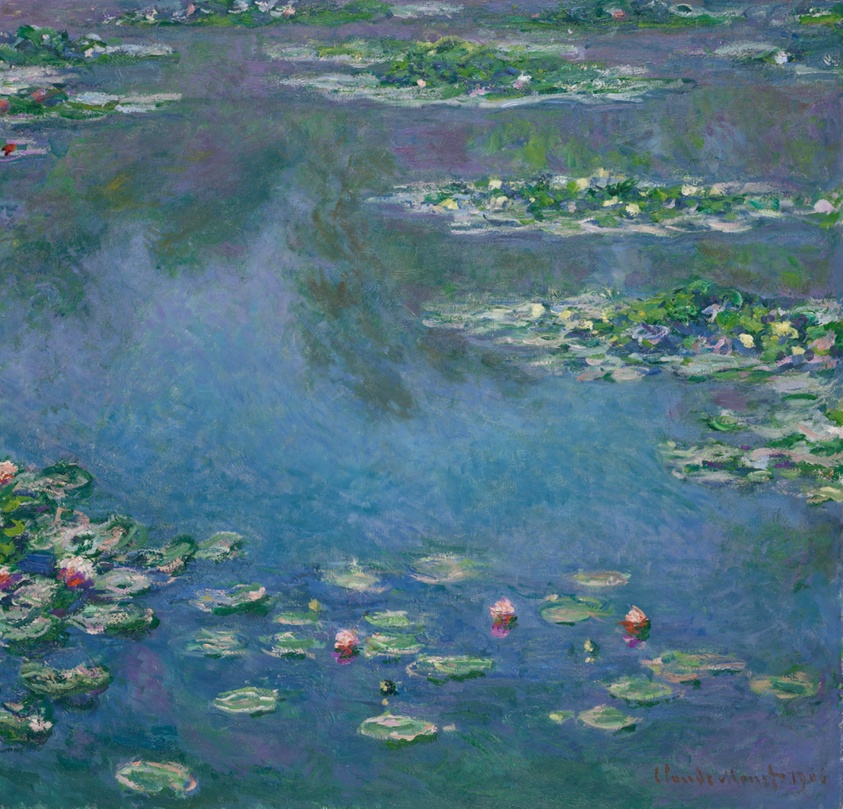
Success came eventually -- the Haystacks series, the Rouen Cathedrals, the poplars along the Epte -- and with it the garden at Giverny, where he spent the last four decades of his life engineering the landscape he would paint: the Japanese bridge, the weeping willows, and above all the water lilies, which became his consuming obsession.
As his eyesight failed to cataracts, the paintings grew larger, looser, more abstract. The final Water Lilies -- vast oval canvases now installed in the Orangerie in Paris -- dissolve the distinction between water and sky, surface and depth, seeing and dreaming. They anticipate abstract expressionism by thirty years.
Monet died at eighty-six, having spent a lifetime proving that the act of seeing is not passive but creative, that light is the true subject of all painting, and that the world, looked at closely enough, dissolves into color and starts over again.
He spent sixty years painting outdoors, in every weather, at every hour, chasing the light the way other men chase love or money.
Notable Works
- Impression, Sunrise
- Water Lilies
- Rouen Cathedral series
- Haystacks series