
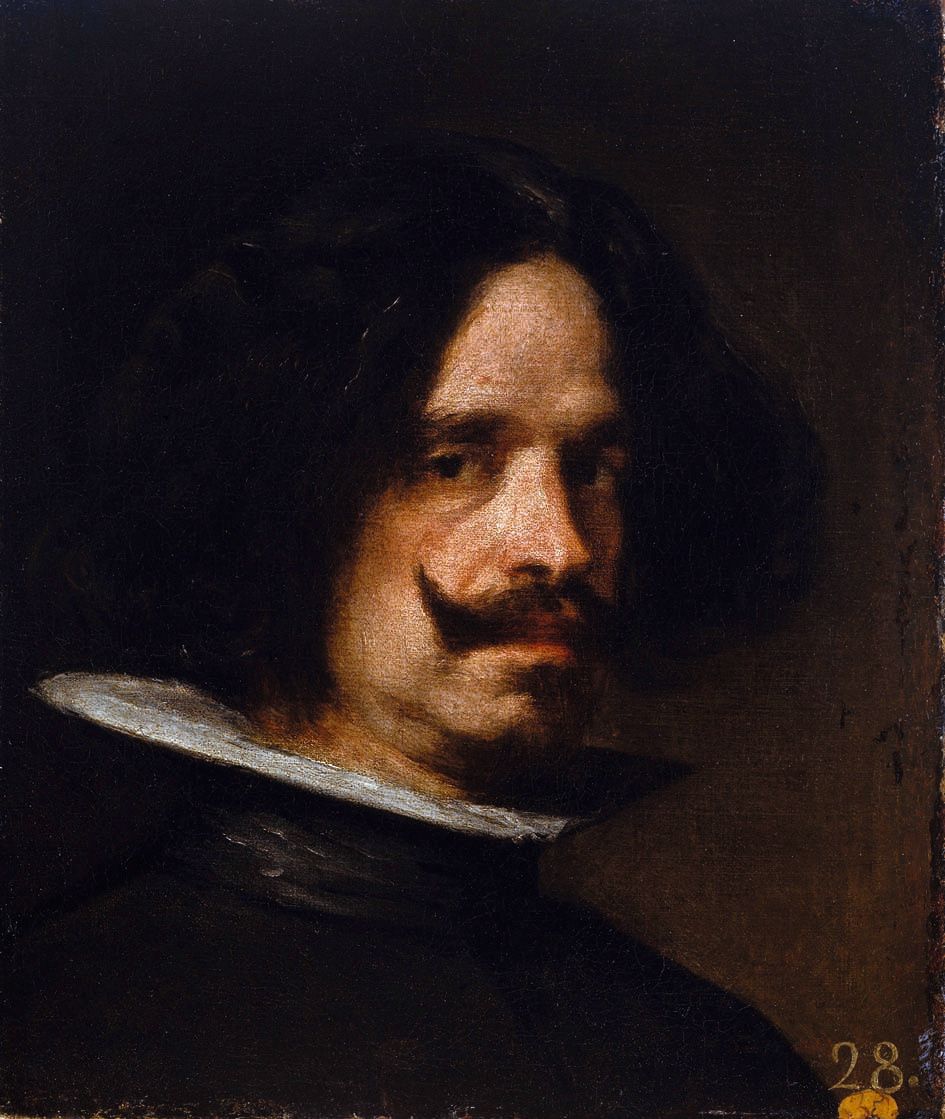
Diego Velázquez
Painter · Spanish · 1599 – 1660
Baroque / Spanish Golden Age
The Painter of the Painter
Diego Rodríguez de Silva y Velázquez was born in Seville in 1599, the same year Shakespeare was writing Hamlet. He apprenticed at twelve to Francisco Pacheco — a local painter better remembered as Velázquez's teacher and father-in-law than for his own work — and by nineteen he was painting the kitchens and taverns of Seville with an accuracy of observation that had no real precedent in Spanish art. He painted a black ewer sweating condensation. He painted an old woman breaking eggs into a pan of oil, the whites just beginning to set. These early pictures, called bodegones, were about looking at the world with the kind of attention Spain reserved, usually, for the saints.
In 1623 he was summoned to Madrid to paint the new king. Philip IV was eighteen; Velázquez was twenty-four. The sitting went so well that the king refused to be painted by anyone else for the next thirty-seven years. Velázquez moved his family into the palace and stayed until he died.
What happened over those thirty-seven years is one of the strangest careers in Western art. Velázquez painted Philip aging — from the long-jawed confident boy to the gray, exhausted, god-burdened man of the late portraits — and he painted the king's dwarfs, the king's children, the king's ministers, the king's horses, the king's court jesters, and a few of the king's saints. He was given titles. He traveled twice to Italy and in Rome painted Pope Innocent X in a picture so ferocious the pope reportedly muttered troppo vero — too truthful — and hung it somewhere inconspicuous. He painted, probably during the same Italian trip, the only surviving female nude by a Spanish master of the Golden Age: a naked Venus seen from behind, gazing at herself in a mirror held by Cupid, the reflection deliberately blurred so we cannot see her face.
And in 1656, four years before he died, he painted Las Meninas.
Las Meninas is almost impossible to describe because its subject is the act of looking. The Infanta Margarita stands in the center of a large, shadowy palace room, attended by her maids of honor and a dwarf and a dog. On the left Velázquez himself stands before an enormous canvas, painting — painting, apparently, us. On the back wall, in the dim glow of a mirror, we can just make out the reflected faces of the Infanta's parents, the king and queen, who must be standing exactly where we stand. Michel Foucault opened The Order of Things with a thirty-page analysis of this painting; he called it "the representation of Classical representation." Picasso, in 1957, painted fifty-eight variations on it in five months. No painting in the Western tradition has been more written about, and still the painting does not give up its secret. The painter is looking out of the canvas at the king and queen and at us; we are looking into the painting at him; and the question of who, in the end, is the subject is one the picture refuses to answer.
Velázquez died on 6 August 1660, six days after returning exhausted from the Spanish-French border, where he had organized the wedding of the Infanta Maria Teresa to Louis XIV. He had been made a Knight of Santiago the year before; you can see the red cross on his chest in Las Meninas, though he had not yet received it when the painting was made. Some say the king himself added it later, in pigment or by decree.
What Velázquez bequeathed was an idea of painting as an act of attention so complete that it becomes its own subject. Manet called him "the painter of painters." Nearly every serious looker since has agreed.
The painter is painting us. We are looking at him. The question of who, in the end, is the subject is one the picture refuses to answer.
Notable Works
- Las Meninas
- The Surrender of Breda
- Portrait of Pope Innocent X
- The Rokeby Venus
- Juan de Pareja
- An Old Woman Cooking Eggs
- Christ Crucified