
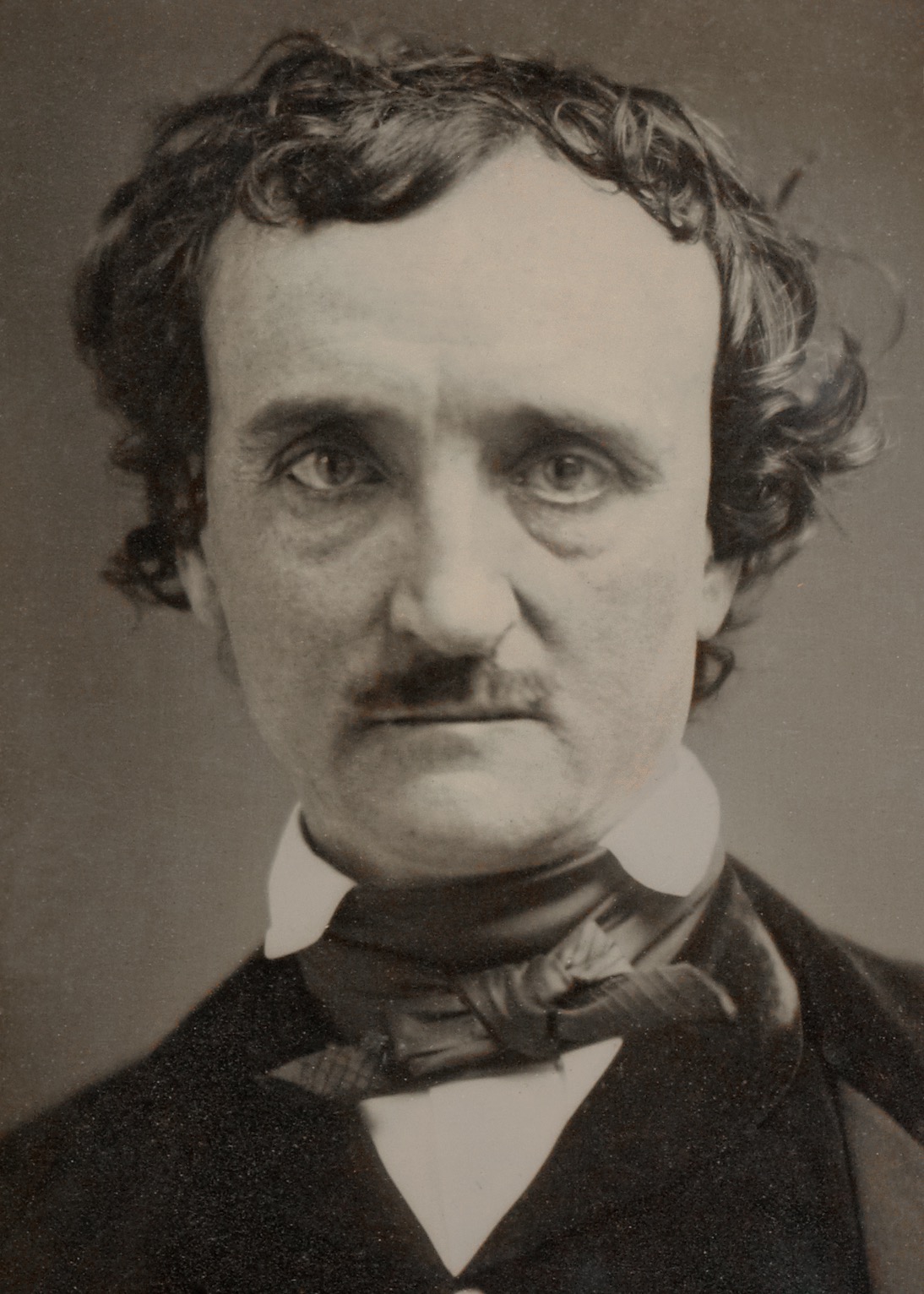
Edgar Allan Poe
Author · American · 1809 – 1849
Dark Romanticism / Gothic / Detective fiction
The Architect of the Haunted Room
He was born in Boston in January 1809 to two traveling actors who were failing at the profession. His father David walked out before Edgar's second birthday and was never heard from again. His mother Eliza, a gifted stage actress consumed by tuberculosis, died in a boarding house in Richmond, Virginia, a year later. The child was two years old and already the most orphaned person in American literature.
He was taken in, though never legally adopted, by a Richmond tobacco merchant named John Allan — whose surname Poe took as his middle name and whose memory he would struggle against for the rest of his life. The relationship with Allan went badly. Allan was a hard, transactional man who resented Poe's literary ambitions, his debts at the University of Virginia, his insubordination at West Point. By the time Poe was twenty-two he had been expelled from both institutions, disinherited, and left to survive in the literary marketplace of 1830s America — which meant magazines, which meant grinding, poorly paid work as a reviewer and editor for periodicals that went bankrupt with some regularity.
He was the first significant American writer who tried to live entirely by his pen. He mostly failed. Even at the peak of his fame, after The Raven appeared in 1845 and he became, overnight, a celebrity on the streets of Manhattan, he was paid nine dollars for the poem. He spent most of his life in poverty. He married his first cousin Virginia Clemm in 1836, when he was twenty-seven and she was thirteen — an age gap disturbing then and more disturbing now, though by all accounts the marriage was companionable and Virginia's mother Maria lived with them and ran the household. Virginia began coughing blood at eighteen. She died at twenty-four. Poe never recovered.
He invented more than he is usually credited with. The modern detective story begins with The Murders in the Rue Morgue in 1841 — the locked-room mystery, the eccentric amateur investigator, the dim-witted police, the device of deductive reasoning laid out on the page for the reader to follow. Conan Doyle acknowledged the debt; every mystery writer after him inherits the template whether they know it or not. He also did more than anyone else to give American literature its distinctive gothic interior, the haunted room as a model of the haunted mind. The Fall of the House of Usher, The Tell-Tale Heart, The Cask of Amontillado are not really ghost stories. They are psychological studies of men who cannot stop hearing the thing they are trying not to hear.
He wrote a treatise called The Philosophy of Composition, in which he claimed — probably with some exaggeration — to have written The Raven entirely by deliberate calculation, choosing each element for precise effect on the reader. The essay has annoyed critics for a hundred and seventy years and has also quietly shaped how short fiction is taught. Poe believed a story should be readable in a single sitting and aim at a single unified impression. Every short-story writer since has had to take a position on that claim.
His death, in October 1849, is the most famous unexplained death in American letters. He was found delirious on a Baltimore street in clothes that were not his, was taken to Washington College Hospital, and died four days later without ever becoming coherent enough to explain what had happened. He was forty. He was buried in the Westminster Hall Burying Ground in Baltimore under a headstone that has, for decades, received anonymous tributes each January — a bottle of cognac and three roses left on the grave before dawn by a figure in black. The visitor stopped coming in 2010. No one has ever identified him.
All that we see or seem is but a dream within a dream.
Notable Works
- The Raven
- The Tell-Tale Heart
- The Fall of the House of Usher
- The Cask of Amontillado
- The Murders in the Rue Morgue
- Annabel Lee