
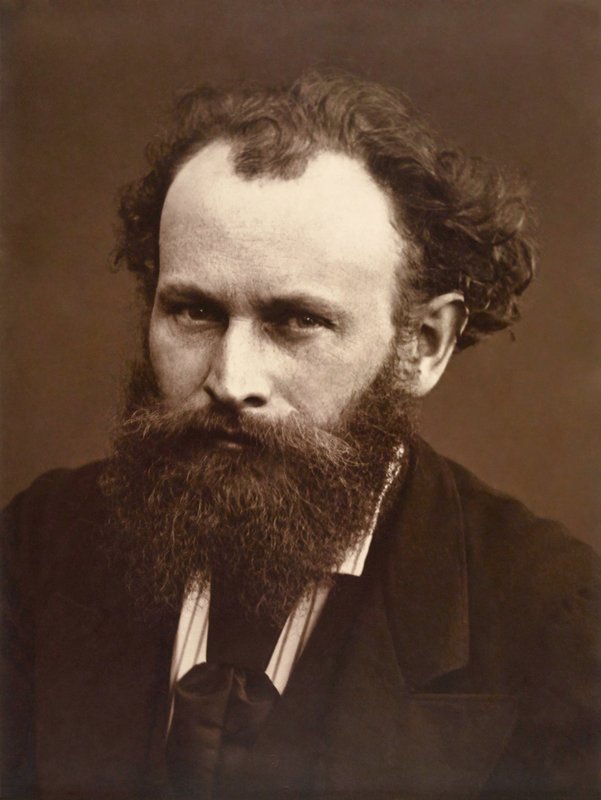
Édouard Manet
Painter · French · 1832 – 1883
Realism
The Scandal That Invented Modern Art
He was the son of a senior judge and the godson of a Swedish crown prince. Edouard Manet grew up in the respectable heart of the Parisian bourgeoisie, was expected to study law, and disappointed his family by joining the navy instead -- and then disappointing them again, worse, by declaring he would be a painter. He spent six years in the studio of Thomas Couture learning the academic grand style, and then the rest of his life breaking it.
In 1863 he submitted a painting called Le Dejeuner sur l'herbe to the Salon. The jury rejected it. When Emperor Napoleon III, embarrassed by the volume of rejections that year, ordered a separate Salon des Refuses, Manet's painting became the scandal of the summer. It showed two fully dressed gentlemen having a picnic in a forest glade with a completely naked woman staring calmly out at the viewer, a second half-clothed woman bathing in the background. The nudity was not the problem -- the Salon was full of nudes. The problem was that she was clearly a contemporary woman, not a goddess, and she was looking back. The male gaze, for the first time in the history of Western painting, was being openly returned.
Two years later Manet did it again, worse, with Olympia -- a reclining nude based on Titian's Venus of Urbino but stripped of all its mythological alibis. This was not Venus. This was a prostitute in her Paris apartment, a black ribbon tied around her throat, her servant bringing her a bouquet from a client, her eyes locking onto the viewer with amused defiance. The crowds had to be held back by guards. Critics called it obscene, grotesque, a monstrosity. Zola defended it. Baudelaire defended it. The scandal was so complete that Manet retreated to Spain for months, to hide and to study Velazquez.
What he was doing -- though it would take the world years to understand -- was ending one tradition of painting and opening another. He flattened the modeling of the academic style into broad, frank planes of tone. He let the black background of a dress sit there as a flat shape instead of a carved volume. He painted the modern city as it actually looked: bars, train stations, cafe terraces, absinthe drinkers, the working women of Paris. He was the hinge between the old world of historical painting and the new world of Impressionism, which he inspired but never quite joined. He refused to exhibit with the Impressionists. He always hoped, stubbornly and a little pathetically, for the Salon's approval, and he never really got it.
In the last year of his life, crippled by locomotor ataxia caused by untreated syphilis, he painted his final masterpiece from a chair in front of an easel in his studio: A Bar at the Folies-Bergere. A barmaid stands behind a marble counter stacked with bottles and a bowl of oranges, her face a mask of quiet exhaustion, while the mirror behind her reflects a version of the scene that cannot possibly be correct -- the angles are wrong, she is in the wrong place, a man in a top hat is addressing her from a position where no one should be standing. It is a painting about looking, about surfaces, about the gap between what we see and what we are told. It is also, quite simply, one of the saddest and most beautiful things ever painted.
Manet died at fifty-one, his left foot amputated in a last attempt to save him. He had asked, over and over in his final decade, only one thing: to be admitted to the Salon. He never was. Within twenty years of his death, half the painters in Europe were imitating him. Within fifty, he was understood as the father of modern painting.
There is only one true thing: instantly paint what you see.
Notable Works
- Olympia
- Le Déjeuner sur l'herbe
- A Bar at the Folies-Bergère
- The Railway