
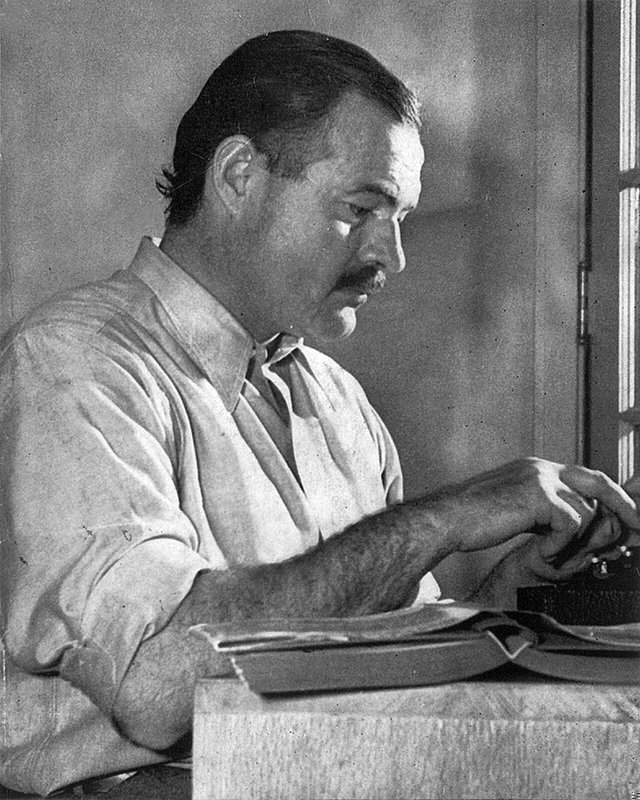
Ernest Hemingway
Author · American · 1899 – 1961
Modernism
The Iceberg Below the Words
He wanted to be a soldier and they sent him to drive an ambulance. Ernest Hemingway was eighteen years old when he arrived at the Italian front in 1918 with the American Red Cross, having been rejected by the U.S. Army for bad eyesight. Within two months a mortar shell exploded beside him in a trench on the Piave River, killing the man next to him and driving more than two hundred fragments of shrapnel into his legs. He carried a wounded Italian soldier to the aid station while bleeding from both knees, and later dug most of the shrapnel out himself. He was nineteen. The Italian government gave him a silver medal for valor. He gave the rest of his life to trying to write the truth about what he had seen there, and about what it costs a person to see it.
He went home to Oak Park, Illinois, to his mother's house, and found that he could not bear to stay. Within two years he was in Paris, working as a foreign correspondent for the Toronto Star, reading Tolstoy and Chekhov in cheap editions, and drinking in the same cafes as Gertrude Stein, Ezra Pound, and James Joyce. Stein read his early stories and told him to throw most of them away. He did. What remained was a voice unlike anything American literature had produced -- spare, declarative, shorn of ornament, built out of short sentences that seemed to be reporting facts but were actually holding back an ocean of feeling.
He called it the iceberg theory. A writer, he said, should show only a seventh of what he knows. The rest must be there -- must be known to the writer, in exhaustive detail -- but must stay underwater. The reader would sense its weight without needing to see it. The result was prose that looked almost childishly simple and that was in fact one of the hardest things in the language to do: sentences in which the silence between the words did most of the work.
The Sun Also Rises made him famous at twenty-seven. A Farewell to Arms made him rich at thirty. For Whom the Bell Tolls -- set during the Spanish Civil War, which he covered as a journalist and lived through with the kind of reckless courage that was becoming his trademark -- sold half a million copies in the first months after publication. He hunted big game in Africa. He fished for marlin in the Gulf Stream off Cuba. He married four women. He lost friends to war and to suicide. He drank harder every year.
In 1952 he published The Old Man and the Sea -- a short novel about an aging Cuban fisherman who hooks a giant marlin and fights it alone for three days and two nights, only to lose the catch to sharks on the way back to shore. It was his last great work. It won the Pulitzer Prize in 1953 and the Nobel Prize in Literature in 1954. The Swedish Academy praised "the forceful and style-making mastery of the art of modern narration." He did not travel to Stockholm to accept the prize. He sent a short, gracious speech in which he said that writing, at its best, is a lonely life.
His final years were dark. Two plane crashes in Africa left him with lifelong injuries. Electroshock treatments at the Mayo Clinic destroyed his ability to write. On the morning of July 2, 1961, at his house in Ketchum, Idaho, he took down a double-barreled shotgun and shot himself. He was sixty-one. His father had done the same thing, with the same weapon. So, later, would his brother, his sister, and one of his granddaughters.
What he left behind was the shape of modern American prose. You can hear his rhythms in Carver, in Didion, in McCarthy, in Marlon James, in half the sentences written in English in the last hundred years. The iceberg is still there, most of it invisible, holding up everything above the water.
There is nothing to writing. All you do is sit down at a typewriter and bleed.
Notable Works
- The Sun Also Rises
- A Farewell to Arms
- For Whom the Bell Tolls
- The Old Man and the Sea