
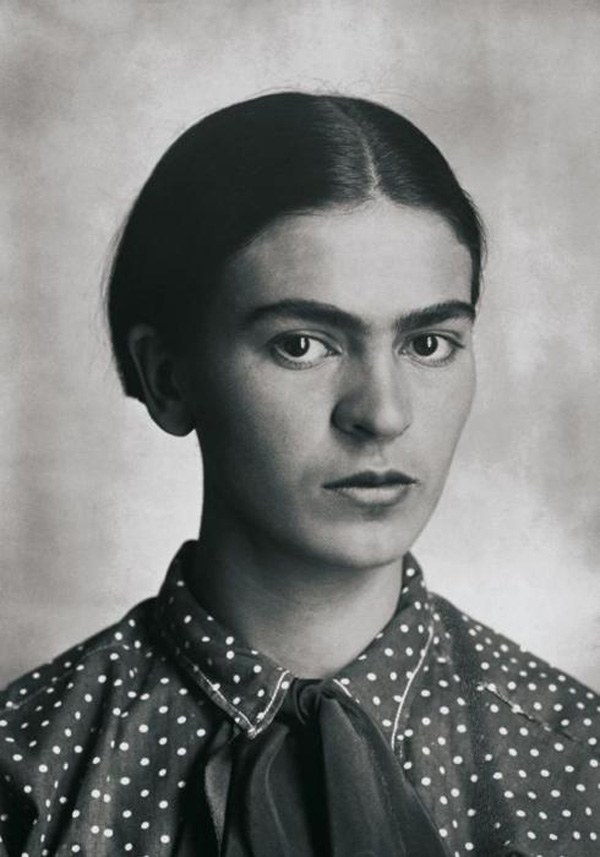
Frida Kahlo
Painter · Mexican · 1907 – 1954
Surrealism
The Body as Battlefield
When Frida Kahlo was eighteen, a streetcar in Mexico City collided with the wooden bus she was riding. A steel handrail pierced her pelvis. Her spinal column fractured in three places. Her collarbone broke, her ribs cracked, her right leg shattered in eleven places, and her right foot was crushed. She would spend the rest of her life -- twenty-nine more years of it -- in intimate, daily conversation with pain.
It was during the first of her many convalescences that she began to paint, propped up in bed with a specially made easel and a mirror mounted on the canopy above her. That mirror became the origin of her art. Of the 143 paintings she produced in her lifetime, 55 are self-portraits -- not from vanity, but from a fierce, almost clinical need to examine the wreckage and find something that was still her.
She painted herself split open, weeping, bleeding, sprouting roots, bound in orthopedic corsets of steel and plaster. In The Broken Column, her torso is cracked apart to reveal an Ionic column crumbling where her spine should be, her skin studded with nails, her face impassive. It is one of the most devastating depictions of chronic pain ever created, and it is completely without self-pity.
Her marriage to Diego Rivera -- the great muralist, twenty years her senior, massive in body and appetite -- was its own kind of wreckage. They loved each other with volcanic intensity and betrayed each other with equal force. Rivera's affair with Frida's younger sister Cristina nearly destroyed her. She responded not with retreat but with defiance, taking lovers of her own, including Leon Trotsky, and painting canvases that turned private anguish into public mythology.
The Surrealists tried to claim her. Andre Breton called her art "a ribbon around a bomb." She rejected the label. "I never painted dreams," she said. "I painted my own reality." And that reality -- a woman's body as a site of trauma, desire, political identity, and indigenous heritage -- anticipated feminist art by decades.
She died in 1954, at forty-seven, in the Blue House in Coyoacan where she had been born. Her last diary entry reads: "I hope the exit is joyful -- and I hope never to return." The exit was not joyful. But the paintings she left behind burn with a life force so ferocious it feels, even now, like an act of defiance against every form of destruction the world could devise.
She painted herself split open, weeping, bleeding, sprouting roots, and it was completely without self-pity.
Notable Works
- The Two Fridas
- Self-Portrait with Thorn Necklace and Hummingbird
- The Broken Column
- Henry Ford Hospital