
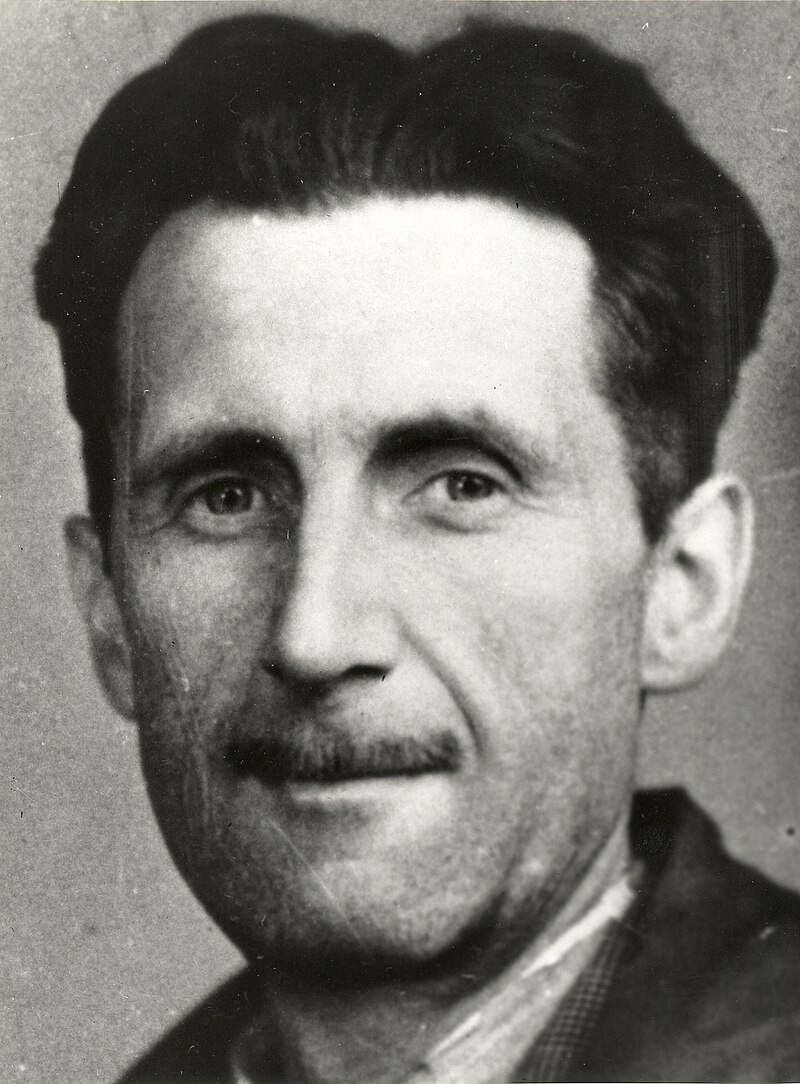
George Orwell
Author · English · 1903 – 1950
Political fiction / Essay / Satire
The Clear-Eyed Englishman
His real name was Eric Arthur Blair, and he was born in Motihari, in what was then the North-Western Provinces of British India, in June 1903. His father was a minor official in the Opium Department, whose job was to oversee the cultivation of opium that the British sold, by treaty and by gunboat, to China. It is a detail Orwell did not write about often but carried with him. He would spend his entire adult life trying to understand what empire does to the people who run it and to the people who are run.
His mother brought the children to England. He won a scholarship to St. Cyprian's prep school and then another to Eton, where he was educated among the sons of the ruling class and came out of it understanding them from the inside. He declined to go to Oxford. Instead he signed up, at nineteen, for the Indian Imperial Police and was sent to Burma, where for five years he presided over district courts, supervised hangings, and came, slowly, to loathe what he was doing. He resigned in 1927 and would later say that he had come back to England with a single clear conviction: that he had to escape not just imperialism, but every form of domination, every form of one person's power over another.
He spent the next decade deliberately making himself poor. He washed dishes in Paris restaurants and tramped through the winter workhouses of England, sleeping in casual wards for ninepence a night so that he could write about them honestly from the inside. Down and Out in Paris and London, his first book, came out of that apprenticeship. The Road to Wigan Pier, commissioned as a reportage of northern coal-mining towns during the Depression, is one of the harshest descriptions of industrial poverty ever written by a man of his class, and the second half of the book is a furious essay in which he turns the attack on his own side — the genteel English Left — for treating workers as a theoretical category.
He went to Spain in December 1936 to write about the civil war and, within a week, had joined a militia of the POUM, a small anti-Stalinist Marxist party, and was fighting on the Aragon front. He was shot through the throat by a Fascist sniper at Huesca in May 1937, survived, and returned to Barcelona in time to watch the Communists, on orders from Moscow, destroy the POUM and other independent left organizations in a series of street battles and secret police arrests during the May Days. He and his wife Eileen barely escaped Spain alive. Homage to Catalonia, the book he wrote about it, was rejected by Victor Gollancz — who was publishing Orwell's other books — for being insufficiently pro-Soviet, and sold almost nothing in his lifetime. It is now considered one of the finest eyewitness accounts of the twentieth century.
Animal Farm was rejected by four publishers during the Second World War, including T. S. Eliot at Faber, on the grounds that an allegorical attack on Stalin was not useful while Britain and the Soviet Union were allies. It was finally published in August 1945, the month the atomic bomb fell on Hiroshima, and was immediately recognized for what it was. Nineteen Eighty-Four followed in 1949. He wrote it on the island of Jura in the Inner Hebrides, in a cold farmhouse with no electricity, while dying of tuberculosis. The book is not a prophecy about the future; it is a description, barely fictionalized, of what Orwell already saw in Stalin's Moscow, in Franco's Spain, in the propaganda ministries of his own side during the war.
He died in University College Hospital, London, in January 1950, of a haemorrhage of the lung, at forty-six. He had married his second wife, Sonia Brownell, three months earlier from his hospital bed. The introduction he had begun writing to a new edition of Animal Farm, rediscovered in his papers, opens with a sentence he might have written as an epitaph: If liberty means anything at all, it means the right to tell people what they do not want to hear.
To see what is in front of one's nose needs a constant struggle.
Notable Works
- Nineteen Eighty-Four
- Animal Farm
- Homage to Catalonia
- Down and Out in Paris and London
- The Road to Wigan Pier
- Politics and the English Language