
Gustav Klimt
Painter · Austrian · 1862 – 1918
Art Nouveau / Vienna Secession
Gold and the Erotic Sublime
Vienna at the turn of the twentieth century was a city at war with itself -- the gilded capital of a crumbling empire, a place where Freud was excavating the unconscious, Mahler was reinventing the symphony, and the old certainties of Habsburg culture were dissolving into neurosis and brilliance. No artist captured this tension between splendor and decay more completely than Gustav Klimt.
He began as a thoroughly conventional decorative painter, producing competent murals for theaters and museums alongside his brother Ernst. But around 1897, something cracked open. He co-founded the Vienna Secession, a breakaway movement dedicated to shattering the boundary between fine art and decorative art, and he began producing work that scandalized the Viennese establishment with its frank eroticism and radical stylization.
His three paintings for the University of Vienna -- Philosophy, Medicine, and Jurisprudence -- provoked such outrage that he returned his commission and never accepted a public contract again. The panels depicted not the triumph of reason but tangled masses of naked, suffering humanity adrift in cosmic darkness. The professors were appalled. Klimt was liberated.
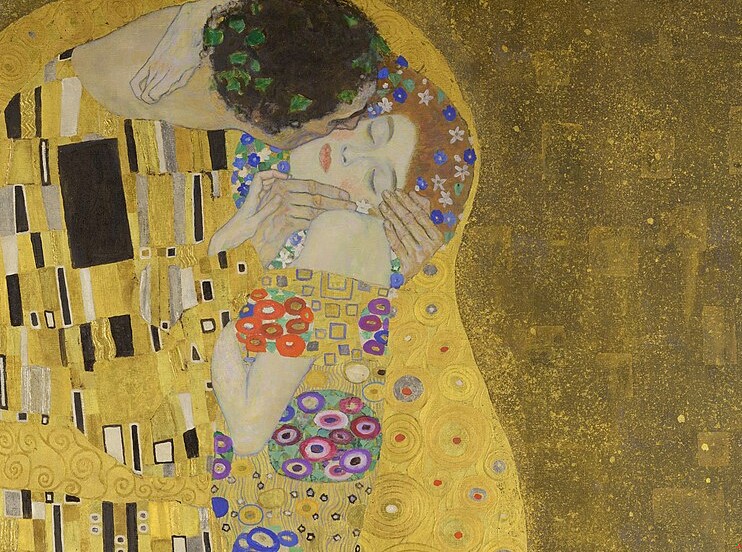
What followed was his "Golden Phase," the period that produced the works the world now knows: The Kiss, where two lovers kneel on a flowered cliff-edge wrapped in a cocoon of gold leaf, geometry, and pattern that dissolves the boundary between their bodies; Portrait of Adele Bloch-Bauer I, in which a real woman disappears into an icon, her pale face and nervous hands emerging from a shimmering field of gold spirals and Egyptian eyes; Judith, holding the severed head of Holofernes with half-closed eyes and parted lips, ecstasy and violence fused in a single golden frame.
Klimt's women are the center of his art. He drew them obsessively -- thousands of erotic sketches survive -- and painted them as simultaneously vulnerable and powerful, icons of desire rendered in a visual language that fused Byzantine mosaics, Japanese prints, Mycenaean gold, and the new psychology of the unconscious.
He never married, though he fathered at least fourteen children. He lived in a paint-stained smock, surrounded by cats, working in a garden studio filled with Japanese armor and art books. He died of a stroke in 1918, the same year the empire he had both adorned and undermined finally collapsed. His art endures as a monument to the beauty that flourishes at the edge of catastrophe -- all gold leaf, all desire, all the gorgeous surface tension of a world about to break.
His art endures as a monument to the beauty that flourishes at the edge of catastrophe.
Notable Works
- The Kiss
- Portrait of Adele Bloch-Bauer I
- The Tree of Life
- Judith and the Head of Holofernes