
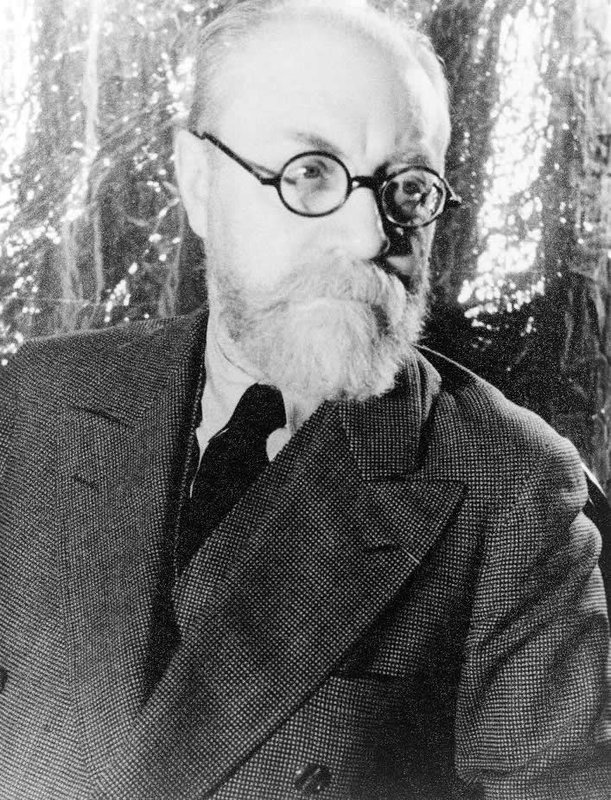
Henri Matisse
Painter · French · 1869 – 1954
Fauvism
The Scissors of a Dying Man
He came to art late, and by accident. Henri Matisse was a law clerk in Saint-Quentin, on the bleak plains of northern France, when he was struck down by appendicitis at the age of twenty-one. During the long months of convalescence his mother bought him a box of paints to pass the time, and the moment he opened it, something in him answered. "From the moment I held the box of colors in my hand," he later said, "I knew this was my life." He abandoned the law, enrolled in art school in Paris, and began the slow, stubborn apprenticeship that would make him one of the two poles -- Picasso was the other -- around which the twentieth century turned.
In 1905 he exhibited a portrait of his wife wearing an enormous feathered hat, her face painted in violent strokes of green and vermilion. The critic Louis Vauxcelles walked into the gallery, saw the gaudy canvases hanging around a small Renaissance-style sculpture, and exclaimed, "Donatello among the wild beasts!" The name stuck. Matisse was the leader of the fauves -- the wild beasts -- and painting had discovered that color did not have to describe the world. Color could be the subject itself.
He worked for decades as a patient, disciplined student of his own instincts. He painted dancers holding hands in a circle against a red ground and a blue sky. He painted his own studio as a single sheet of burning vermilion in which furniture and canvases hover like floating memories. He painted odalisques in Moroccan rooms filled with patterned textiles, and he painted the view from every window of every apartment he ever rented, because the window was his great obsession -- the meeting place between inside and outside, between the self and the world.
He had a famous, half-joking rivalry with Picasso. They bought and swapped each other's paintings, they praised each other in public and complained about each other in private, and when Matisse died, Picasso said, "All things considered, there is only Matisse."
The final chapter of his life was the most remarkable. In 1941, at seventy-one, he was diagnosed with cancer and given the removal of most of his intestine. The surgery saved him but left him bedridden, unable to stand at an easel. For anyone else, this would have been the end. For Matisse, it was a reinvention. He picked up a pair of scissors and began cutting shapes out of paper that his assistants had painted with gouache in pure, saturated colors. He called it "painting with scissors." From his bed and his wheelchair he made some of the most joyful, radiant works of his entire career -- The Snail, Jazz, The Swimming Pool, Blue Nudes -- giant compositions of leaves and swimmers and birds assembled like musical notation.
He died in 1954, at eighty-four, having worked in his wheelchair until the final month. His last project was the design of the Chapel of the Rosary in Vence, which he called the masterpiece of his entire life. He believed, with a conviction that hardened rather than softened as he aged, that the purpose of art was to give joy -- to be, as he put it, like a good armchair for a tired businessman. Underneath that modest formulation was a conviction as radical as Picasso's: that pleasure is not the opposite of seriousness, and that to lift the eye toward delight is also a form of truth.
I don't paint things. I paint the differences between things.
Notable Works
- Dance
- The Red Studio
- Woman with a Hat
- The Swimming Pool