
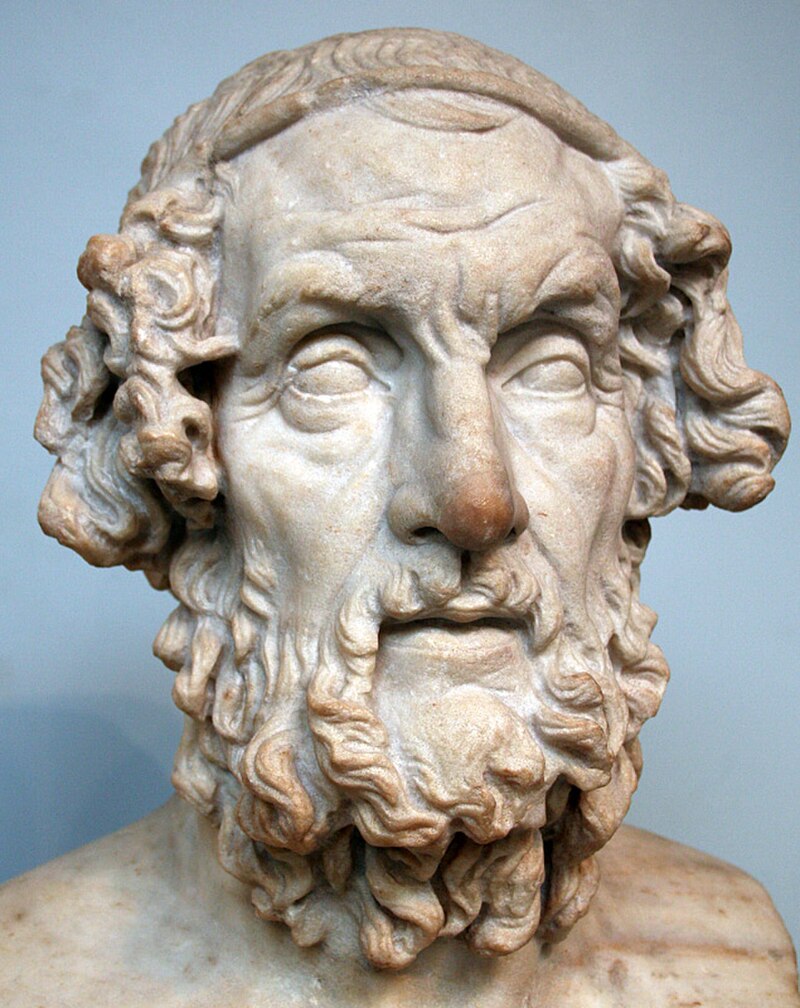
Homer
Poet · Ancient Greek · c. 8th century BCE – c. 8th century BCE
Archaic Greek / Epic
The Blind Man Who Remembered Everything
He may not have existed. He may have existed and been blind, as the ancient tradition insists. He may have been a woman. He may have been many poets, or one poet at the end of a long oral tradition, or the name a culture gives to the moment when its memory finally becomes literature. The Greeks themselves, who admired Homer more than they admired any other poet in their language, were already arguing about who he was three centuries before Plato. Herodotus guessed he had lived four hundred years before his own time. Seven different cities claimed to be his birthplace. The name itself may mean nothing more than "hostage" or "he who must go with" -- a wandering singer, attached to no house, paid in bread and wine.
What survives under that name are two poems, each approximately fifteen thousand lines of dactylic hexameter, composed in a literary dialect that nobody ever actually spoke, stitched together out of centuries of oral formulaic phrases -- rosy-fingered Dawn, wine-dark sea, swift-footed Achilles -- by a poet or poets of unimaginable compression and force, probably in the late eighth century before our era, probably in the Greek settlements on the coast of what is now Turkey.
The Iliad is not a poem about the Trojan War. It is a poem about fifty-one days in the tenth year of that war, and more specifically about the rage of a single warrior -- Achilles -- who is insulted by his commanding officer, withdraws from the fighting, watches his closest friend die wearing his armor, and returns to the battlefield in an ecstasy of grief to kill the Trojan prince Hector and drag his body around the walls of Troy behind a chariot. In the final book, Hector's aged father Priam comes alone through the Greek lines at night, kneels before Achilles, and kisses the hands that killed his son, begging for the body so he can give it a proper burial. Achilles, who has been weeping for his own friend, weeps for Priam, and the two men sit together in the tent and eat a meal. Then the poem ends, with the funeral of Hector. Troy has not yet fallen. The war is not over. But the poem has found what it was looking for, which is a moment of recognition between enemies, across the body of the dead.
The Odyssey is its shadow and its answer. Where the Iliad is a poem about young men dying in the ninth and tenth years of a war, the Odyssey is a poem about a middle-aged man trying to get home for twenty years. Odysseus, king of Ithaca, is the most intelligent of the Greek heroes -- a trickster, a liar when lying is required, a man who builds a wooden horse to win a war that armies could not. The gods punish him with storms, sirens, monsters, enchantresses, and finally with his own long absence from his wife Penelope and his son Telemachus. The poem is about what endures when everything else is stripped away. Home. A marriage. A particular olive tree around which Odysseus built his bedroom. A dog who recognizes him after twenty years and dies.
The two poems between them taught the Greeks how to be Greeks, and then taught the Romans how to be Romans, and then taught Dante and Milton and Joyce and Walcott how to write epic. Everything western literature has ever said about war, homecoming, honor, friendship, hospitality, grief, and the possibility of mercy in a universe where the gods are not on your side -- all of it begins here, with a singer or a line of singers, working in a language no one spoke, for audiences who sat around fires and listened, and who passed what they heard, line by line, to the next generation, until someone finally wrote it down.
Sing, O Muse, of the rage of Achilles.
Notable Works
- The Iliad
- The Odyssey