
Johannes Vermeer
Painter · Dutch · 1632 – 1675
Dutch Golden Age
The Silence of Delft
Johannes Vermeer painted perhaps thirty-five pictures in his life, and for two hundred years after his death almost nobody remembered he had lived at all. He was born in Delft in October 1632, the son of a silk weaver and inn-keeper who also bought and sold paintings on the side. Delft was a small, tidy, canal-threaded town of red brick and white trim, famous for its tin-glazed pottery and for the blue light that falls off the North Sea in thin, even sheets. Vermeer spent almost the whole of his life inside it.
He joined the painters' guild of Saint Luke in 1653, the same year he married Catharina Bolnes, a Catholic woman whose mother made him convert before she would allow the wedding. They had fifteen children, four of whom did not survive infancy, and Vermeer — who never seems to have sold much of his work — lived on the edge of debt his entire career. He painted slowly. He used ultramarine, the most expensive pigment in Europe, with a generosity that bankrupted him. He kept his sitters inside a single upstairs room with a tall leaded window on the left-hand side, and into that room he let fall the light that would become the subject of almost every painting he ever made.
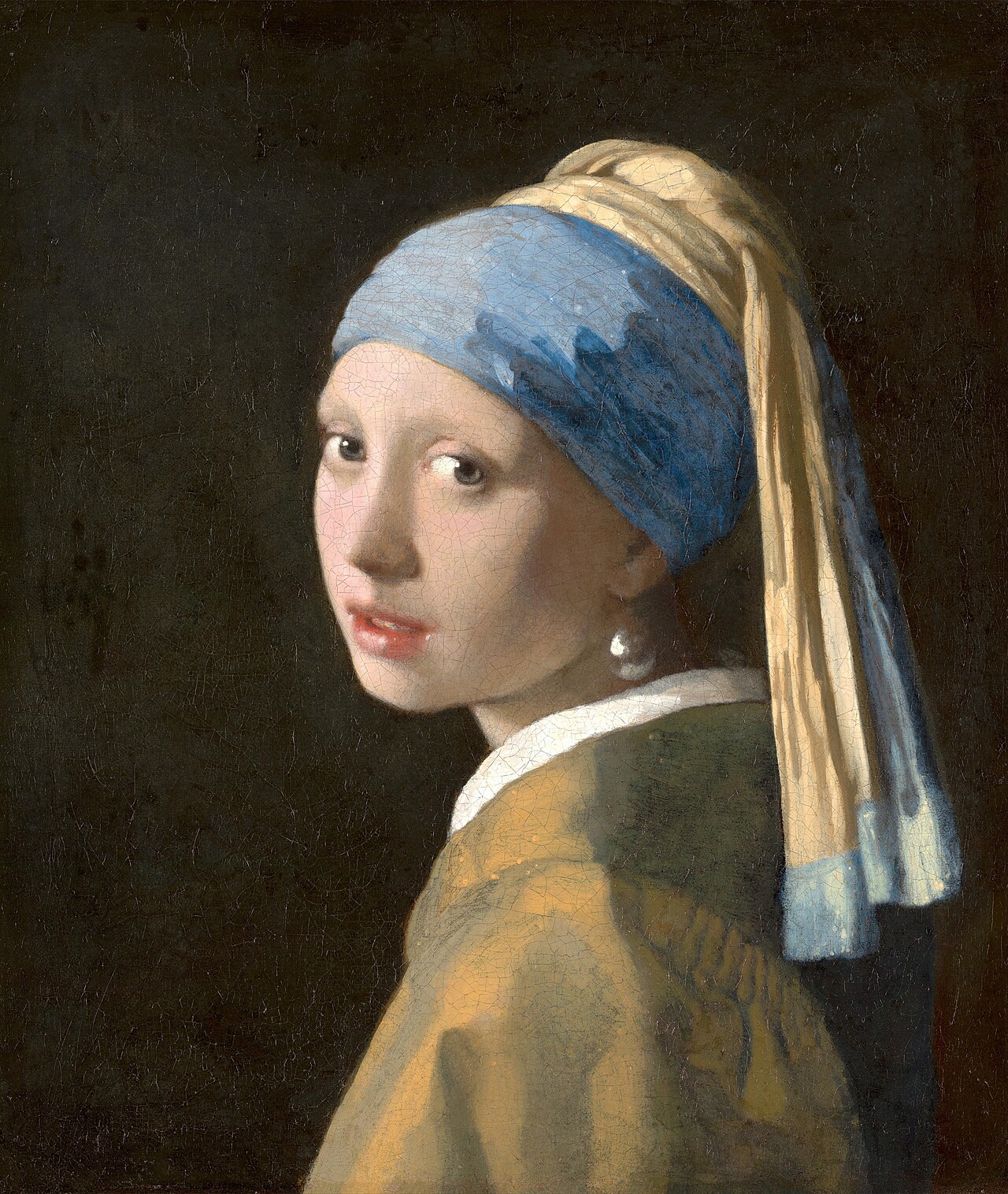
What he painted in that light was almost nothing. A woman pouring milk. A woman reading a letter. A woman weighing a set of pearls against nothing at all. A young girl, mouth just opened, turning her head toward someone who is about to speak to her. His pictures refuse the narrative scaffolding that Dutch painting of his century loved: no moralizing emblem, no hidden saint, no sly joke. Something is about to happen, or has just happened, and the painter has caught it in the long exhalation between. The critic Lawrence Gowing called this the "suspended moment," but suspension is the wrong word. Nothing is suspended. Everything continues — the milk, the light, the thought — at its own unhurried pace.
He almost certainly used a camera obscura. Pearls in his paintings catch specular highlights that only a lens can produce; the blurred edges of near-foreground objects read as optical, not painterly. But the camera is the least of it. Hundreds of Dutch painters owned lenses; only Vermeer made pictures in which the world seems to have arrived on the canvas without anyone having painted it.
He died in December 1675, aged forty-three, suddenly, of what Catharina called "a frenzy." He left her with eleven living children and enormous debts. She petitioned the court to settle his estate and was forced to sell the two paintings he had kept for himself to the local baker, in exchange for a bread bill. For the next two centuries Vermeer's name appeared only in inventories and tax records. Paintings by him were catalogued as by Pieter de Hooch, Nicolaes Maes, Gabriël Metsu — by anyone, that is, but him.
In 1866 the French critic Théophile Thoré-Bürger published the essay that rediscovered him. Proust read it. In the long scene in À la recherche du temps perdu where the writer Bergotte dies looking at View of Delft — before "the little patch of yellow wall" — Proust gave the painter his final, highest canonization: a body of work worth dying in front of. Today Vermeer is held to be, by general consent, the quietest great painter who ever lived.
His subject was never the woman, or the milk, or the letter. It was the light falling on them and the fact that this falling, in its particular minute, would not come again.
A woman is pouring milk. Nothing else is happening. It is among the most absolute events in Western painting.
Notable Works
- Girl with a Pearl Earring
- The Milkmaid
- View of Delft
- The Art of Painting
- Woman Holding a Balance
- The Geographer