
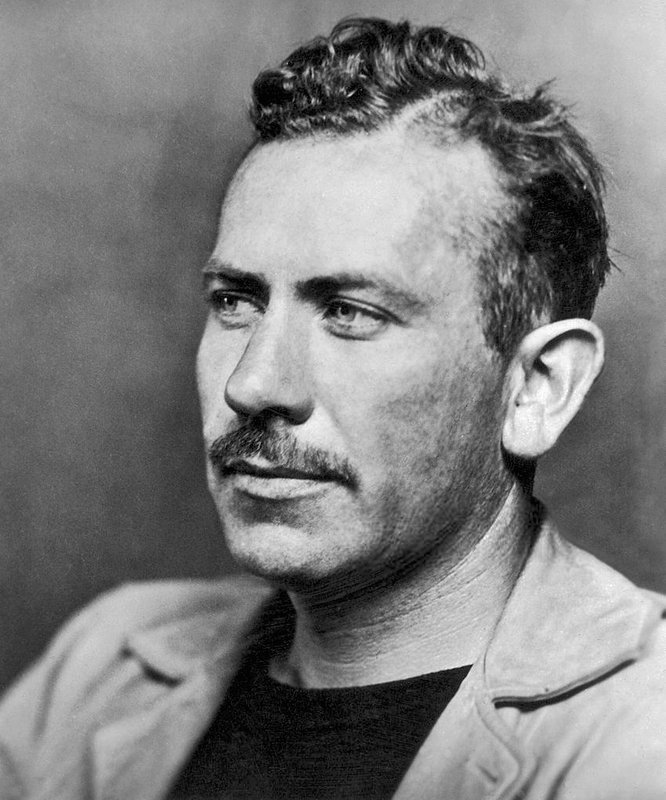
John Steinbeck
Author · American · 1902 – 1968
Realism
The Witness from Salinas
He was born in Salinas, California, the son of a county treasurer and a schoolteacher, and he spent his childhood tramping through the agricultural valleys of the central coast -- the long, flat fields of lettuce and strawberries worked by Mexican and Japanese and Filipino laborers, the foothills where vaqueros still rode, the beaches at Monterey where the last of the sardine fishermen were still hauling in their nets. John Steinbeck would spend his entire writing life trying to bear witness to what those places held, and to what America was doing to the people who worked there.
He studied at Stanford without earning a degree, worked as a fruit picker and a ranch hand and a stonemason, and published his first novels in obscurity during the early years of the Great Depression. He nearly starved. His second wife later said that during their first year of marriage they ate almost nothing but fish he caught off the pier at Monterey and vegetables from a patch he tended behind their shack. He kept writing anyway, partly because the writing was the only thing that kept him sane, and partly because he had begun to understand something about the country he lived in that he could not bear to leave unsaid.
In 1937 he published Of Mice and Men, a small, perfect, devastating book about two migrant ranch hands named George and Lennie -- one small and sharp, the other a giant with the mind of a child -- whose dream of owning their own place is destroyed by a single tragic accident. Written as a "playable novel" that could be staged verbatim, it is still one of the shortest routes to tears in American literature.
Two years later came the book that would define him forever. He had spent the previous year embedded with the Okies -- the dust-bowl farmers of Oklahoma who had been driven off their land by drought and debt and had come streaming west into California only to find that the promises printed on the handbills were lies, that there were no jobs, that the state police were turning them back at the border, that the landowners were paying starvation wages for backbreaking work. He followed a single family's migration in his notebook. Then he sat down and, in less than six months, wrote The Grapes of Wrath.
It was the most politically incendiary American novel of the twentieth century. Landowners burned copies in Kern County. Senators denounced him. The FBI opened a file on him. And it sold 430,000 copies in the first year, won the Pulitzer Prize, and made Steinbeck -- who hated the spotlight, who was painfully shy in public, who wanted only to be left alone to write -- the most famous writer in America. "I've done my damndest to rip a reader's nerves to rags," he said. "I don't want him satisfied."
His later work was uneven. East of Eden, the sprawling Cain-and-Abel saga he considered his masterpiece, was criticized as melodramatic when it appeared in 1952 but has aged into something closer to love. Travels with Charley, his account of driving around America with his standard poodle at the age of fifty-eight, is an elegiac small masterpiece about a country he barely recognized anymore. He won the Nobel Prize in Literature in 1962 and, characteristically, said in his acceptance speech that he was not sure he deserved it.
He died in 1968, in New York, of heart failure. His ashes were buried in a family plot in Salinas, in the valley where the lettuce still grows and where, most mornings, the fog comes in off Monterey Bay. He had said once that the writer must "lift up, expose, and celebrate the heart and spirit of man in his grief and triumph." He had done exactly that, for people who had no one else to do it for them.
In the souls of the people the grapes of wrath are filling and growing heavy, growing heavy for the vintage.
Notable Works
- The Grapes of Wrath
- Of Mice and Men
- East of Eden
- Cannery Row