
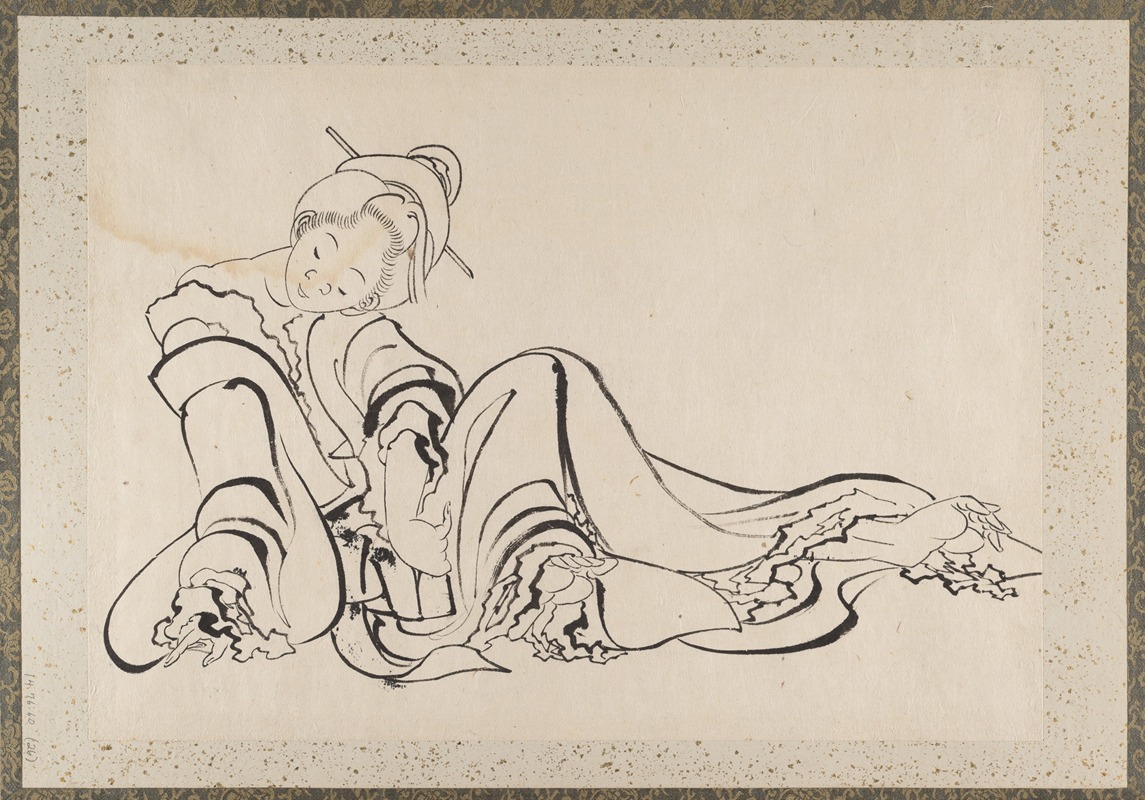
Katsushika Hokusai
Painter · Japanese · 1760 – 1849
Ukiyo-e
The Old Man Mad About Painting
He changed his name at least thirty times. He moved house ninety-three times. He called himself, at various points, Shunro, Sori, Kako, Taito, Gakyojin, Iitsu, and finally, in old age, Gakyo Rojin Manji -- "The Old Man Mad About Painting." No name ever contained him, just as no single art form ever could. Over a career spanning seven decades, Katsushika Hokusai produced an estimated 30,000 works: woodblock prints, paintings, illustrated novels, sketches, erotic albums, and a fifteen-volume encyclopedia of drawing called the Hokusai Manga that influenced artists from Degas to Monet to the inventors of modern comics.
He was born in Edo -- present-day Tokyo -- in 1760, the son of a mirror-maker. He was apprenticed to a woodblock engraver at thirteen and entered the studio of Katsukawa Shunsho at eighteen, beginning a lifelong education in the floating world of ukiyo-e: the art of transient pleasures, beautiful women, kabuki actors, and the landscape of a country most Japanese would never physically travel.
But Hokusai was never content with the floating world alone. He studied Chinese painting, Dutch copperplate engraving, and Western perspective. He absorbed everything and transformed it. In his seventies, he produced the series that would make him immortal: Thirty-six Views of Mount Fuji, a sequence of landscape prints in which the sacred mountain appears from every conceivable angle and distance, through every season and weather, sometimes dominating the frame, sometimes a tiny triangle on the horizon.
The most famous of these -- The Great Wave off Kanagawa -- depicts three fishing boats caught beneath a towering curl of ocean, with Fuji sitting small and snow-capped in the distance. It is one of the most reproduced images in human history, and its power lies in the tension Hokusai understood better than anyone: between the enormous force of nature and the fragile persistence of human endeavor.
He never stopped working. At eighty-three, he reportedly wept and said: "If only Heaven will give me just another ten years... just another five more years, then I could become a real painter." He died at eighty-eight, in 1849, still reaching. His final breath, according to legend, carried the words: "If only I had one more year."
Hokusai's restlessness was not dissatisfaction but devotion -- the understanding that mastery is not a destination but a direction, and that the only honest response to the visible world is a lifetime of looking, and looking again, and never believing you have seen enough.
Mastery is not a destination but a direction, and the only honest response to the visible world is a lifetime of looking.
Notable Works
- The Great Wave off Kanagawa
- Thirty-six Views of Mount Fuji
- Hokusai Manga
- Fine Wind, Clear Morning