
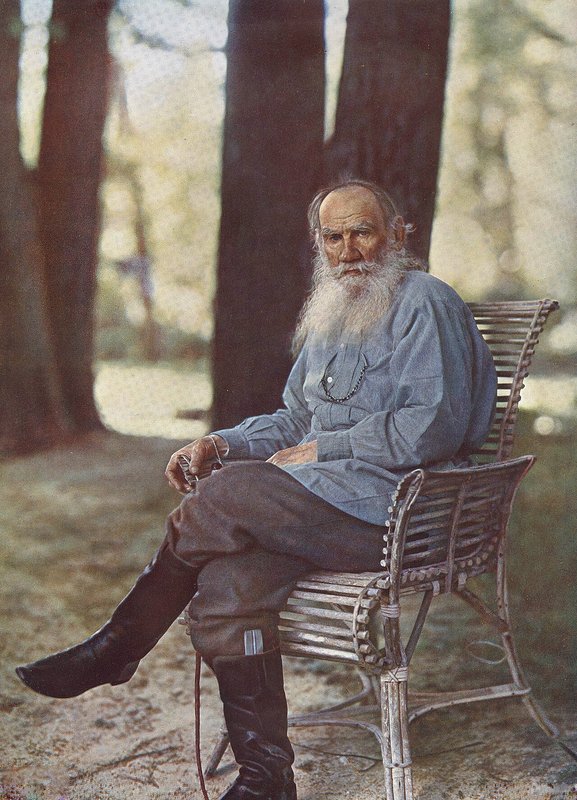
Leo Tolstoy
Author · Russian · 1828 – 1910
Realism
The Count Who Walked Away
He was born a count on the estate of Yasnaya Polyana -- "bright glade" -- two hundred kilometers south of Moscow, the fourth son of an ancient aristocratic family that traced its line back to a Lithuanian knight in the service of Alexander Nevsky. Leo Tolstoy would spend the first half of his life enjoying every privilege that station afforded him -- Moscow balls, German universities, gambling debts, commissions in the artillery, hunting trips, affairs with peasant women, and the profound, self-loathing boredom of a young man with too much money and no idea what he was for. He would spend the second half of his life trying to give it all away.
He served as an artillery officer in the Crimean War, at the siege of Sevastopol, and wrote dispatches that were among the first honest accounts of modern warfare in the Russian language. He came home disgusted. He inherited Yasnaya Polyana, attempted to reform his peasants' lives, failed, traveled Europe, met Victor Hugo, returned home again, and married Sofia Andreyevna Behrs, a young woman sixteen years his junior who would bear him thirteen children and copy out War and Peace by hand seven times as he revised it.
War and Peace -- which he began in his late thirties and published in its complete form in 1869 -- is not really a novel. It is a universe. Twelve hundred pages, nearly six hundred named characters, the Napoleonic invasion of Russia seen from the ballrooms of St. Petersburg and the bivouac fires of the retreating army and the mind of a single wounded soldier lying on his back in a field looking up at an infinite sky. It is the closest any writer has ever come to giving a reader the sense of living inside history. Then, less than a decade later, he published Anna Karenina, which Nabokov called the greatest novel ever written, a tragedy of love and ruin in which the first sentence -- "Happy families are all alike; every unhappy family is unhappy in its own way" -- became one of the most famous openings in world literature.
And then, at fifty, having written two of the greatest novels in any language, Tolstoy stopped. He had a spiritual crisis so complete that he nearly killed himself. He began reading the Gospels in the original Greek. He started wearing peasant clothes, plowing his own fields, making his own boots. He concluded that the entire structure of nineteenth-century European civilization -- its church, its state, its property, its armies, its art -- was a lie against the teaching of Jesus. He renounced his copyrights, refused further income from his books, and began giving away his land. His wife, who had thirteen children to feed and a household to run, was horrified. Their marriage, once tender, turned into a forty-year civil war between two people who loved each other and could not agree on what love required.
He wrote The Death of Ivan Ilyich -- a short novel about a high-court judge who discovers, in the process of dying painfully of cancer, that his entire respectable life has been a form of death. It is the most devastating piece of short fiction in Russian literature. He wrote religious tracts that were banned by the censor and smuggled out to printers abroad. He was excommunicated by the Russian Orthodox Church in 1901. Pilgrims began arriving at Yasnaya Polyana by the hundreds -- peasants, students, anarchists, Gandhi, who would later say that Tolstoy was the greatest influence on his doctrine of nonviolent resistance.
On the night of October 28, 1910, at the age of eighty-two, he walked away from Yasnaya Polyana for good. He left a letter for his wife. He boarded a third-class train carriage, caught pneumonia in the cold, and died ten days later in the stationmaster's house at a small railway town called Astapovo. His last recorded words were: "The truth... I care a great deal... how they..." No one knows how the sentence was supposed to end.
He had spent thirty years trying to become a simple man. He had succeeded, perhaps, only in the last ten days.
Everyone thinks of changing the world, but no one thinks of changing himself.
Notable Works
- War and Peace
- Anna Karenina
- The Death of Ivan Ilyich
- Resurrection