
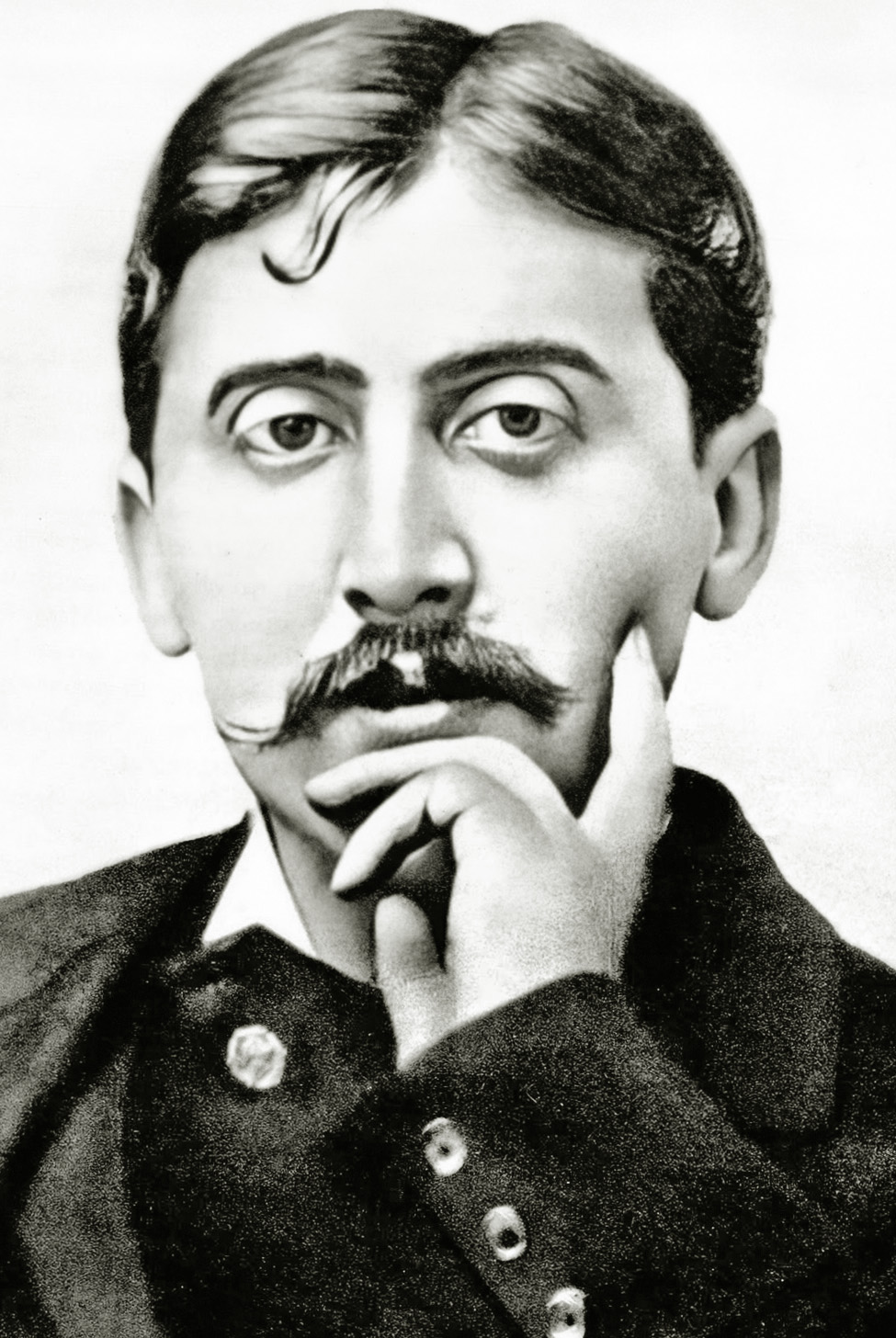
Marcel Proust
Author · French · 1871 – 1922
Modernism / Stream-of-consciousness
The Cork-Lined Room
He was born in the Paris suburb of Auteuil in July 1871, two months after the fall of the Paris Commune, into a household that embodied the divided consciousness of the French bourgeoisie. His father Adrien was a prominent Catholic physician, a pioneer in public hygiene who helped contain the cholera epidemics of the late nineteenth century. His mother Jeanne Weil was Jewish, the daughter of a wealthy stockbroker family. Marcel, the elder son, was devoted to his mother with an intensity that never fully resolved itself into anything else.
He was a sickly child. His first asthma attack, at nine, on a family walk in the Bois de Boulogne, nearly killed him, and the disease never left him. He spent his twenties as a fashionable young man about town, a fixture at the salons of Madame Arman de Caillavet and Madame Straus, a dilettante in love with the aristocracy, a translator of Ruskin, an author of minor society pieces for Le Figaro. By thirty-five he had produced almost nothing of consequence. Then, in September 1905, his mother died.
He did not write for two years. When he began to write again, he wrote as if possessed. He moved into the apartment at 102 Boulevard Haussmann and had the bedroom walls lined with cork to keep out the noise of the street. He lived inside that room for the rest of his life. He slept during the day and wrote at night, surrounded by the fumigation powders for his asthma, often working in bed with a wooden tray for a desk. Friends who visited in the evenings were received in a cold room with the curtains drawn; he himself, propped on pillows in a fur coat, had not been outside in days.
The book he was writing, which he called À la recherche du temps perdu, was a single work of nearly 1.3 million words in seven volumes that would take him sixteen years to finish and would not be complete at his death. The opening volume, Swann's Way, was rejected by Gallimard — by André Gide personally — as a mannered society novel by a minor amateur. Proust paid to have it published himself in 1913. Gide later called the rejection the greatest mistake of his life at the NRF. In 1919 the second volume, Within a Budding Grove, won the Prix Goncourt. By then the literary world had understood what it was dealing with.
The Recherche is not really a novel in the inherited sense. It is a long, looping investigation of how memory works, how time is not a line but a room one wanders through, how a taste or a smell or a phrase of music can open a door back into a self one had thought was gone. The famous madeleine — a small shell-shaped cake dipped in tea, which returns the narrator to the Sunday mornings of his childhood in the town of Combray — is one of the most analyzed passages in all of European literature. It is also twenty lines long in a book of three thousand pages. Proust's scale is patient in a way almost no twentieth-century writer has matched.
He kept writing as his health failed. He added, revised, inserted whole passages on loose sheets pinned to the manuscript. He died of pneumonia in November 1922, still dictating corrections to his housekeeper Céleste Albaret, leaving the final three volumes to be edited and published posthumously by his brother Robert. He was fifty-one. The last word he wrote, which closes Time Regained, is temps — time — and the book that begins with a child unable to fall asleep ends with a middle-aged man understanding, at last, what he has been looking for.
We do not receive wisdom, we must discover it for ourselves after a journey that no one can take for us or spare us.
Notable Works
- In Search of Lost Time
- Swann's Way
- Within a Budding Grove
- The Guermantes Way
- The Captive
- Time Regained