
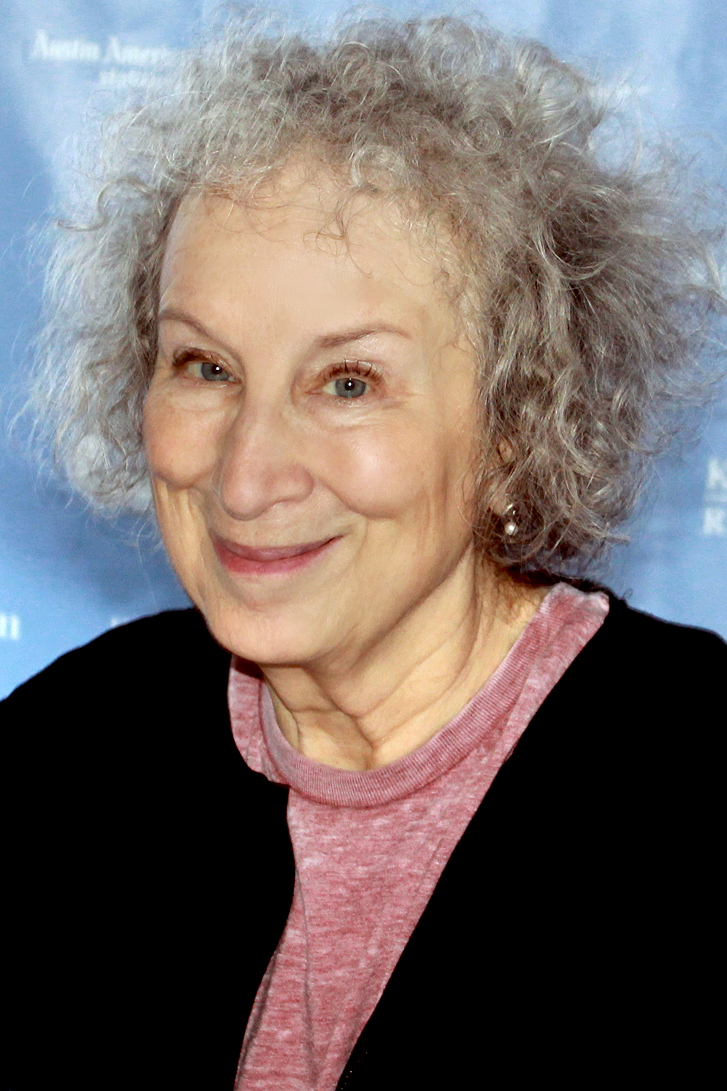
Margaret Atwood
Author · Canadian · b. 1939
Speculative fiction / Feminist
The Witness from the North
She was born in Ottawa in November 1939, the daughter of an entomologist who spent half of each year doing fieldwork in the forests of northern Quebec. She spent her first years in a series of tents and log cabins, learning to read from her mother at the edge of lakes that had no names on any map. It is difficult to imagine a less likely apprenticeship for the writer who would eventually become the most recognizable literary voice of Canada — except, of course, for the fact that all of her work is about what happens at the edges. The edges of forests, the edges of memory, the edges of a society that is convinced it knows what it is.
She was an early reader and, improbably, an early comic-book writer — she and her brother produced illustrated serials for their own private audience of two. She studied at the University of Toronto under Northrop Frye, whose theory of literary archetypes she absorbed and then spent a career gently subverting, and went to Harvard for graduate school in the early 1960s. She disliked it. Harvard in 1962, she later said, treated women the way a nineteenth-century gentleman's club would have treated an unexpected squirrel. She wrote her first novel, The Edible Woman, in pencil on the backs of examination booklets in a basement carrel and could not find a publisher for four years.
The book that made her unignorable came in 1985. The Handmaid's Tale is set in the Republic of Gilead, a theocratic regime that has overthrown the United States government, and follows a woman known only as Offred — of Fred, the property of — who has been assigned as a reproductive surrogate to a senior official. Atwood has been careful, for forty years now, to insist that every practice in Gilead has a historical precedent: the forced pregnancies, the ritual executions, the specific costume of the Handmaids in red with white wings. "I did not put anything into the book," she has said repeatedly, "that had not already happened somewhere." In the Trump years, when the red robes became a protest costume at American statehouses, the book acquired a second life its author had not wanted but had anticipated.
She is not only a novelist. She has published more than twenty volumes of poetry. She has written criticism — Survival, her 1972 book on Canadian literature, reshaped the field by arguing that the central theme of the national imagination was, literally, survival in a hostile landscape, a thesis Canadians have been arguing about ever since. She invented the LongPen, a remote book-signing device that would be funny if it did not actually work. She has written for television, for opera, for children. She has won the Booker Prize twice — for The Blind Assassin in 2000 and, controversially shared, for The Testaments in 2019.
The through-line in all of it is attention. She writes about environmental collapse (the MaddAddam trilogy), about nineteenth-century murder (Alias Grace), about girlhood cruelty (Cat's Eye), about financial collapse (Payback) — but the register is always the same. Quiet, observant, dry, merciless. She notices the thing you would like to look away from, and she describes it in language plain enough that there is nowhere to hide.
She lives in Toronto, still writes every morning, is a prolific user of Twitter where she fights with climate deniers and promotes other writers, and has survived, among other things, her long companionship with the novelist Graeme Gibson, who died in 2019 of a stroke on the day The Testaments was published. She went on with the book tour anyway. That detail tells you more about her than a biography could.
A word after a word after a word is power.
Notable Works
- The Handmaid's Tale
- Oryx and Crake
- The Blind Assassin
- Alias Grace
- Cat's Eye
- The Testaments