
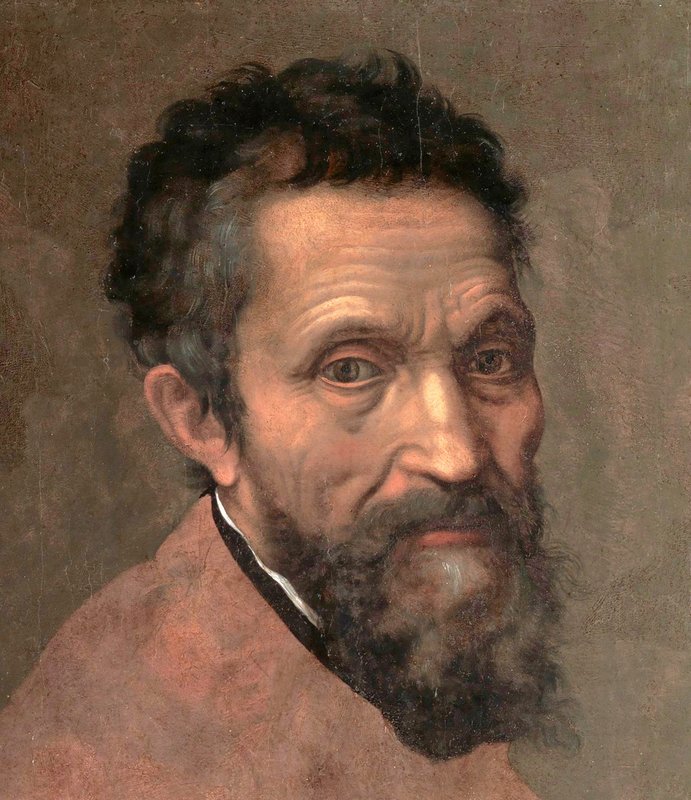
Michelangelo
Painter · Italian · 1475 – 1564
High Renaissance
The Solitary Titan
He thought of himself as a sculptor. Everything else -- the fresco ceilings, the architecture, the poetry he wrote by lamplight late into old age -- was a distraction from the one true art, which was the freeing of a figure imprisoned in a block of marble. Michelangelo Buonarroti insisted on this definition of himself for nearly ninety years, and he kept insisting even when the Pope ordered him, against his will, to spend four years on his back painting the ceiling of the Sistine Chapel.
He was born in a Tuscan village to a minor nobleman who beat him for wanting to be an artist -- a trade the family considered beneath them. He was apprenticed at thirteen to the painter Ghirlandaio in Florence, and within a year Lorenzo de' Medici had plucked him out of the workshop and installed him in the Medici palace, where he ate at the family table, studied classical sculpture in the Medici garden, and listened to the philosophers of the Platonic Academy argue about the nature of the soul. He was sixteen years old and already carving stone that made older sculptors weep.
At twenty-four he made the Pieta for St. Peter's -- a young Mary holding the dead body of Christ across her lap, her face almost impossibly young, her robes falling in waves of polished marble so fluid that the stone seems to have been breathed into shape. When he heard visitors attributing the work to another sculptor, he slipped into the basilica at night and carved his name across Mary's sash. It is the only work he ever signed. He regretted it afterward, saying his vanity had shamed him, and he never signed another.
At twenty-nine, from a single damaged block of Carrara marble that other sculptors had rejected as ruined, he carved the David -- seventeen feet tall, nude, watchful, caught in the instant before the slingshot is loaded. It became the symbol of Florence, the symbol of the Renaissance, and one of the most famous objects in the history of human hands.
Then came the ceiling. Julius II ordered it. Michelangelo resisted. He painted lying on his back on scaffolding so high it gave him permanent neck pain, paint dripping into his eyes and beard. In four years -- 1508 to 1512 -- he covered five thousand square feet with more than three hundred figures: the creation of the world, Adam reaching toward the finger of God, the prophets and sibyls brooding on their marble thrones. He worked almost alone, refusing most assistants, eating bread and onions, sleeping in his clothes. When it was finished he was thirty-seven, half-blind, and famous throughout Europe.
He lived another fifty-two years. He painted the Last Judgment on the altar wall of the same chapel in his sixties -- a seething, terrifying vision of resurrection and damnation that shocked even the cardinals who had commissioned it. He designed the dome of St. Peter's in his seventies and eighties, refusing payment because he said it was his duty to God. He wrote sonnets to the young Roman nobleman Tommaso de' Cavalieri that are among the first frank declarations of same-sex love in European literature. He was difficult, suspicious, fiercely religious, lonely, and impossibly productive.
He died in 1564, at eighty-eight, still working on a marble Pieta that he had already been carving for nearly a decade and that he never finished. His nephew smuggled the body back to Florence, against the wishes of the Pope, and buried it in Santa Croce. The greatest artist of the Renaissance had believed, to the end, that he was only beginning to learn his craft.
The sculpture is already complete within the marble block before I start my work. I just have to chisel away the superfluous material.
Notable Works
- David
- Pietà
- Sistine Chapel Ceiling
- The Last Judgment