
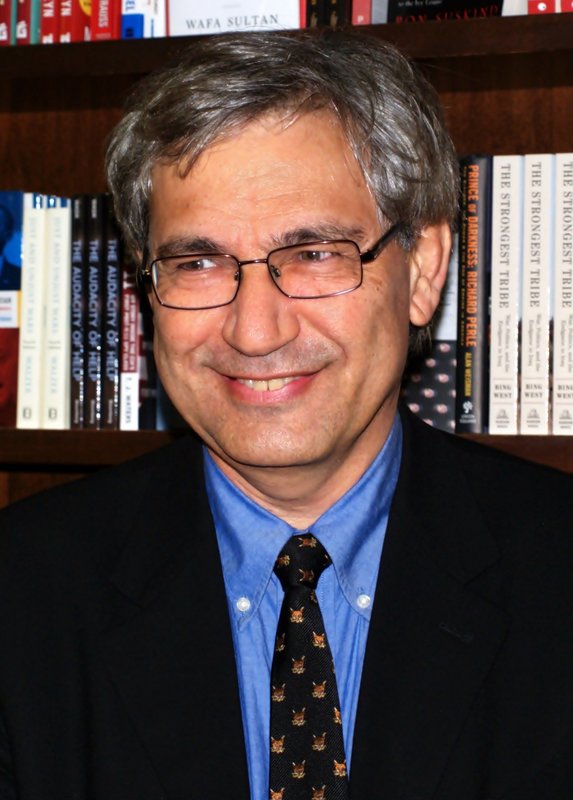
Orhan Pamuk
Author · Turkish · b. 1952
Contemporary
The Archivist of a Vanished City
He was born into a wealthy Istanbul family that had made and then lost a fortune in railways during the final years of the Ottoman Empire. Orhan Pamuk grew up in a tall apartment building in the Nisantasi neighborhood, surrounded by his grandmother's gilt mirrors, his uncles' failed business ventures, and a low hum of familial melancholy that the Turks have a particular word for: huzun. He would spend the next fifty years trying to describe the texture of that word, which is not sadness exactly and not nostalgia exactly, but something closer to the particular quality of light that falls on a city that was once the center of an empire and now is not.
He studied architecture for three years and then quit, scandalizing his family, and announced that he was going to be a novelist. He locked himself in his mother's apartment and wrote for seven years before publishing his first book, Cevdet Bey and His Sons, a multi-generational family saga clearly modeled on Buddenbrooks. It was received politely in Turkey and not at all anywhere else. He kept writing.
What emerged, book by book, was one of the most ambitious bodies of work in contemporary world literature. The White Castle -- a short novel about a seventeenth-century Italian slave and his Ottoman master who come to resemble each other so closely they switch identities -- established his fascination with the permeable border between East and West, self and other. The Black Book, set in a single Istanbul week in which a lawyer disappears and his wife pursues him through the city's labyrinth of metaphors and conspiracy theories, announced him as a postmodernist capable of folding Borges and Calvino into an unmistakably Turkish frame.
Then, in 1998, came My Name Is Red. Set in Istanbul in 1591, narrated in turn by miniaturist painters, murdered corpses, coins, trees, the color red itself, and the ghost of a dog, it is a murder mystery, a love story, a meditation on the clash between Islamic and European theories of representation, and a hymn to the vanishing art of the Ottoman court. It is also one of the most beautiful novels of the last fifty years. It won the International IMPAC Dublin Literary Award, was translated into sixty languages, and made Pamuk a global figure.
And then he made an enemy of his own country.
In 2005 he told a Swiss newspaper: "Thirty thousand Kurds and a million Armenians were killed in these lands, and nobody but me dares to talk about it." He was prosecuted under Article 301 of the Turkish penal code for "insulting Turkishness." Nationalist mobs burned his books in the streets. He received death threats. He was placed under police protection. The charges were eventually dropped on a technicality but the damage was done. He continued to speak, and continued to write, and continued to walk the streets of Istanbul every morning with a notebook.
In 2006 he won the Nobel Prize in Literature "for the quest of the melancholic soul of his native city." He was fifty-four, the youngest Turkish laureate, and the first author from Turkey to win the prize. His acceptance lecture was about his father's suitcase full of unpublished writing, and about what a writer owes to the place he comes from.
He has written since then about a street vendor of boza in mid-century Istanbul (A Strangeness in My Mind), a doomed love affair in the 1970s (The Museum of Innocence, for which he built an actual museum in an old wooden house in the Cukurcuma neighborhood, stocked with thousands of objects mentioned in the novel), and the nightmarish politics of a small fictional Anatolian city in the 1890s (Nights of Plague). He still lives in Istanbul, in the same city that gave him huzun and then tried to silence him and never quite managed to do either. He still writes every morning. He is still keeping the archive.
I read a book one day and my whole life was changed.
Notable Works
- My Name Is Red
- Snow
- The Museum of Innocence
- Istanbul: Memories and the City