
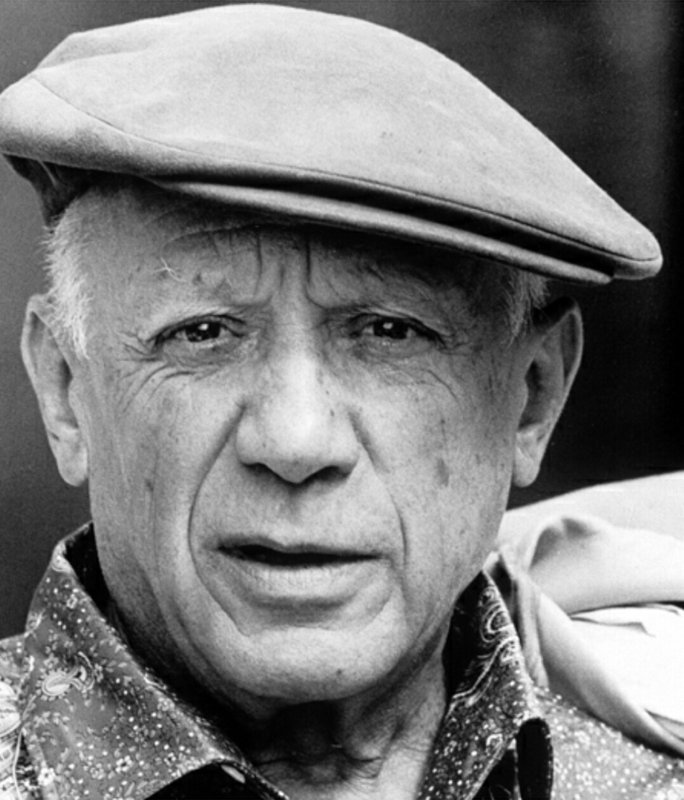
Pablo Picasso
Painter · Spanish · 1881 – 1973
Cubism
The Man Who Broke the Window
He drew before he could speak. His first word, according to family legend, was "piz" -- short for lapiz, the Spanish word for pencil. By the time Pablo Picasso was thirteen, his father -- an academic painter who taught at the art school in La Coruna -- had given him his own brushes and declared that he would never paint again; the son had already surpassed the master.
What followed was the longest, most restless career in the history of modern art. Over nearly eighty years, Picasso would make more than 50,000 works -- paintings, sculptures, ceramics, prints, stage sets, illustrated books -- and invent or reinvent a new visual language every decade. The Blue Period, drenched in the melancholy of poverty and the suicide of his friend Casagemas. The Rose Period, warmed by circus performers and tender motherhoods. And then, in 1907, the detonation: Les Demoiselles d'Avignon, a painting so jagged and confrontational that even his closest friends recoiled. Five nude prostitutes stared out from a canvas that looked as though it had been broken into shards and glued back together wrong. African masks instead of faces. A window had been smashed, and through the break, modern art walked in.
With Georges Braque he invented Cubism -- the dismantling of the Renaissance illusion of space, the insistence that a painting was a flat surface with its own logic, not a window onto the world. For three years they worked in near-telepathic collaboration. "We were like two mountain climbers roped together," Braque later said.
But Picasso could never stay in one mode. He swung into neoclassicism in the 1920s, Surrealism in the 1930s, monumental political art with Guernica in 1937 -- his response to the Nazi bombing of a Basque town, rendered in black and white and gray on a canvas twenty-five feet wide, a scream against fascism that still echoes in every room it enters.
His private life was volcanic and often cruel. Seven major women, two of whom took their own lives after his death, and countless affairs. He used people like paint, and yet his tenderness -- for his children, for certain friends, for the act of making -- was also real. He was capable of astonishing generosity and astonishing damage, sometimes on the same day.
He worked until the final months of his life. He died at ninety-one in a farmhouse in the south of France, still painting, still drawing, still insisting that the most important thing an artist could do was refuse to become his own imitator. His entire life was a war against the comfort of a finished style. "I am always doing that which I cannot do," he said, "in order that I may learn how to do it."
Every act of creation is first an act of destruction.
Notable Works
- Les Demoiselles d'Avignon
- Guernica
- The Weeping Woman
- Girl before a Mirror