
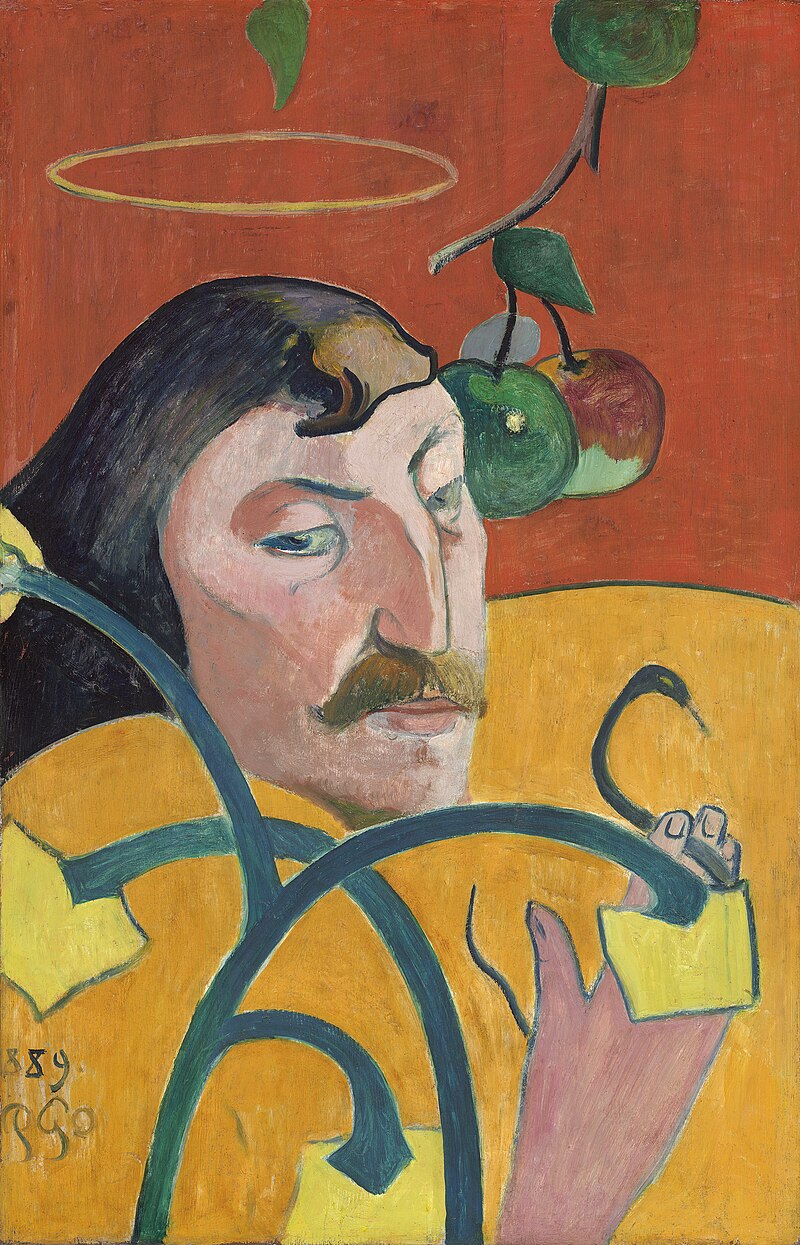
Paul Gauguin
Painter · French · 1848 – 1903
Post-Impressionism / Symbolism
The Stockbroker Who Ran Away
He was born in Paris in 1848, the year of revolutions, and spent the first six years of his life in Peru, where his mother had fled with the children after the death of their journalist father during the Atlantic crossing. Paul Gauguin never really recovered from that early childhood of tropical light, Spanish colonial houses, and a grandmother who smoked cigars and wrote socialist pamphlets. He returned to France a small boy who already believed that the center of the world was somewhere else.
He joined the merchant marine at seventeen and sailed to Rio and Panama and the Arctic. He came back at twenty-three, got a job at the Paris stock exchange, made a great deal of money, married a pretty Danish woman named Mette, fathered five children, and began collecting Impressionist paintings on the side. He bought Manets and Pissarros and Cezannes with his broker's bonuses. He started painting on weekends. Pissarro took him on as a pupil. He exhibited with the Impressionists in their last four group shows.
And then, in 1883, at the age of thirty-five, the Paris stock market crashed, and Paul Gauguin lost his job and -- to Mette's horror -- decided not to look for a new one. He announced that from now on he would paint full-time. The marriage collapsed slowly, painfully, and with increasing distance across the next decade; Mette took the children back to Copenhagen; Gauguin spent a humiliating winter there trying to sell tarpaulins, failed, and returned alone to France. He would never really live with his family again.
What followed was a long, furious invention of a new kind of painting. He went to Brittany, to the village of Pont-Aven, where the peasant women still wore medieval headdresses and the light was hard and flat. There he painted The Vision After the Sermon -- Breton women in white caps watching Jacob wrestle an angel in a field of pure vermilion red -- and something fundamental changed in European art. Color no longer had to describe. A field could be red. A shadow could be green. A painting could be a dream flattened against a wall.
He met Van Gogh in Paris and agreed to come live with him in Arles, in the yellow house, in the autumn of 1888. They painted side by side for nine weeks. They quarreled constantly. On the night of December 23 the argument reached a breaking point; Gauguin walked out and slept at an inn; Van Gogh, alone and in a state of collapse, cut off part of his own ear. Gauguin left Arles the next day and never saw him again. Two years later Van Gogh was dead.
Gauguin sailed to Tahiti in 1891, looking, he said, for a place not yet poisoned by European civilization. What he found was a French colony where the old Polynesian religion had been largely erased by missionaries and syphilis was rampant. He half-invented, half-recorded the Tahiti he had come for: painted dark-skinned women in pareus against skies of pink and gold, painted the old gods walking at dusk, painted a young Tahitian girl named Teha'amana -- who was thirteen when he took her as his "bride" in a ceremony he later described with tremendous self-regard and no apparent sense of the power difference -- lying face down on a bed while a spirit of the dead watches from the shadows.
The late Gauguin is not a comfortable figure. He idealized and exploited the women of a colonized people, spread his diseases among them, wrote a mythologized memoir (Noa Noa) that inflated his own role into prophet and savage, and fathered children he would not support. He also produced, out of that morally compromised encounter, some of the most haunting paintings of the nineteenth century -- flat planes of saturated color that opened the door for Matisse, for Picasso, for the whole twentieth-century rejection of Renaissance space.
His final years, in the Marquesas Islands, were spent in pain and poverty, his body failing from syphilis and heart disease, fighting the local colonial administration on behalf of the Marquesan islanders against the very French authority that had funded his passage. He died alone on the eighth of May, 1903, in a hut he had called the House of Pleasure. His last painting, unfinished on the easel, was a Breton village in the snow.
I shut my eyes in order to see.
Notable Works
- Where Do We Come From? What Are We? Where Are We Going?
- The Vision After the Sermon
- Spirit of the Dead Watching
- Two Tahitian Women