
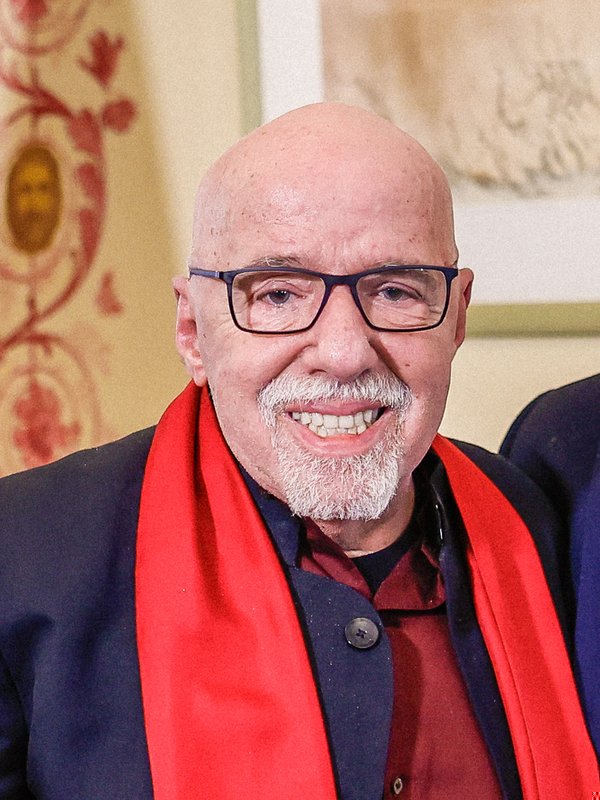
Paulo Coelho
Author · Brazilian · b. 1947
Contemporary
The Pilgrim of the Improbable
When he was seventeen his parents had him committed to a mental hospital in Rio de Janeiro. His crime was that he wanted to be a writer, and in the Brazil of the 1960s, inside a conservative middle-class Catholic family, the wish to be a writer was considered evidence of a disordered mind. Paulo Coelho was held in the psychiatric ward three times. He was subjected to electroshock treatment. When he was finally released, he drifted into the counterculture, wrote song lyrics for the Brazilian rock star Raul Seixas, dabbled in magic and the occult, and, in the mid-1970s during the Brazilian military dictatorship, was imprisoned and tortured by the regime, which considered his lyrics politically subversive.
Nothing in that biography predicts what came next.
In 1986, at the age of thirty-nine, he walked the medieval pilgrim road to Santiago de Compostela in northern Spain -- five hundred miles on foot through the mountains and wheat fields of Galicia. The experience cracked him open. He wrote a book about it called The Pilgrimage. It sold almost nothing. Undeterred, a year later he wrote a second book, a short fable about a shepherd boy named Santiago who dreams of a treasure buried at the base of the Egyptian pyramids and sets off to find it. The book was called The Alchemist. His Brazilian publisher issued a small print run. It sold about nine hundred copies in its first year. The publisher dropped him.
He took the rights back and started over.
The Alchemist is now the second-bestselling novel by a living author in the history of publishing. It has been translated into eighty-three languages, sold more than 150 million copies, and been read by popes, prime ministers, prison inmates, and schoolchildren on every inhabited continent. It is also, to a large part of the literary establishment, a book whose enormous popularity makes no sense. It is a fable. Its prose is deliberately simple. Its message -- that when a person truly wants something, the universe conspires in helping them to achieve it -- has been called mystical nonsense by critics and profound spiritual truth by readers. Coelho, characteristically, is unbothered by either verdict.
He has written more than thirty books since. Veronika Decides to Die is a novel about a young woman who, having attempted suicide, wakes up in a mental hospital and is told she has a week to live -- and discovers, in that week, the life she should have been living all along. It is also, transparently, about his own experience of psychiatric incarceration. Eleven Minutes is a novel about a Brazilian prostitute in Geneva searching for the difference between sex and love. The Witch of Portobello, Brida, The Zahir -- each book circles the same questions he has been asking since Santiago de Compostela: what are we supposed to do with this one life, how do we listen to the small quiet voice that knows what we really want, and what do we owe to our own soul.
He lives in Geneva with his wife Christina, writes every book in about two weeks of white-hot drafting, runs one of the largest personal Twitter accounts in Brazil, and gives away his books for free in countries that cannot afford to buy them. He is viewed by critics as a literary lightweight and by millions of ordinary readers as the most important writer of their lives. Both views are probably true, and both probably miss the point. The point, for him, is that a book is not a monument. It is a pilgrim's staff -- a thing to lean on while walking somewhere.
When you want something, all the universe conspires in helping you to achieve it.
Notable Works
- The Alchemist
- Veronika Decides to Die
- Eleven Minutes
- Brida