
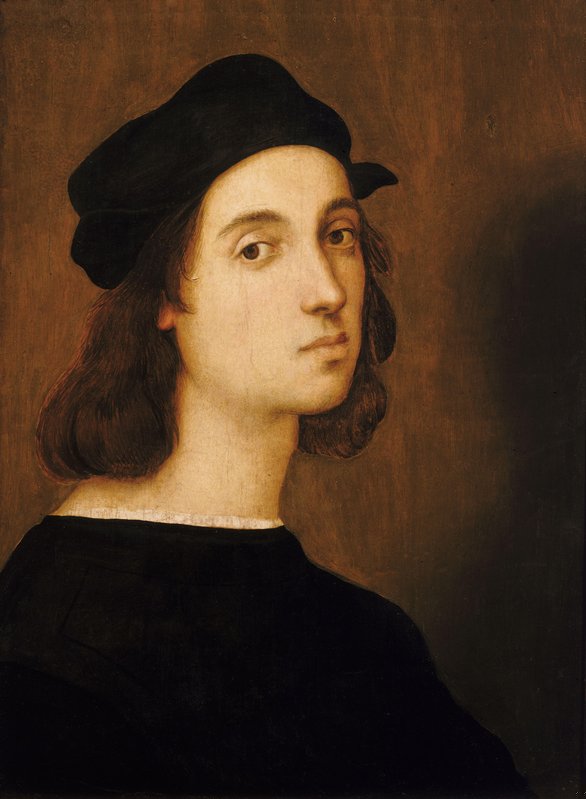
Raphael
Painter · Italian · 1483 – 1520
High Renaissance
The Grace That Walked Through Rome
He was born in Urbino on Good Friday, 1483, the son of a court painter in a small Italian duchy famous for its elegant court culture and its library of ancient manuscripts. Raffaello Sanzio -- known to the world simply as Raphael -- grew up surrounded by the idea that beauty and learning were the same thing, that a well-formed sentence, a well-placed column, and a well-turned face all belonged to a single order of grace. He would spend his short life trying to paint that order.
His mother died when he was eight. His father died when he was eleven. By the time he was seventeen he was already being called a master. He studied briefly with Perugino, absorbed the soft atmospheric landscapes and sweet-faced Madonnas of that style, and then kept moving -- to Florence, where he watched Leonardo and Michelangelo working on their rival frescoes in the Palazzo Vecchio, and finally to Rome, where Pope Julius II summoned him in 1508 to decorate the papal apartments at the Vatican.
He was twenty-five years old, and he had just been handed one of the greatest commissions in European history. In the room now called the Stanza della Segnatura he painted four vast frescoes, the greatest of which -- The School of Athens -- assembled every philosopher of the ancient world beneath a soaring barrel vault: Plato pointing upward, Aristotle gesturing toward the earth, Pythagoras scribbling on a slate, Heraclitus brooding alone on the steps. It was a mind-map of the classical tradition rendered in paint, a declaration that the Renaissance understood itself as the rightful heir of Athens. Raphael painted himself into the crowd, quietly, at the edge -- a slender young man in a black cap, looking out at the viewer across five hundred years.
What distinguished him from the two titans he stood between was something harder to define than power or invention. He was not as restless as Leonardo or as monumental as Michelangelo. He had what the Italians call grazia -- grace -- a quality of effortless rightness in which every gesture seemed to fall exactly where the eye wanted it to be. His Madonnas are not theological arguments; they are mothers looking at their children with a tenderness so direct it still dissolves something in the viewer.
He ran the largest workshop in Rome, supervising architects and fresco painters and decorators while also producing his own easel paintings, designing tapestries for the Sistine Chapel, and serving as the papal commissioner for antiquities. He was handsome, charming, beloved by women and patrons alike, and apparently happy -- a rare thing in any era of art.
He died on his thirty-seventh birthday, on Good Friday, 1520, after a brief fever. Rome went into mourning. His body lay in state beneath his unfinished Transfiguration, and he was buried in the Pantheon -- the only modern artist ever to be laid to rest among the gods of ancient Rome. On his tomb Cardinal Pietro Bembo had carved: "Here lies Raphael, by whom Nature herself feared to be outdone while he lived, and when he died, feared to die with him."
When he died, Nature herself feared she might die with him.
Notable Works
- The School of Athens
- Sistine Madonna
- The Transfiguration
- Portrait of Baldassare Castiglione