
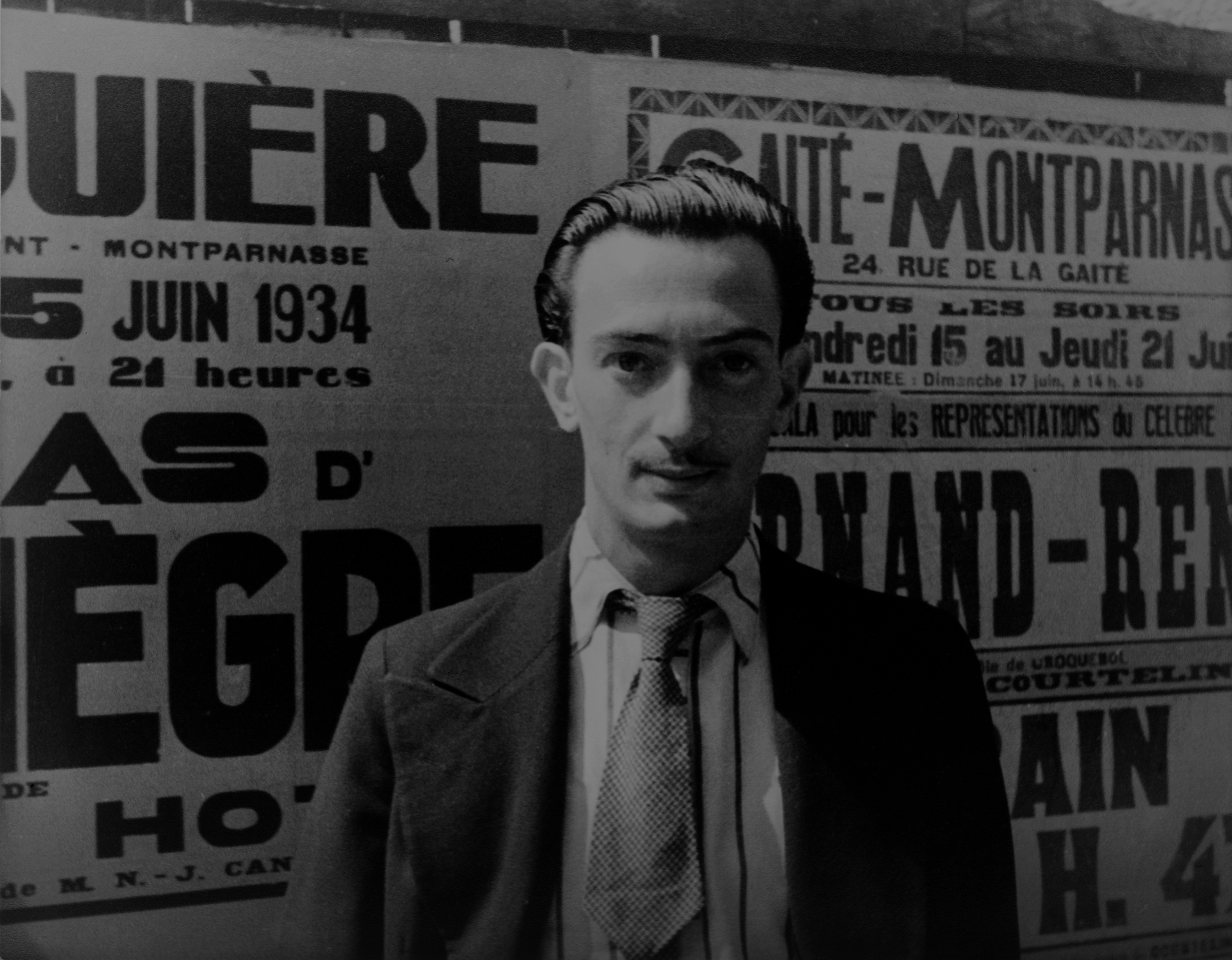
Salvador Dalí
Painter · Spanish (Catalan) · 1904 – 1989
Surrealism
The Painter Who Sold Surrealism
He was born in Figueres, Catalonia, in May 1904, nine months after the death of an older brother also named Salvador — a coincidence his parents never hid from him. Dalí would later say that his entire life had been a battle to prove he was not the reincarnation of a dead child. It is hard to read his paintings without that sentence in the back of the mind.
He arrived in Madrid at seventeen with a mustache in progress and the manners of a minor aristocrat. At the Residencia de Estudiantes he befriended the poet Federico García Lorca and the filmmaker Luis Buñuel, and spent most of his time avoiding the professors who would eventually expel him for refusing to be examined by them — on the grounds, he said, that none of them were competent to judge him. He may have been right.
In 1929 he went to Paris to meet the Surrealists, and met instead Gala Éluard, a Russian émigrée already married to the poet Paul Éluard. She was ten years older than him and, by every account including her own, had already decided what she wanted. She left Éluard and moved in with Dalí. She managed his money, managed his career, and managed him. He painted her for the rest of her life, in every conceivable pose and costume and mythological register, and the only constant in the paintings is the absolute certainty that she was the axis the world turned on.
The Persistence of Memory was finished in 1931. He was twenty-seven. The canvas is small — nine and a half inches by thirteen — and it rearranged twentieth-century painting. The melting watches, the flies, the ants, the ambiguous fleshy thing on the ground are all in a landscape that is recognizably the coast of Cap de Creus north of his hometown. He did not invent Surrealism. He invented its photograph.
In 1939 André Breton expelled him from the Surrealist movement for supporting Franco, for his obsession with money (Breton famously rearranged the letters of his name to spell Avida Dollars), and for a general refusal to behave. Dalí was unconcerned. He spent the war years in America, where he painted window displays for Bonwit Teller, designed a dream sequence for Hitchcock's Spellbound, collaborated with Walt Disney on an animated short, and turned himself into a celebrity of the kind that had not previously existed in the visual arts — an artist as brand, as television personality, as product endorser. He signed thousands of blank sheets of paper in his later years so that lithographs could be printed on them after his death. Most of the work sold under his name in the 1960s and 70s is of uncertain authorship.
And yet. Christ of Saint John of the Cross, painted in 1951 from a drawing by the sixteenth-century Spanish mystic, is one of the most reproduced religious images of the twentieth century. The Sacrament of the Last Supper hangs in the National Gallery in Washington. The late Dalí — the one everyone dismisses — painted Nuclear Mysticism, crystalline Christs, visions informed by Heisenberg and Catholic theology, works of obsessive technical virtuosity that critics have still not fully reckoned with.
Gala died in 1982. Dalí moved into the castle in Púbol he had bought for her and essentially stopped painting. He died in Figueres in 1989, of heart failure, in a hospital across from the theatre-museum he had designed as his own tomb. He is buried there, under a plain stone slab in the floor, beneath a dome where visitors walk over him without knowing.
The only difference between me and a madman is that I am not mad.
Notable Works
- The Persistence of Memory
- The Elephants
- Christ of Saint John of the Cross
- The Great Masturbator
- Metamorphosis of Narcissus
- The Sacrament of the Last Supper