
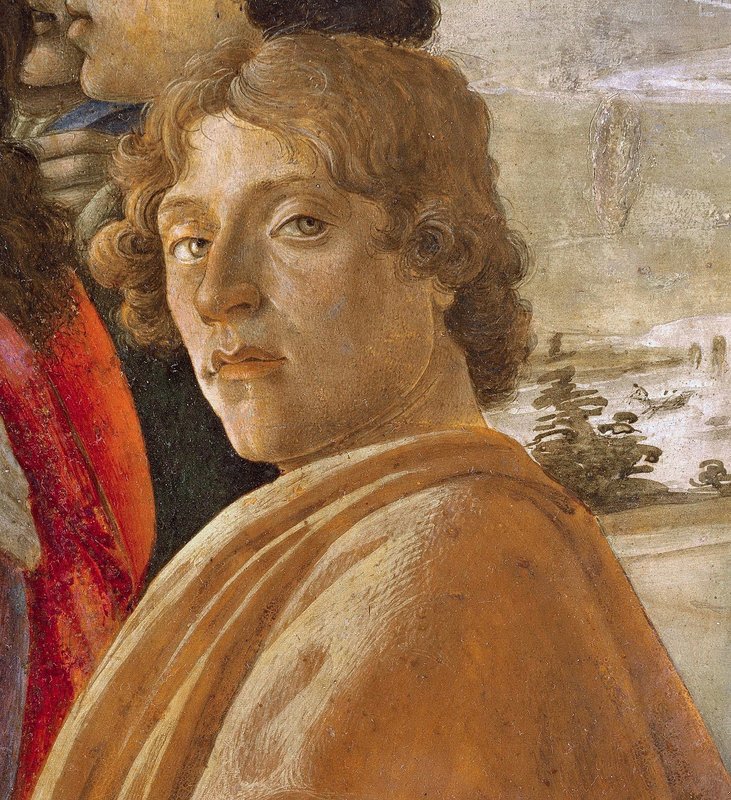
Sandro Botticelli
Painter · Italian · 1445 – 1510
Early Renaissance
The Line That Sang
He was born in Florence, the youngest son of a tanner in a narrow street near the Arno, and at first he was apprenticed -- according to the family legend -- to a goldsmith. That training may explain the peculiar precision of his line. Botticelli drew as though with an engraver's burin: thin, firm, impossibly elegant contours that seem to sing the figures into being rather than describe them. No painter before or since has made drawing itself feel so much like music.
He entered the workshop of Fra Filippo Lippi, the worldly friar-painter, and absorbed the sweet, dreamy style of Lippi's Madonnas. Then he was taken up by the Medici, the banking dynasty that ran Florence the way popes run churches, and for twenty years he lived and worked at the center of the most cultivated court in Europe. The Medici garden was the meeting place of the Platonic Academy -- a circle of humanist philosophers who believed that the beauty of the classical gods could be reconciled with Christian devotion, that Venus and the Virgin Mary could coexist in the same city without blasphemy.
Out of that strange theological experiment came the two paintings that make Botticelli immortal. Primavera -- the Allegory of Spring -- shows Venus presiding over a grove of orange trees where the Three Graces dance in translucent robes, Mercury stirs the clouds with his staff, and Zephyr, the west wind, pursues the nymph Chloris across the right-hand side. And the Birth of Venus shows the goddess being blown to shore on a giant scallop shell by two winged lovers, her long hair falling in golden spirals to cover her nakedness, a nymph waiting on the beach with a cloak of pink roses. Both paintings were commissioned for the private apartments of a young Medici cousin. Both were almost unknown outside Florence for three hundred years. Both are now among the most recognizable images in the history of art.
What sets them apart from everything around them is that strange, ungrounded lightness. Botticelli's figures seem to weigh nothing. Their feet barely touch the ground. Their robes billow in a wind that carries no weight of gravity. His Venus is not the sensual goddess of Titian or the muscular nude of Michelangelo; she is a thought made visible, a line that has learned how to dream.
Then came Savonarola. In the 1490s the Dominican friar whose apocalyptic sermons swept through Florence like a fever convinced much of the city, Botticelli apparently included, that the humanist celebration of pagan beauty was a sin. The Bonfire of the Vanities burned in the Piazza della Signoria. Art, cosmetics, books, lutes, and classical sculptures were thrown into the flames. Botticelli, according to Vasari, threw several of his own early paintings onto the fire. His style turned darker, more austere. He painted bleak, anguished crucifixions and mystical nativities prophesying the end of the world.
He died in 1510, poor, half-forgotten, a neglected survivor of an age that had moved on. For three centuries his name was barely known. Then, in the 1860s, the English Pre-Raphaelites rediscovered him, and the twentieth century fell in love. The Birth of Venus was cleaned. Scholars wrote about her. She became, somehow, the defining face of the Renaissance -- not the confident David, but the startled, half-sad goddess rising from the sea, covering herself with her own hair, not quite certain yet whether the world she has arrived in will turn out to be kind.
A line, when it is pure, is a kind of silence in which beauty can finally be heard.
Notable Works
- The Birth of Venus
- Primavera
- The Adoration of the Magi
- Venus and Mars