
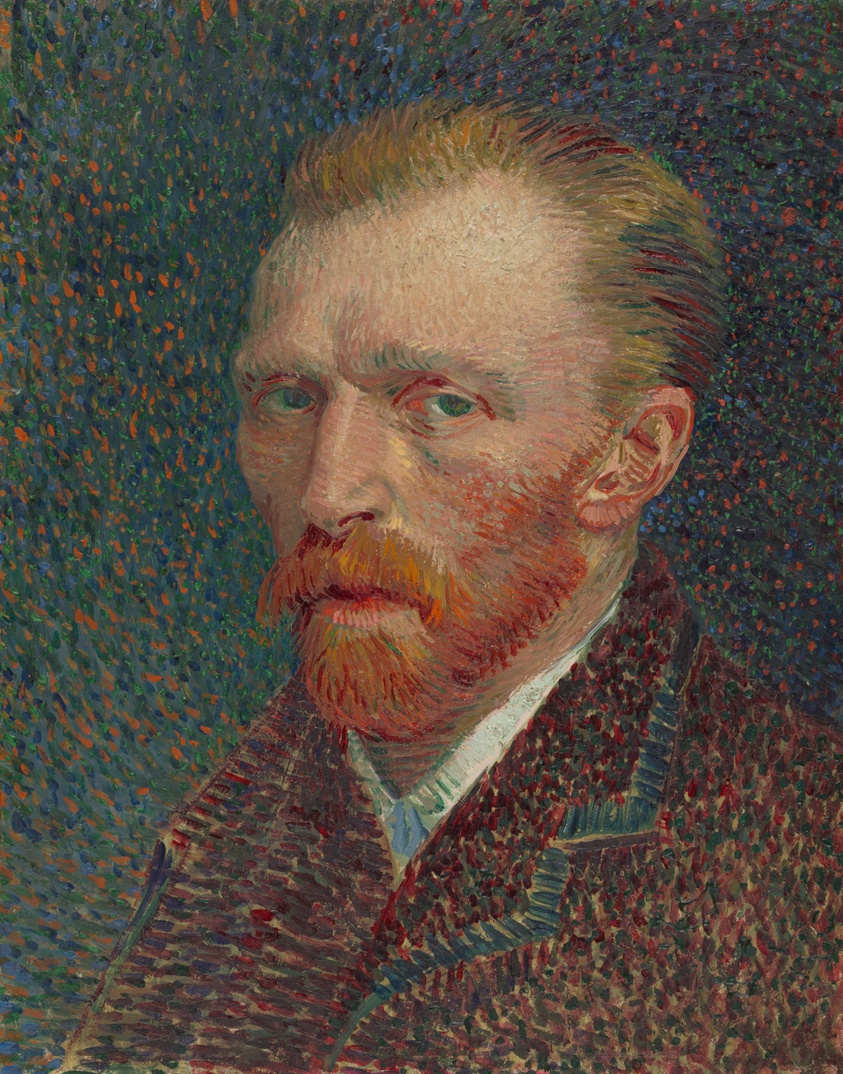
Vincent van Gogh
Painter · Dutch · 1853 – 1890
Post-Impressionism
The Letters We Almost Lost
Before he ever picked up a brush, Vincent van Gogh failed at everything. He failed as an art dealer in The Hague, London, and Paris. He failed as a schoolteacher in England. He failed as a bookshop clerk. He failed, most painfully, as an evangelical preacher in the coal-mining country of the Borinage in Belgium, where he gave away his clothes, slept on straw, and descended into the mines to minister to workers who did not want his sermons. The church dismissed him for excessive zeal. He was twenty-seven years old, penniless, and broken.
Then he began to draw.
In the decade that followed -- the only decade of art he would ever have -- Van Gogh produced roughly 2,100 works, including around 860 oil paintings. He taught himself, copying Millet's peasant scenes, studying Japanese woodblock prints, absorbing the color theories of Delacroix. In Paris, he met the Impressionists and his palette exploded from the mud-browns of his Dutch period into cadmium yellows, cobalt blues, and emerald greens that vibrate on the canvas like struck tuning forks.
He moved to Arles in the south of France, chasing the light, and there he painted the works that would reshape modern art: sunflowers blazing in ceramic vases, a night cafe drenched in acid green and blood red, the swirling heavens of The Starry Night. He painted not what he saw but what he felt, and what he felt was everything, all at once, at an intensity most people could not survive.
He did not survive it. The famous episode of the ear -- sliced off during a breakdown in December 1888, after a catastrophic visit from Gauguin -- was only the most dramatic of many collapses. He committed himself to the asylum at Saint-Remy, where he painted between seizures, producing some of his most luminous work in the gaps between despair.
Through it all, he wrote letters to his brother Theo -- over 650 of them survive -- that are among the most beautiful and heartbreaking documents in the history of art. They reveal a man of enormous intellect, deep literary knowledge, and desperate loneliness, who understood exactly what he was doing on canvas even as his mind unraveled.
He shot himself in a wheatfield outside Auvers-sur-Oise on July 27, 1890. He was thirty-seven. He had sold, in his lifetime, perhaps one painting. Today those paintings are among the most valuable objects on earth, but their true worth lies elsewhere: in the proof that a human being can transmute suffering into color, and color into something that feels, across a century, like love.
He painted not what he saw but what he felt, and what he felt was everything, all at once, at an intensity most people could not survive.
Notable Works
- The Starry Night
- Sunflowers
- Bedroom in Arles
- Wheatfield with Crows