
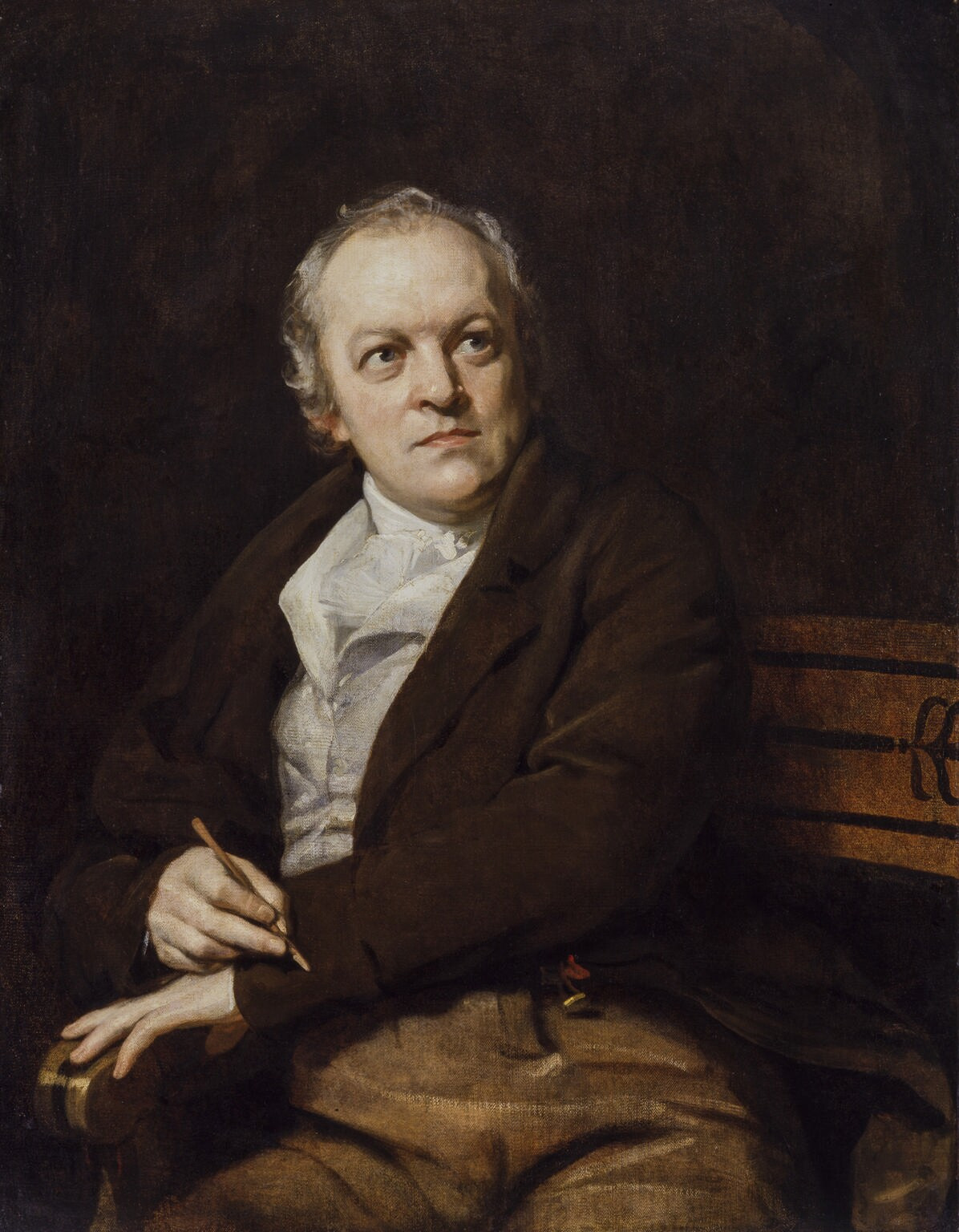
William Blake
Painter · British · 1757 – 1827
Romanticism / Visionary
The Engraver Who Saw God
William Blake was born above a hosier's shop in Soho in November 1757, the third son of a dissenting family who did not baptize him in any established church. He saw his first vision at four, when God "put his head to the window" and he screamed. At about eight, walking on Peckham Rye, he looked up into an oak tree and found it "filled with angels, bright angelic wings bespangling every bough like stars." He reported this at home and was only saved from a beating by his mother.
He became an engraver because his family could not afford to make him a painter. He apprenticed at fourteen to James Basire, a conservative antiquarian engraver, and spent seven years in Westminster Abbey copying the tombs of Plantagenet kings; the long, clean, contour line he would use for the rest of his life came straight from those medieval effigies. He grew up hating the smooth, shaded style of Reynolds and the Royal Academy. He thought clear outline was truth. He thought chiaroscuro was a lie.
In 1788 he invented what he called "illuminated printing." He wrote his poems backward on copper plates using an acid-resistant varnish, etched away the un-varnished copper, and pulled the result as a relief print, hand-coloring each impression in watercolor. The resulting books — Songs of Innocence (1789), The Marriage of Heaven and Hell (1790), Songs of Experience (1794), America, Europe, Jerusalem — were made one copy at a time, by him and his wife Catherine, at the kitchen table of the small rooms they lived in their whole marriage. No one knows how many copies of each he printed. Some exist in editions of a dozen. He died almost entirely unknown as a poet; the world he now owns was posthumous.
His pictures are mythologies. He invented his own pantheon — Urizen the cold lawgiver, Luvah the passionate, Los the imagination, Orc the revolutionary — and he painted their struggles the way a Renaissance fresco-painter painted the struggles of Saul and David. The Ancient of Days shows Urizen leaning out of a golden disc at the dawn of creation to measure the void with compasses; Blake, who loathed the mechanical universe of Newton, meant the image as an accusation, not a benediction. Newton, painted the next year, shows the scientist crouched at the bottom of the sea, reducing the cosmos to a line on a scroll, blind to the coral and infinity around him. Nebuchadnezzar, on all fours, nails grown into claws, is what happens to a king who lives by reason alone.
Blake was, politically, a radical his whole life. He wore the red cap of the French Revolution in the streets of London during the Terror and took it off only when his friends begged him to. He was tried for sedition in 1803 after a soldier accused him of saying "Damn the King." He was acquitted. He scraped by on engraving commissions, was swindled by a would-be patron named Robert Cromek, and died in 1827 working on illustrations to Dante. Eyewitnesses said that on the afternoon of his death he saw visions of Heaven, sat up in bed, and began to sing. Catherine wrote afterward, "I have very little of Mr Blake's company. He is always in Paradise."
He was forgotten for forty years and then, one by one, the nineteenth century's great readers picked him up: Swinburne, Rossetti, Yeats. In the twentieth Ginsberg heard him read Ah! Sun-flower aloud in a vision in Harlem in 1948 and wrote Howl as an answer. Jim Morrison took the band's name from a Blake line. Philip Pullman built a trilogy around him. He is now read as the first truly visionary English poet of the modern age, and as one of the strangest and most original image-makers in the history of European art.
He would have hated both the categorization and the praise. He believed he was simply reporting what he had seen.
He saw his first vision at four, when God put his head to the window and he screamed. The world he now owns was posthumous.
Notable Works
- The Ancient of Days
- Newton
- Nebuchadnezzar
- The Great Red Dragon and the Woman Clothed with the Sun
- Pity
- Songs of Innocence and of Experience
- Jerusalem: The Emanation of the Giant Albion