
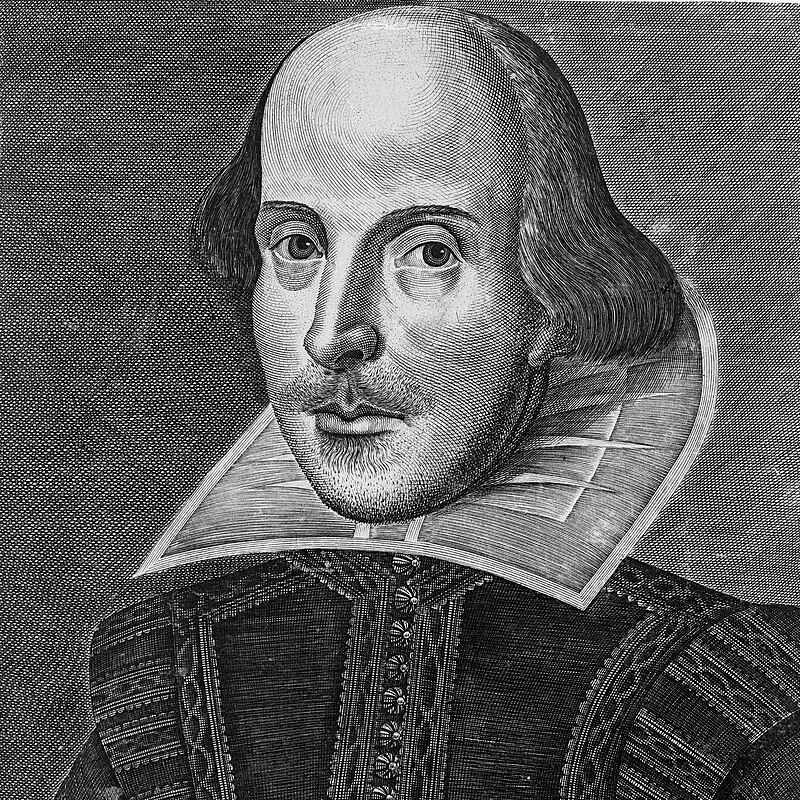
William Shakespeare
Author · English · 1564 – 1616
English Renaissance
The Glover's Son Who Made English
He was baptized in Stratford-upon-Avon on the twenty-sixth of April, 1564, the third child and first surviving son of a glover and a farmer's daughter. His father John Shakespeare sold fine leather gloves, speculated in wool, rose to become an alderman, and then -- for reasons that have never been fully explained -- slipped quietly into debt and absence from the town council. William grew up in a middling family in a small market town, attended the local grammar school where he learned enough Latin to read Ovid and Seneca, and at eighteen married a woman eight years his senior named Anne Hathaway, who was already pregnant with their first child. Three children by twenty-one. And then, around 1585, the documents go silent. For seven years we have no record of William Shakespeare at all.
When he surfaces again, in 1592, it is in London, and it is as an actor and playwright being sneered at in a rival's pamphlet as an "upstart crow, beautified with our feathers." Someone, in those missing years, had taught himself how to write for the stage. No one knows who. No one knows how.
For the next twenty years he wrote an average of one and a half plays a year and acted in most of them himself, working alongside a company of actors -- the Lord Chamberlain's Men, later the King's Men -- that became the dominant theatrical troupe of the age. The company built the Globe on the south bank of the Thames in 1599, a wooden O capable of holding three thousand people, where on any given afternoon a cobbler and a courtier might stand shoulder to shoulder in the pit and watch a Danish prince talk to the skull of a dead jester, or a Scottish general hallucinate a floating dagger, or two Veronese teenagers fall in love and kill themselves inside five acts.
What he did to the English language has never been matched. He expanded its vocabulary by perhaps two thousand words -- bedroom, lonely, swagger, assassination, eyeball, gossip, addiction -- and built hundreds of phrases that are still the currency of ordinary speech: "in my mind's eye," "the be-all and end-all," "a sorry sight," "wild-goose chase," "neither here nor there," "it was Greek to me." He could write a pun and a cosmology in the same line. He could give a murderer a soliloquy that made you understand, briefly and terribly, the logic of the murder.
He also wrote one hundred and fifty-four sonnets -- many addressed to a beautiful young man, some to a dark lady -- which remain the most sustained investigation of desire, jealousy, time, and the desperate wish to preserve a loved face against its own decay that has ever been written in English. "So long as men can breathe, or eyes can see, so long lives this, and this gives life to thee."
He retired to Stratford around 1613, a prosperous gentleman with a coat of arms (secured, finally, for his father), a large house called New Place, and a reputation already monumental enough that his actor-colleagues would spend years after his death assembling his scattered plays into a single folio edition so that the work would not be lost. He died on what may have been his fifty-second birthday, in 1616, and was buried in the chancel of Holy Trinity Church beneath a curse he had allegedly composed himself: "Blessed be the man that spares these stones, and cursed be he that moves my bones."
The grave has never been opened. The plays have never been silent.
We know what we are, but know not what we may be.
Notable Works
- Hamlet
- King Lear
- Macbeth
- The Tempest
- A Midsummer Night's Dream
- The Sonnets