
The Philosopher of the Garden
His enemies called him a glutton and a hedonist. Centuries of Christian polemicists would use his name as a synonym for debauchery. The irony is exquisite, because Epicurus — the man who made pleasure the foundation of his philosophy — lived on bread, water, and the occasional half-portion of cheese, in a garden outside the walls of Athens, surrounded by friends, and declared himself the happiest man alive.
He was born on Samos in 341 BCE, the son of an Athenian schoolteacher, and came to philosophy early. At fourteen he reportedly grew frustrated with his teachers because they could not explain the origin of chaos in Hesiod's cosmology. He studied under a follower of Democritus, the atomist, and from that inheritance built a comprehensive worldview — physics, ethics, epistemology — that would rival Stoicism as the dominant philosophy of the Hellenistic world.
The physics came first. Epicurus adopted Democritus's idea that everything is made of atoms moving through void, but added a crucial innovation: the swerve. Atoms do not fall in perfectly straight lines; they deviate unpredictably, and from this deviation comes the complexity of the world and — crucially — the possibility of free will. In a universe of deterministic atomic motion, the swerve was the crack through which human freedom entered.
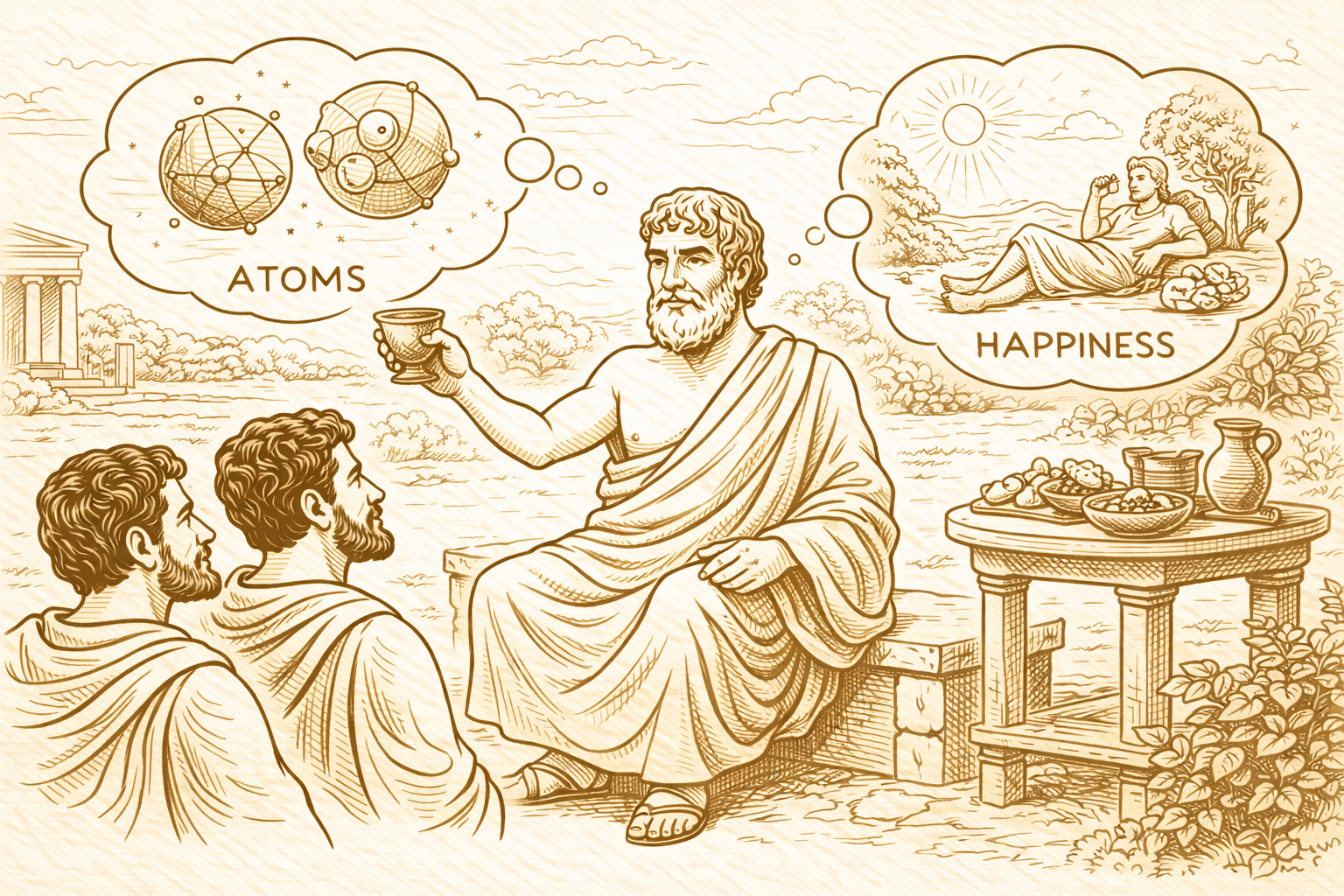
But it was the ethics that changed lives. Epicurus argued that pleasure is the highest good — not the wild pleasures of excess, but the calm, sustained pleasure of a body free from pain and a mind free from anxiety. He called this state ataraxia: undisturbedness, tranquility, the deep contentment that comes from understanding the world and your place in it.
The greatest sources of anxiety, he taught, were fear of the gods and fear of death. His remedy was philosophical understanding. The gods exist but they do not interfere in human affairs — they are blissful beings in the spaces between worlds, indifferent to our prayers and sacrifices. And death is simply the dissolution of the atoms that compose us. Where death is, we are not; where we are, death is not. There is nothing to fear.
The path to happiness was not ambition, wealth, or political power — all of which bring anxiety — but friendship, simplicity, and philosophical conversation. Epicurus bought a garden outside the city walls and established a community unlike anything Athens had seen. Women were admitted. Slaves were admitted. There were no lectures but long conversations over simple meals. The inscription over the gate reportedly read: "Stranger, here you will do well to tarry; here our highest good is pleasure."
He was ill for much of his later life, suffering from kidney stones so severe that he could not stand. Yet he wrote to his friends on his final day that the joy of remembered conversations outweighed the pain. He died in 270 BCE, at seventy-two, having demonstrated in his own person that happiness is not the absence of suffering but the presence of understanding.
Of his roughly three hundred written works, almost nothing survives — only three letters and two collections of sayings. But his philosophy endured through Lucretius, whose poem De Rerum Natura transmitted Epicurean physics and ethics to the Roman world and, eventually, to the Renaissance. Today, when we speak of pleasure as a legitimate human good, when we argue that fear is the enemy of happiness, when we prize friendship and simplicity over ambition and display — we are speaking, whether we know it or not, the language of the garden.
Epicurus, the man who made pleasure the foundation of his philosophy, lived on bread, water, and the occasional half-portion of cheese, and declared himself the happiest man alive.
“Death is nothing to us, since when we are, death has not come, and when death has come, we are not.”
Key Ideas
Pleasure as the highest good
Ataraxia (tranquility)
The swerve of atoms
Death is nothing to us
Key Works
- 01Letter to Menoeceus
- 02Letter to Herodotus
- 03Principal Doctrines
- 04Vatican Sayings
Intellectual Lineage
Did you know
Despite his name giving us epicurean — meaning luxurious — Epicurus actually lived on bread, water, and the occasional bit of cheese. His idea of paradise was a garden where friends talked philosophy. The original low-maintenance lifestyle.