
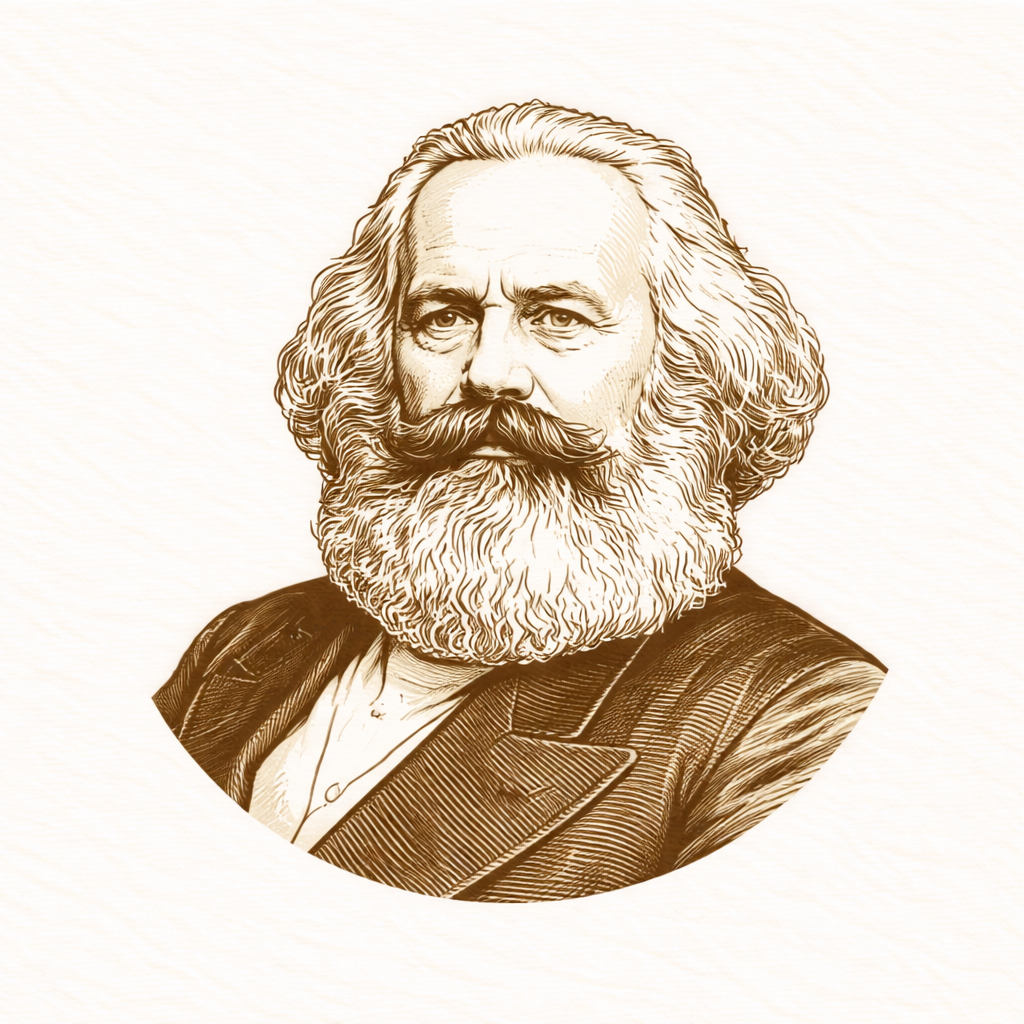
The Exile Who Remade the World
He spent the last thirty-four years of his life in London, mostly in poverty, borrowing money from Friedrich Engels, pawning his wife's silverware, and watching three of his children die from diseases that better living conditions might have prevented. He worked in the Reading Room of the British Museum six days a week, year after year, consuming mountains of economic data, parliamentary reports, and factory inspections, building an analysis of capitalism so vast and so detailed that he never finished it. Das Kapital, his masterwork, was published only in its first volume during his lifetime. The rest was assembled by Engels from Marx's nearly illegible manuscripts after his death.
Karl Marx was born in 1818 in Trier, a small city in the Prussian Rhineland, to a family of Jewish converts to Protestantism. His father was a lawyer; his childhood was comfortable and unremarkable. At university he studied law, then philosophy, fell in with the Young Hegelians, and discovered his vocation: not contemplation but critique. "The philosophers have only interpreted the world, in various ways," he wrote in 1845. "The point is to change it."
From Hegel, Marx took the dialectical method — the idea that history moves through contradictions that generate transformations. But he turned Hegel upside down. Where Hegel saw the driving force of history in Spirit — in ideas, consciousness, and culture — Marx located it in material conditions: the way human beings produce and reproduce their lives. It is not consciousness that determines social being, but social being that determines consciousness. The ideas, laws, religions, and philosophies of any era are not timeless truths but reflections of the economic structure that produces them.
This was historical materialism, and its implications were revolutionary. If the ruling ideas of every epoch are the ideas of the ruling class, then morality, justice, and freedom are not universal principles but ideological weapons — tools the powerful use to justify their power. The history of all hitherto existing society, Marx and Engels declared in the Communist Manifesto of 1848, is the history of class struggles: freeman and slave, lord and serf, bourgeoisie and proletariat.
Marx's analysis of capitalism was both an act of admiration and an indictment. He recognized that capitalism was the most productive and dynamic economic system in human history — it had created more wealth in a century than all previous civilizations combined. But this productivity was achieved through exploitation. The worker sells his labor to the capitalist, who pays him less than the value of what he produces. The difference — surplus value — is the source of profit. The worker is alienated from his labor, from the product of his labor, from his fellow workers, and ultimately from his own humanity. He becomes a tool in a process designed to enrich someone else.
Marx predicted that capitalism's internal contradictions — the tendency of the rate of profit to fall, the concentration of wealth in fewer hands, the recurring crises of overproduction — would eventually produce a revolution. The proletariat, having nothing to lose but their chains, would overthrow the bourgeoisie, seize the means of production, and establish a classless society in which the state would wither away and human beings would finally be free to develop their full capacities.
The revolution came, but not as he predicted — not in the advanced capitalist countries of Western Europe but in backward, agricultural Russia, and later in China, Cuba, and Vietnam, where it produced not classless utopias but authoritarian regimes that invoked his name while violating virtually every value he held. The question of whether these outcomes were inherent in Marx's thought or betrayals of it has been debated for over a century and shows no sign of resolution.
He died in London on March 14, 1883, stateless and largely unknown to the broader public. Eleven people attended his funeral. Engels delivered the eulogy: "His name will endure through the ages, and so also will his work."
Engels was right, though not in the way he imagined. Marx's influence on the twentieth century was as vast as any single individual's — for good and for catastrophic ill. But stripped of its utopian predictions and its association with totalitarian regimes, what remains in Marx's thought is something indispensable: the insistence that economic structures shape human life more profoundly than most people recognize, that ideas are never innocent of the interests they serve, and that the suffering of the many for the profit of the few is not a natural law but a human arrangement — and what humans have arranged, humans can change.
He worked in the British Museum six days a week, year after year, building an analysis of capitalism so vast he never finished it.
“The philosophers have only interpreted the world, in various ways; the point is to change it.”
Key Ideas
Historical materialism
Class struggle
Alienation of labor
Base and superstructure
Key Works
- 01Das Kapital
- 02The Communist Manifesto
- 03Economic and Philosophic Manuscripts of 1844
- 04The German Ideology
Intellectual Lineage
Influenced by
Karl
He influenced
Did you know
Karl Marx was perpetually broke and covered in boils. He wrote Das Kapital while living off loans from his friend Engels, who ran a factory — making Marx's anti-capitalism literally funded by capitalism.