
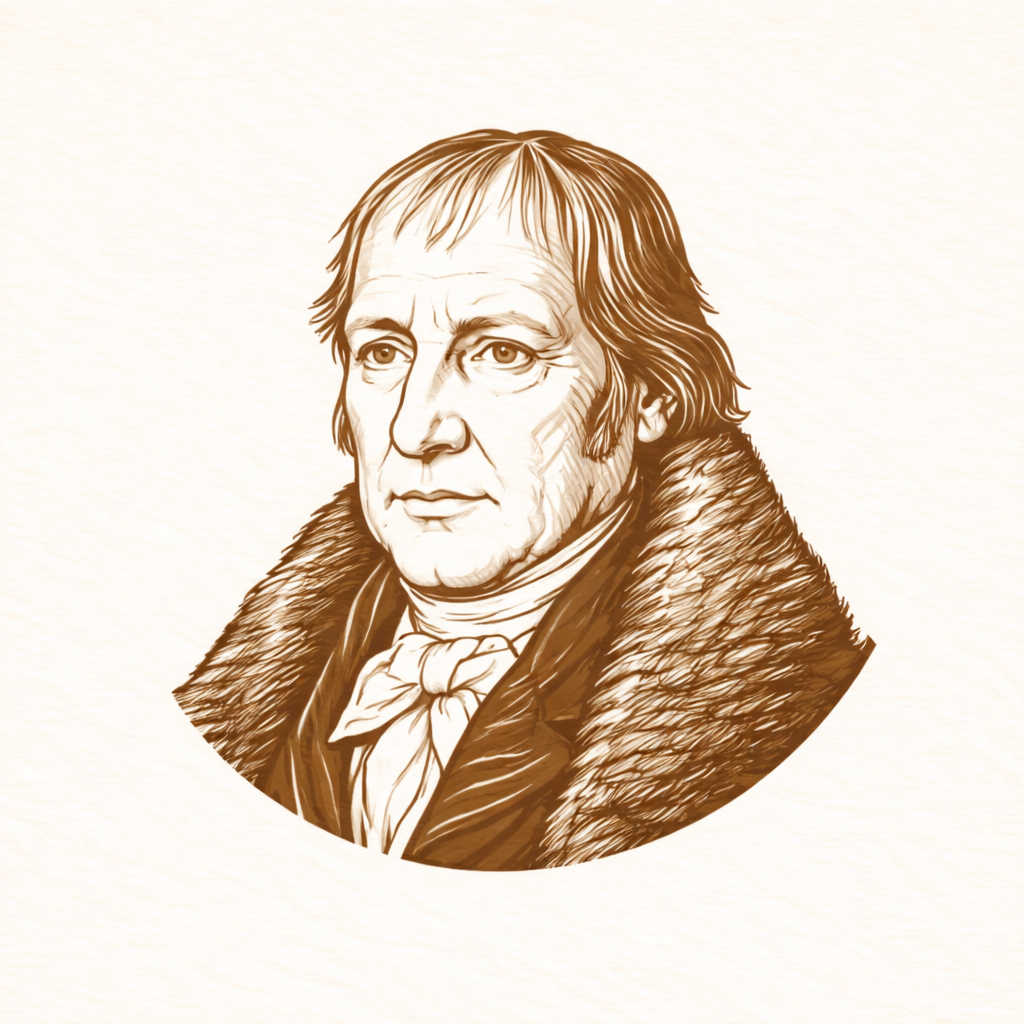
The Philosopher of Becoming
No philosopher has been more admired and more mocked, more influential and more misunderstood, more studied and more unread than Georg Wilhelm Friedrich Hegel. His prose is legendary for its difficulty — dense, spiraling, clause within clause, building to conclusions that seem to dissolve just as you grasp them. Marx worked through him. Kierkegaard rebelled against him. Entire philosophical traditions — existentialism, Marxism, pragmatism — were born either from his ideas or from the violent rejection of them. And yet, ask most people what Hegel actually said, and you will get a blank stare or, at best, the words "thesis, antithesis, synthesis" — a formula he never actually used.
He was born in Stuttgart in 1770, the son of a civil servant, and grew up in the shadow of two revolutions: the French Revolution, which he greeted with wild enthusiasm as a young man (he reportedly planted a liberty tree with his friends Schelling and Holderlin), and Kant's revolution in philosophy, which he both absorbed and sought to transcend.
Hegel's central insight was that reality is not static but dynamic — not a thing but a process. Everything that exists is in a state of becoming, driven by internal contradictions that push it toward ever more complex and comprehensive forms. The acorn contains the contradiction that drives it to become the oak. A political system contains the contradictions — inequality, injustice, unfreedom — that drive it toward revolution and transformation. Even our concepts develop dialectically: every idea, pushed to its logical extreme, generates its opposite, and the tension between them is resolved in a higher synthesis that preserves what was true in both.
This dialectical movement is not just a feature of thought; it is the structure of reality itself. For Hegel, the universe is not dead matter organized by external laws but a living, self-developing process of Geist — Spirit or Mind — coming to know itself through the unfolding of history, nature, art, religion, and philosophy. History is not one damn thing after another; it is the progressive realization of freedom, as Spirit works through the contradictions of each epoch to achieve higher forms of self-consciousness.
The Phenomenology of Spirit (1807), his first masterwork, traces this journey of consciousness from the most basic sensory experience to absolute knowledge. Its most famous passage — the dialectic of master and slave — shows how the relationship of domination contains within itself the seeds of its own reversal. The master depends on the slave for recognition and becomes passive; the slave, through labor and the fear of death, develops self-consciousness and ultimately achieves a deeper freedom than the master ever possessed. Marx would later transform this insight into the engine of his theory of history.
Hegel became the most famous philosopher in Germany, holding the chair in philosophy at the University of Berlin from 1818 until his death. His lectures — on history, aesthetics, religion, and the history of philosophy — drew students from across Europe and shaped the intellectual culture of the age.
But his system contained its own contradictions. Kierkegaard attacked it as an abstraction that ignored the concrete, anguished reality of individual existence. Marx turned it upside down, replacing Spirit with material economic forces. Nietzsche dismissed it as a theology in disguise. The analytic philosophers of the twentieth century regarded it as the paradigm of everything philosophy should not be: obscure, grandiose, and untestable.
He died in 1831, probably of cholera, at sixty-one. His last words are disputed — one version has him saying "Only one man understood me, and even he did not understand me." Whether or not he said it, the sentiment captures something true. Hegel's philosophy is a labyrinth: it rewards those who enter it with a vision of reality as dynamic, interconnected, and meaningful, but it demands a commitment of attention that few readers in any century have been willing to give.
What endures is the dialectical vision itself — the idea that contradiction is not a sign of error but the engine of progress, that reality develops through conflict and resolution, that freedom is not a given but an achievement of history. Every time we speak of the "arc of history," of progress through struggle, of ideas that contain the seeds of their own transformation — we are speaking Hegel's language, whether we know it or not.
No philosopher has been more admired and more mocked, more influential and more misunderstood, more studied and more unread.
“The owl of Minerva spreads its wings only with the falling of the dusk.”
Key Ideas
Dialectics (thesis-antithesis-synthesis)
The Absolute Spirit
Master-slave dialectic
History as the progress of freedom
Key Works
- 01Phenomenology of Spirit
- 02Science of Logic
- 03Philosophy of Right
- 04Lectures on the Philosophy of History
Intellectual Lineage
Influenced by
Georg
He influenced
Did you know
Hegel submitted his masterwork, the Phenomenology of Spirit, to his publisher while Napoleon's cannons were literally firing outside his window at the Battle of Jena. He called Napoleon the world-soul on horseback.