
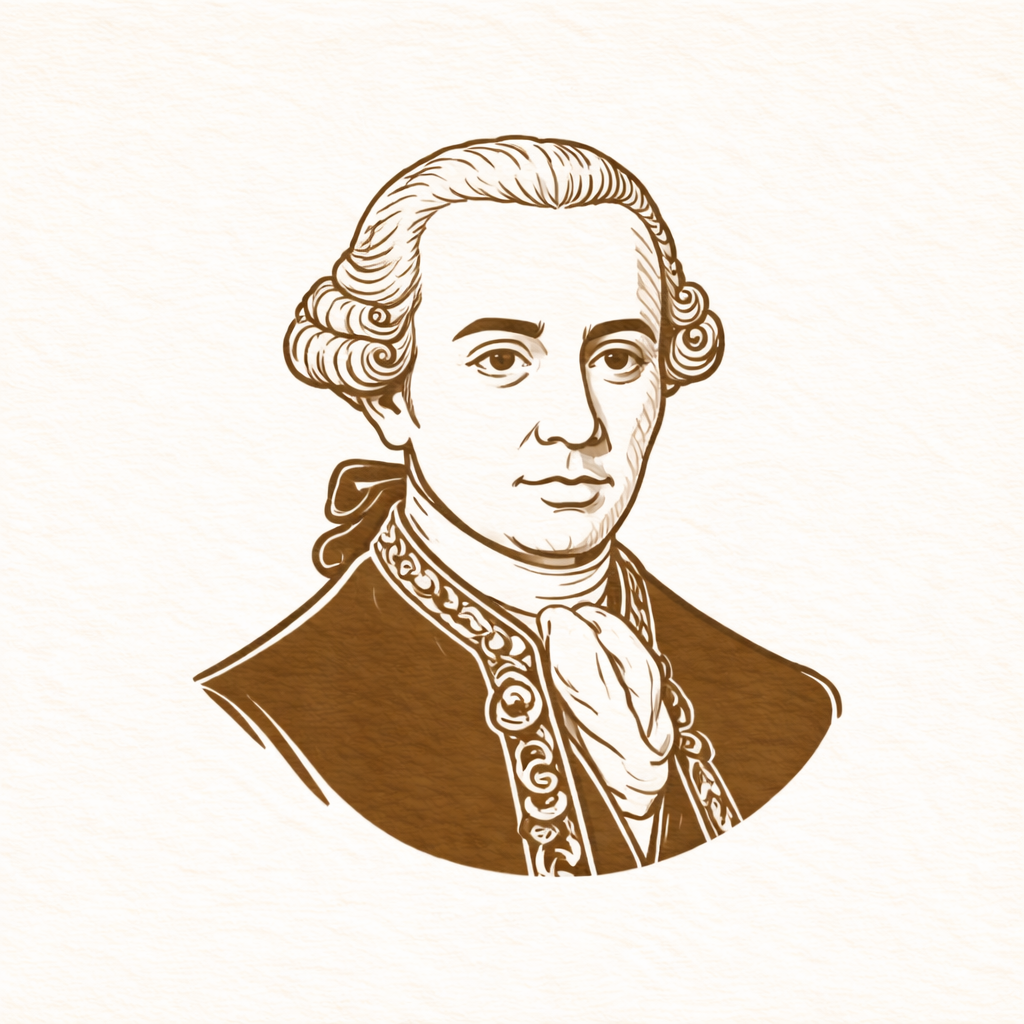
The Man Who Never Left Konigsberg
He never traveled more than fifty miles from the city where he was born. He never married. He walked the same route through Konigsberg at such precisely the same time each day that his neighbors reportedly set their clocks by him. He was thin, short, slightly deformed in the chest, and so regular in his habits that his servant's only duty of note was to wake him at exactly five o'clock each morning. Immanuel Kant lived the most uneventful life in the history of philosophy, and from that unvarying routine produced the most revolutionary philosophical system since Plato.
He was born in 1724 in Konigsberg, East Prussia (now Kaliningrad, Russia), the fourth of nine children in a family of modest means. His parents were Pietists — devout, austere, morally serious — and their influence never left him. He studied at the University of Konigsberg, worked for years as a private tutor, and finally secured a professorship in 1770, at the age of forty-six. By then he was a respected but unremarkable academic, known for his lectures on geography and his pre-critical writings on cosmology.
Then Hume woke him up. Kant later wrote that reading Hume had interrupted his "dogmatic slumber" — the comfortable assumption that pure reason could deliver knowledge of the world. Hume had shown that our most basic concepts, like causation, cannot be derived from experience alone. Most philosophers responded by either attacking Hume or ignoring him. Kant did something far more radical: he agreed with Hume's diagnosis and proposed a cure that transformed the nature of philosophy itself.
The Critique of Pure Reason, published in 1781 after a decade of preparation, is arguably the most difficult and most important philosophical work ever written. Its central question is: How is knowledge possible? Kant's answer was his "Copernican revolution" — just as Copernicus had explained the apparent motion of the stars by recognizing that the observer is moving, Kant explained the structure of experience by recognizing that the mind actively shapes what it receives.
We do not passively absorb a world of raw data. The mind imposes its own structure on experience: space and time are not features of things in themselves but the forms through which the mind organizes sensation. The categories of understanding — causation, substance, unity — are not discovered in the world but brought to it by the mind as conditions for the possibility of experience. We can know the world as it appears to us (phenomena), but we can never know it as it is in itself (noumena).
This was not skepticism — it was the opposite. Kant was saving science from Hume's skepticism by showing that the laws of nature are necessary because they originate in the structure of the mind itself. Causation is not a habit of expectation; it is a precondition for having experience at all. But the price was steep: the world as it is in itself — the thing beyond all experience — is forever beyond our reach.
In ethics, Kant was equally revolutionary. He sought a moral law that was absolute, universal, and independent of all contingency — a law that would bind every rational being regardless of their desires, culture, or circumstances. He found it in the Categorical Imperative: "Act only according to that maxim whereby you can at the same time will that it should become a universal law." Morality, for Kant, is not about consequences or feelings but about the rational consistency of your principles. If you cannot universalize your action without contradiction, it is wrong.
The second formulation was even more powerful: "Treat humanity, whether in your own person or in the person of another, always at the same time as an end, and never merely as a means." Human beings are not tools for someone else's purposes; they are ends in themselves, possessed of a dignity that no price can measure. This idea — that every person has inherent, inviolable worth simply by virtue of being rational — became the philosophical foundation of human rights.
He wrote two more critiques — one on morality and the nature of freedom, one on aesthetics and the purposiveness of nature — and dozens of other works, each a monument of systematic thought. His influence on philosophy was so total that the entire subsequent tradition can be divided into those who accepted his framework and tried to extend it, and those who rejected it and tried to escape it. Almost no one has succeeded in ignoring it.
He died on February 12, 1804, in Konigsberg, the city he never left. His last words were reportedly "Es ist gut" — "It is good." The man who never traveled had mapped the furthest reaches of the human mind, and in his unchanging routine had enacted his own philosophy: that freedom is not the ability to do what you want, but the capacity to act according to laws you give yourself. The starry heavens above him and the moral law within him — those were enough.
He never traveled more than fifty miles from the city where he was born, and from that unvarying routine produced the most revolutionary philosophical system since Plato.
“Two things fill the mind with ever new and increasing admiration and awe — the starry heavens above me and the moral law within me.”
Key Ideas
The Categorical Imperative
Synthetic a priori knowledge
The Copernican revolution in philosophy
Phenomena vs. noumena
Key Works
- 01Critique of Pure Reason
- 02Critique of Practical Reason
- 03Groundwork of the Metaphysics of Morals
- 04Critique of Judgment
Intellectual Lineage
Influenced by
Immanuel
Did you know
Immanuel Kant never traveled more than ten miles from his hometown of Königsberg in his entire life. His daily walk was so precisely timed that neighbors set their clocks by him. The only time he was late was when he was reading Rousseau.