
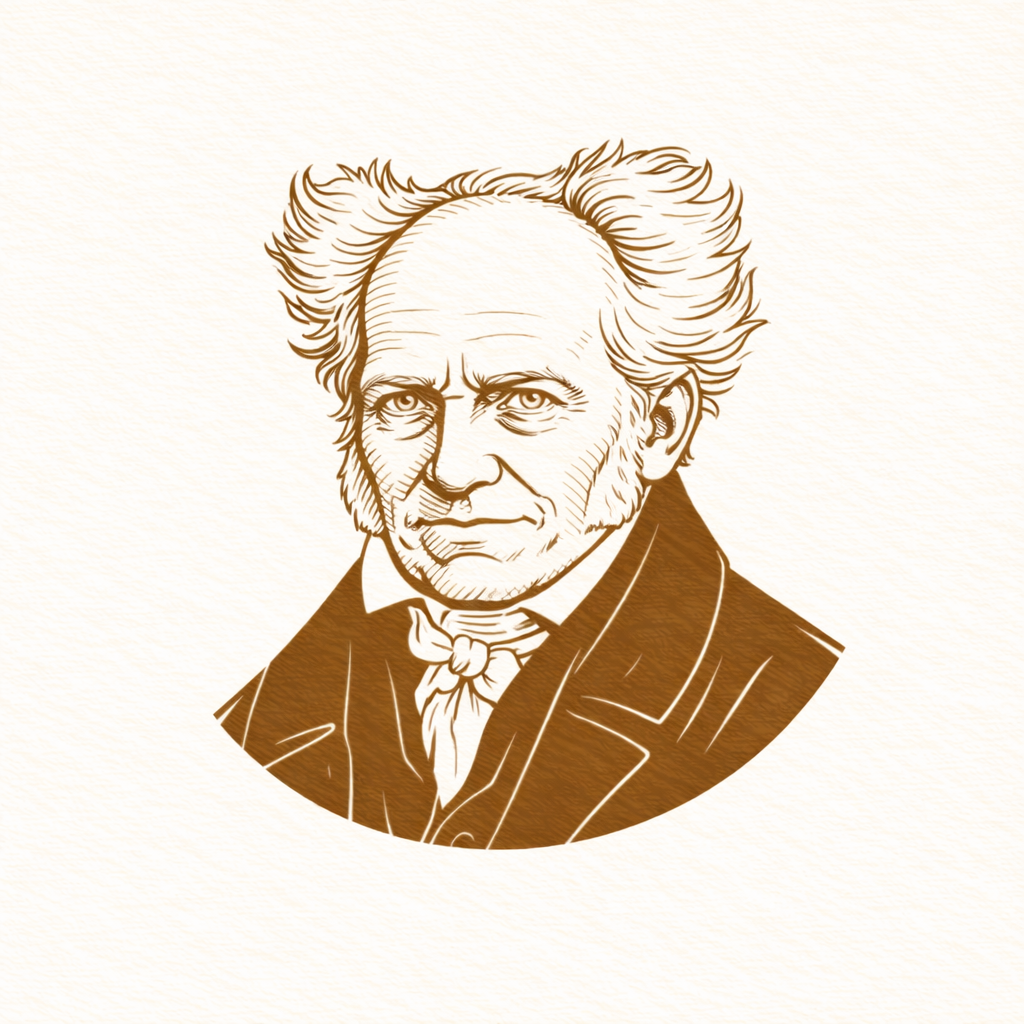
The Philosopher Who Told the Truth Nobody Wanted to Hear
He was magnificently unpleasant. He threw a seamstress down a flight of stairs and was forced to pay her a pension for the rest of her life. He despised women, other philosophers (especially Hegel, whom he called "a flat-headed, insipid, nauseating, illiterate charlatan"), and most of humanity. He kept a succession of poodles, each named Atma (Sanskrit for "world soul"), because he found dogs more trustworthy than people. He lived alone in Frankfurt for the last twenty-seven years of his life, eating lunch daily at the Englischer Hof and tipping the waiter a gold coin that he placed on the table at the start of the meal and pocketed at the end if no one at the neighboring tables said anything stupid.
And yet Arthur Schopenhauer, for all his misanthropy, wrote with a clarity and honesty that make him one of the most readable philosophers in the Western tradition, and his central insight — that beneath the orderly surface of reason and civilization, a blind, irrational, insatiable force drives everything that exists — was among the most important philosophical ideas of the nineteenth century.
He was born in Danzig (now Gdansk) in 1788, the son of a wealthy merchant and a mother who was a successful novelist and salon hostess. His father, who may have suffered from depression, drowned — possibly a suicide — when Schopenhauer was seventeen. His relationship with his mother was toxic; she once pushed him down a staircase. "Your company is burdensome to me," she told him. He never saw her again after the age of thirty.
He discovered Kant as a student and was electrified. Kant had argued that the world as it appears to us — the phenomenal world — is shaped by the mind's categories, and that the world as it is in itself — the noumenal world — is forever unknowable. Schopenhauer accepted the first claim but rejected the second. He believed he had identified the thing-in-itself, the reality behind appearances: it was the Will.
Not willpower, not intention, not conscious desire — the Will is a blind, purposeless, ceaseless striving that underlies all of nature. It is the force that drives the plant toward the light, the animal toward food, the human toward desire after desire in an endless cycle of wanting, briefly having, and wanting again. We experience it most directly in our own bodies — in hunger, lust, fear, ambition — but it pervades everything. The entire natural world is the Will made visible.
From this metaphysics, Schopenhauer drew the darkest conclusion in the history of philosophy: life is essentially suffering. The Will ensures that we are always wanting, and wanting is painful. When we get what we want, satisfaction is fleeting, and we are immediately driven toward the next desire. The only alternative to desire is boredom — the torment of having nothing to want. "Life swings like a pendulum backward and forward between pain and boredom." Human history, with its wars, cruelties, and catastrophes, is not an aberration but the natural expression of an irrational force that has no purpose, no plan, and no end.
But Schopenhauer was not merely a pessimist. He offered three paths of escape from the tyranny of the Will. The first was aesthetic contemplation: in the presence of great art — especially music, which he considered the most direct expression of the Will itself — we can momentarily step outside the cycle of desire and see the world as pure representation, without wanting anything from it. The second was compassion: recognizing that all beings suffer, and that the boundaries between self and other are illusions of the Will, leads to a moral life grounded not in duty or reason but in shared suffering. The third was asceticism: the deliberate renunciation of desire, as practiced by the saints and mystics of all traditions, which alone can achieve a permanent quieting of the Will.
His masterwork, The World as Will and Representation, was published in 1818, when he was thirty. It was ignored for decades — partly because Hegel dominated German philosophy, partly because the reading public was not ready for a philosophy this bleak. Schopenhauer deliberately scheduled his lectures at Berlin to compete with Hegel's; his classroom was empty while Hegel's overflowed. He never forgave the slight.
Fame came late, in the 1850s, when a collection of essays — Parerga and Paralipomena — reached a popular audience. By then, Schopenhauer was an old man, gratified but not surprised. He had always known he was right.
He died in 1860, at seventy-two, sitting on his sofa after breakfast. His influence was enormous: Nietzsche began as a Schopenhauerian and never fully escaped; Wagner composed Tristan und Isolde under his spell; Freud's theory of unconscious drives is Schopenhauer in clinical dress; Tolstoy, Proust, and Beckett all wrote in his shadow. But his deepest legacy is a question that Western philosophy had spent two thousand years avoiding: What if the world is not rational, not good, not progressing toward anything — and the honest response is not despair but clear-eyed compassion for everything that suffers?
He kept a succession of poodles, each named 'world soul,' because he found dogs more trustworthy than people.
“Life swings like a pendulum backward and forward between pain and boredom.”
Key Ideas
The Will as the thing-in-itself
Life as suffering
Aesthetic contemplation as escape
Compassion as the basis of ethics
Key Works
- 01The World as Will and Representation
- 02On the Basis of Morality
- 03Parerga and Paralipomena
- 04The Art of Being Right
Intellectual Lineage
Influenced by
Arthur
He influenced
Did you know
Schopenhauer was so grumpy that he once pushed a woman down the stairs for being too loud outside his apartment — then had to pay her a pension for the rest of her life. He also talked to his poodle more than to most people.