
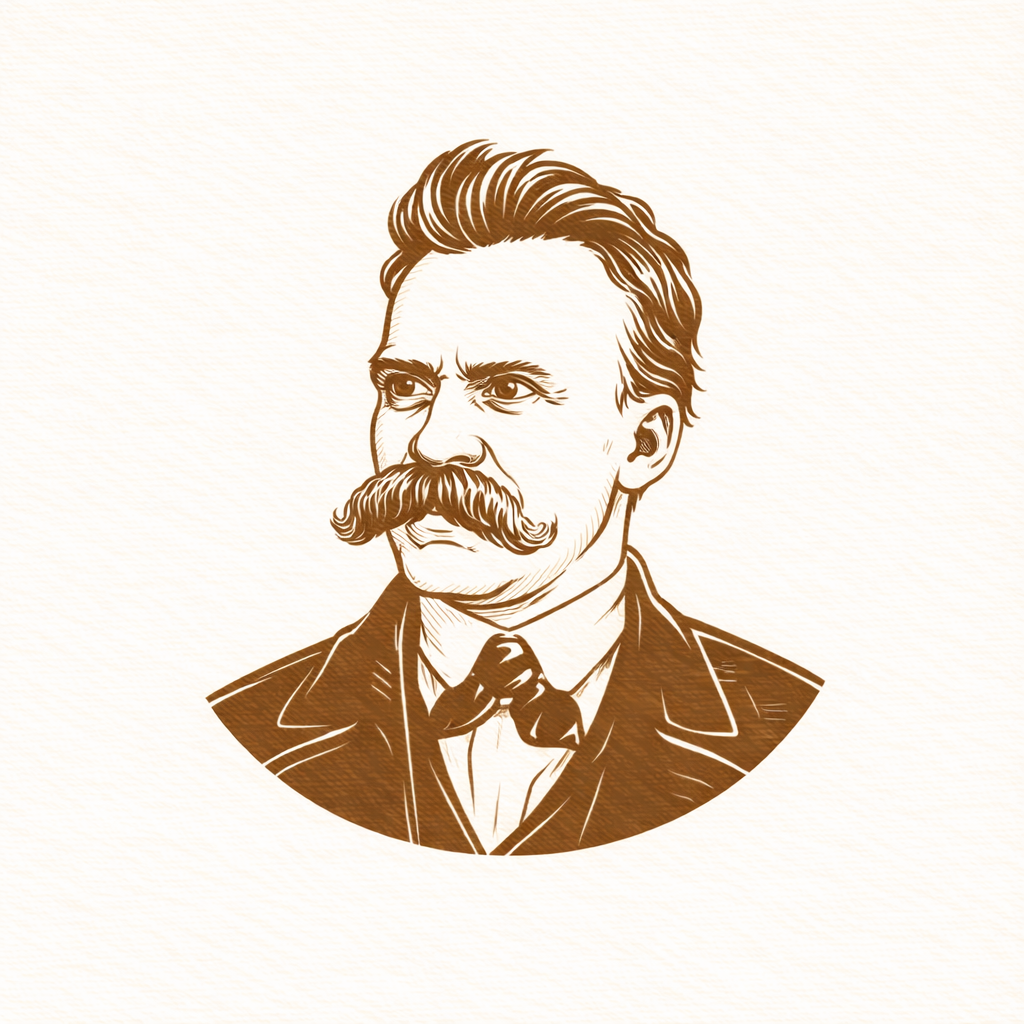
The Prophet of a Godless Age
He was a pastor's son who declared God dead. A classical philologist who destroyed his academic career with his first book. A man of extraordinary physical frailty who preached the philosophy of strength. A solitary wanderer through Swiss and Italian boarding houses who imagined himself the teacher of all mankind. Friedrich Nietzsche is the philosopher of contradictions, and the greatest of those contradictions is this: the man who diagnosed the nihilism of modern civilization more accurately than anyone else ended his life in a state of complete mental collapse, spending his last eleven years in silent madness while his sister edited his unpublished writings into a grotesque caricature that would be appropriated by the Nazis.
He was born in 1844 in Rocken, a small Saxon village, the son and grandson of Lutheran pastors. His father died of a brain disease when Nietzsche was four — a fact that haunted him as his own mental health deteriorated. He was a brilliant student, appointed to a full professorship of classical philology at the University of Basel at the extraordinary age of twenty-four, before he had even completed his doctorate.
His first book, The Birth of Tragedy (1872), combined classical scholarship with the philosophy of Schopenhauer and the music of Wagner to argue that Greek tragedy was born from the tension between two fundamental forces: the Apollonian (order, form, individuation) and the Dionysian (chaos, ecstasy, dissolution of the self). The academic establishment was horrified. His career in philology was effectively over.
What followed was a decade of chronic illness — migraines so severe they left him vomiting for days, near-blindness, digestive torment — during which he resigned his professorship, abandoned academic life, and wandered from boarding house to boarding house in Switzerland, Italy, and the French Riviera, writing the books that would remake modern thought. He had almost no readers, almost no money, and almost no human companionship. He wrote in isolation, for a future he believed in but could not see.
The central event of Nietzsche's philosophy is the death of God — not as a theological argument but as a cultural diagnosis. In The Gay Science (1882), a madman runs through the marketplace with a lantern, crying "God is dead! God remains dead! And we have killed him!" This is not a celebration; it is a catastrophe. For two thousand years, Western civilization had grounded its values — its morality, its meaning, its sense of cosmic order — in the Christian God. With the collapse of that foundation, everything built upon it threatens to collapse as well. If God is dead, then there is no objective basis for morality, no transcendent meaning to life, no cosmic justice. Nihilism — the conviction that nothing matters — looms as the greatest danger of the modern age.
Nietzsche's response to nihilism was not to retreat into comfortable illusions but to push through it. The Ubermensch — the Overman — is the human being who creates their own values, who says yes to life in all its suffering and absurdity, who lives with such intensity and authenticity that they could will the eternal recurrence of their life, moment by moment, exactly as it was, without changing a thing. This is the ultimate test: not whether your life has been pleasant, but whether you could bear to live it again, forever.
His analysis of morality was equally radical. In The Genealogy of Morals, he argued that what we call "good" and "evil" are not timeless truths but historical inventions. The original moral distinction was between "good" (noble, powerful, life-affirming) and "bad" (common, weak, base). But the slaves — the oppressed, the resentful — engineered a "transvaluation of values," redefining the powerful as "evil" and the weak as "good." Christianity, for Nietzsche, was the supreme expression of this slave morality: a religion that sanctified suffering, self-denial, and meekness while condemning strength, pride, and the joy of living.
In January 1889, in Turin, Nietzsche collapsed on the street, reportedly after seeing a horse being beaten. He never recovered. The last eleven years of his life were spent in a state of progressive mental deterioration, cared for first by his mother and then by his sister Elisabeth, who was a virulent anti-Semite and German nationalist — everything Nietzsche despised. She took control of his literary estate, edited his unpublished notes into a book called The Will to Power, and shaped his public image to align with the very ideologies he had rejected.
He died on August 25, 1900. The twentieth century would vindicate his diagnosis — the death of God, the crisis of values, the threat of nihilism — with a precision that is almost unbearable. But it also vindicated his hope: that human beings, deprived of cosmic guarantees, might yet find the courage to create meaning for themselves. Every artist, rebel, or thinker who refuses to accept inherited values and insists on asking "Why?" is walking a path that Nietzsche cleared, alone, in pain, in the cheap rooms of a dozen Italian pension.
A pastor's son who declared God dead. A man of extraordinary frailty who preached the philosophy of strength.
“He who has a why to live can bear almost any how.”
Key Ideas
God is dead
Will to power
Eternal recurrence
Ubermensch (Overman)
Key Works
- 01Thus Spoke Zarathustra
- 02Beyond Good and Evil
- 03The Genealogy of Morals
- 04The Gay Science
Intellectual Lineage
Influenced by
Friedrich
He influenced
Did you know
Nietzsche once collapsed in a street in Turin, sobbing and throwing his arms around a horse that was being beaten. He never recovered his sanity. The man who declared God is dead spent his last eleven years in quiet madness, cared for by his sister.