
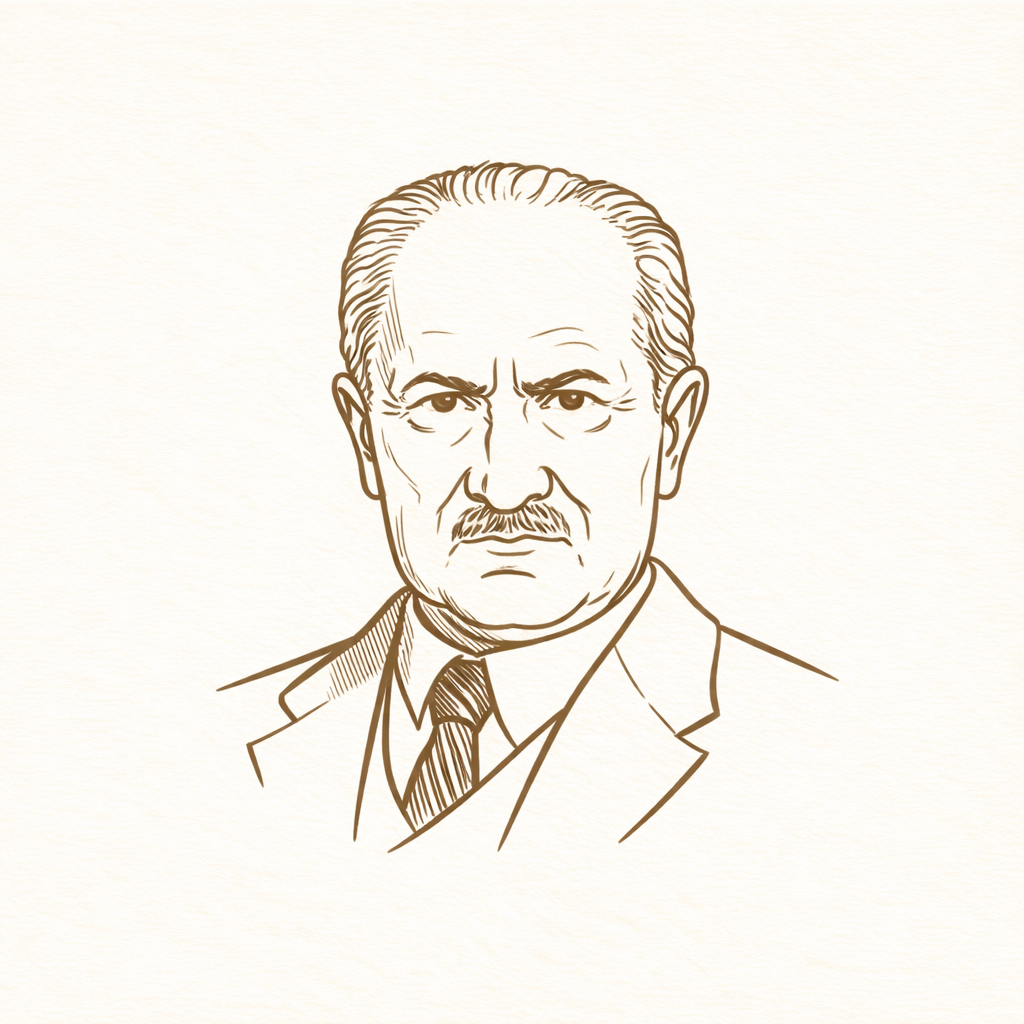
The Dark Genius of Being
No philosopher of the twentieth century was more brilliant, more original, or more morally compromised than Martin Heidegger. His masterwork, Being and Time (1927), is widely regarded as one of the most important philosophical texts of the modern era — a radical rethinking of what it means to exist, to understand, to be in the world. And its author, in 1933, joined the Nazi Party, served as rector of the University of Freiburg, and never adequately explained or apologized for his complicity. The tension between the work and the life has never been resolved, and perhaps cannot be.
He was born in 1889 in Messkirch, a small town in rural Swabia, the son of a sexton in the Catholic church. He studied theology, then philosophy, and fell under the influence of Edmund Husserl, whose phenomenological method he would both adopt and transform beyond recognition. When Being and Time was published, dedicated to Husserl, Heidegger was thirty-eight years old and already recognized as the most powerful philosophical mind of his generation.
The book begins with a question that Heidegger claimed philosophy had forgotten for two thousand years: What is Being? Not what are beings — the specific things that exist — but what does it mean for anything to exist at all? The question sounds abstract, but Heidegger insisted it was the most concrete question of all, because the being that asks it is us. We are the beings for whom our own existence is an issue.
He called this being Dasein — literally "being-there" — and his analysis of Dasein's existence is one of the most penetrating descriptions of human life ever written. Dasein is not a detached mind observing the world from outside; it is always already "thrown" into a world, engaged with tools, entangled with other people, shaped by a past it did not choose and directed toward a future it cannot control. We do not first exist and then encounter the world; we are our engagement with the world.
Most of the time, Heidegger argued, we live inauthentically — absorbed in "Das Man" (the They), doing what one does, thinking what one thinks, following the crowd without ever confronting the fundamental question of our own existence. We chatter, we busy ourselves, we flee from the one certainty that could wake us up: death. Not death as an abstract concept but death as my ownmost possibility — the possibility that is uniquely mine, that no one else can die for me, and that reveals the radical finitude of my existence.
Being-toward-death is not morbidity; it is the condition of authenticity. Only by confronting the fact that I will die — that my time is limited and non-negotiable — can I take ownership of my life. Anxiety (Angst), like Kierkegaard before him, is not a disorder but a mood that discloses the truth of our situation: that we are finite beings in a world that offers no guarantees.
After Being and Time, Heidegger's thought underwent what he called a "turn" (Kehre). He moved away from the analysis of human existence toward the question of Being itself, and increasingly toward a critique of modern technology. In The Question Concerning Technology, he argued that technology is not merely a set of tools but a way of revealing the world — a "framework" (Gestell) that reduces everything to a standing reserve of resources to be optimized and exploited. Nature becomes raw material; human beings become human resources; even thought itself becomes information processing. This technological enframing, Heidegger warned, is the greatest danger of the modern age — not because technology is bad, but because it conceals other, more primordial ways of being in the world.
The Nazi episode casts a long shadow. Heidegger joined the Party in May 1933 and served as rector for one year, during which he implemented Nazi policies at the university, reportedly denounced colleagues, and delivered speeches that invoked the "inner truth and greatness" of the National Socialist movement. After the war, he was banned from teaching for five years and never publicly reckoned with what he had done. His recently published Black Notebooks contain passages of unmistakable antisemitism.
He died in 1976, at eighty-six. The question of how to relate to his philosophy — whether the thought can be separated from the thinker, whether the ideas themselves are contaminated by the politics — remains one of the most contested questions in contemporary philosophy. What is not in question is the power of the ideas themselves. Every time we speak of authenticity, of being-in-the-world, of the way technology shapes our relationship to reality, of the difference between existing and merely being present — we are speaking a language that Heidegger, for better and for worse, was the first to articulate with full philosophical force.
No philosopher of the twentieth century was more brilliant, more original, or more morally compromised.
“The most thought-provoking thing in our thought-provoking time is that we are still not thinking.”
Key Ideas
Being-in-the-world (Dasein)
Being-toward-death
The question of Being
Authenticity vs. Das Man
Key Works
- 01Being and Time
- 02What Is Metaphysics?
- 03The Question Concerning Technology
- 04Letter on Humanism
Intellectual Lineage
Influenced by
Martin
He influenced
Did you know
Heidegger lived in a tiny wooden hut in the Black Forest where he did his best thinking. He chopped his own firewood, drew water from a well, and believed technology was destroying humanity — while his books were, of course, printed on machines.