
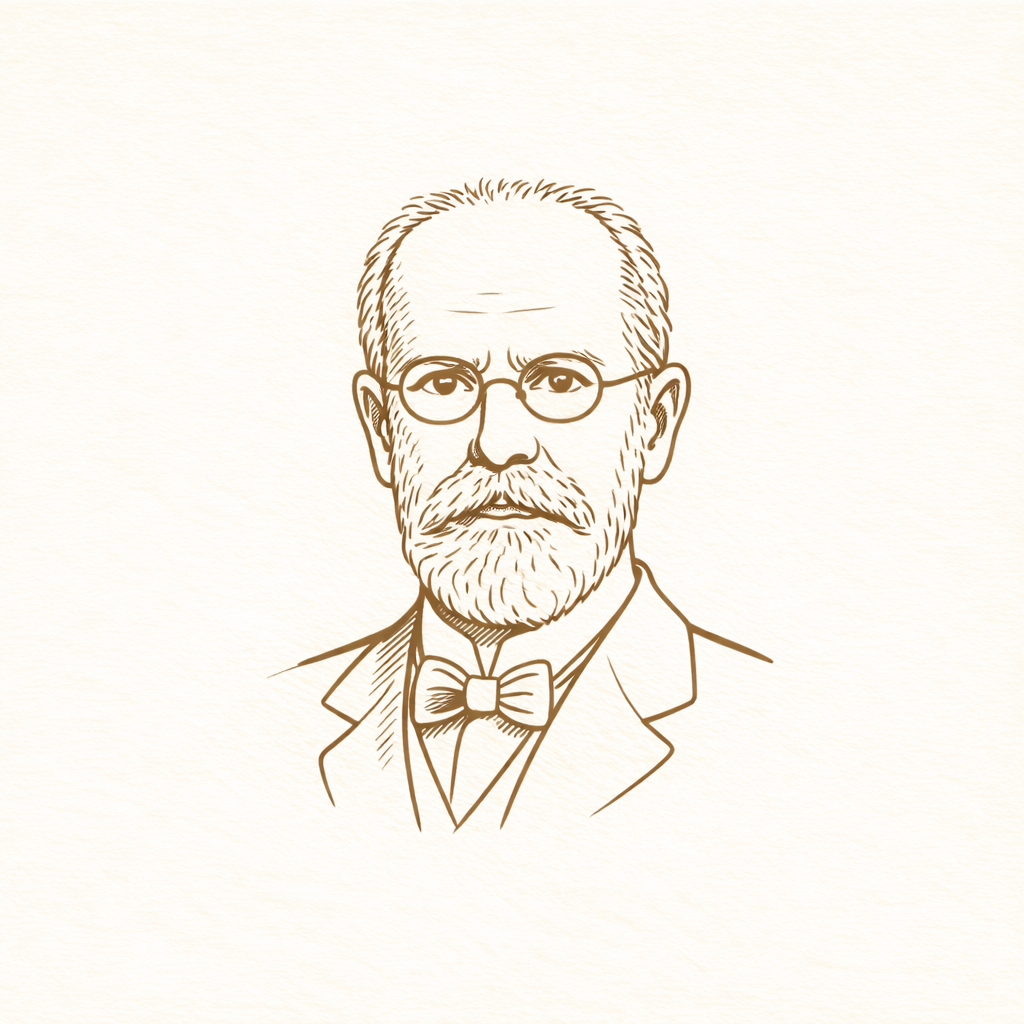
The Mathematician Who Discovered Consciousness
He began as a mathematician, studying under Karl Weierstrass in Berlin, and might have remained one had a crisis of vocation not sent him to the lectures of Franz Brentano in Vienna. There, Edmund Husserl encountered an idea that would consume the rest of his life: intentionality — the insight that consciousness is always consciousness of something. Every act of thinking, perceiving, imagining, or remembering is directed toward an object. There is no empty awareness; the mind is always reaching out.
This seemingly modest observation became the foundation of phenomenology — the philosophical movement that would shape Continental philosophy for the entire twentieth century. Husserl, born in 1859 in Prossnitz, Moravia (now in the Czech Republic), transformed it from an observation into a rigorous method for investigating the structures of experience itself.
His ambition was enormous: to establish philosophy as a "rigorous science" — not by imitating the natural sciences but by returning to the most fundamental level of inquiry, the level of lived experience before it is organized by scientific theories, cultural assumptions, or common sense. "Back to the things themselves!" was his battle cry — not to physical objects, but to phenomena as they appear to consciousness.
The method was the phenomenological reduction (or epoche): a disciplined suspension of all assumptions about whether the objects of experience actually exist independently of our awareness. You bracket the question of reality and instead describe, with painstaking precision, the structures of experience as they are given. How does a melody appear in consciousness? Not all at once — each note passes, is retained in memory, while the next is anticipated. The experience of time, Husserl showed, involves a constant interplay of retention, primal impression, and protention. The present is never a bare instant; it is thick with the just-past and the about-to-come.
Husserl worked obsessively, filling over 40,000 pages of shorthand manuscripts. He was not a natural writer — his prose is painstaking, repetitive, and often opaque — but his analyses were revelatory. He showed that perception is never passive reception but active constitution: we do not simply receive sensory data and then interpret it; consciousness actively organizes, structures, and gives meaning to what it encounters. A house is not a collection of visual impressions; it is an object with unseen sides that we co-intend, an object embedded in a horizon of possibilities.
His later work took a turn that surprised even his followers. In The Crisis of European Sciences, written in the last years of his life as the Nazi regime stripped him of his rights as a person of Jewish origin, Husserl argued that the European intellectual tradition was in crisis. The natural sciences, by abstracting from lived experience and replacing it with mathematical formulas, had lost touch with the Lebenswelt — the lifeworld, the pre-theoretical world of everyday experience in which all science is ultimately grounded. Science had forgotten its own origins and was now unable to address the questions that matter most to human beings: questions of meaning, value, and purpose.
This was not anti-science; it was a call to remember what science exists for. The same rigor that builds telescopes and accelerators must also be directed at the human experience that gives science its significance. Without this grounding, technology advances while wisdom retreats.
Husserl was stripped of his university privileges in 1936 under the Nuremberg Laws. His former student Martin Heidegger, by then rector of the University of Freiburg and a member of the Nazi Party, reportedly did nothing to help. Husserl died in 1938, his manuscripts smuggled out of Germany by a Franciscan friar and eventually deposited in Leuven, Belgium, where they remain — 40,000 pages of the most sustained attempt to understand consciousness from the inside that any philosopher has ever undertaken.
His influence is incalculable. Heidegger took phenomenology and redirected it toward the question of Being. Sartre used it to build existentialism. Merleau-Ponty applied it to the body. Derrida deconstructed it. Levinas turned it toward ethics. But behind all of them stands Husserl's original insight: that the first task of philosophy is not to explain the world but to describe how the world shows up for us — carefully, patiently, without presuppositions, with nothing but the steady gaze of a consciousness that refuses to look away.
He filled over 40,000 pages of shorthand manuscripts — the most sustained attempt to understand consciousness from the inside ever undertaken.
“To the things themselves!”
Key Ideas
Phenomenological reduction
Intentionality of consciousness
Lifeworld (Lebenswelt)
Back to the things themselves
Key Works
- 01Logical Investigations
- 02Ideas Pertaining to a Pure Phenomenology
- 03Cartesian Meditations
- 04The Crisis of European Sciences
Intellectual Lineage
Influenced by
Edmund
He influenced
Did you know
Edmund Husserl produced over 40,000 pages of shorthand manuscripts — so many that a special archive was created just to decode them. His motto to the things themselves was ironically buried under the most things any philosopher ever wrote.