
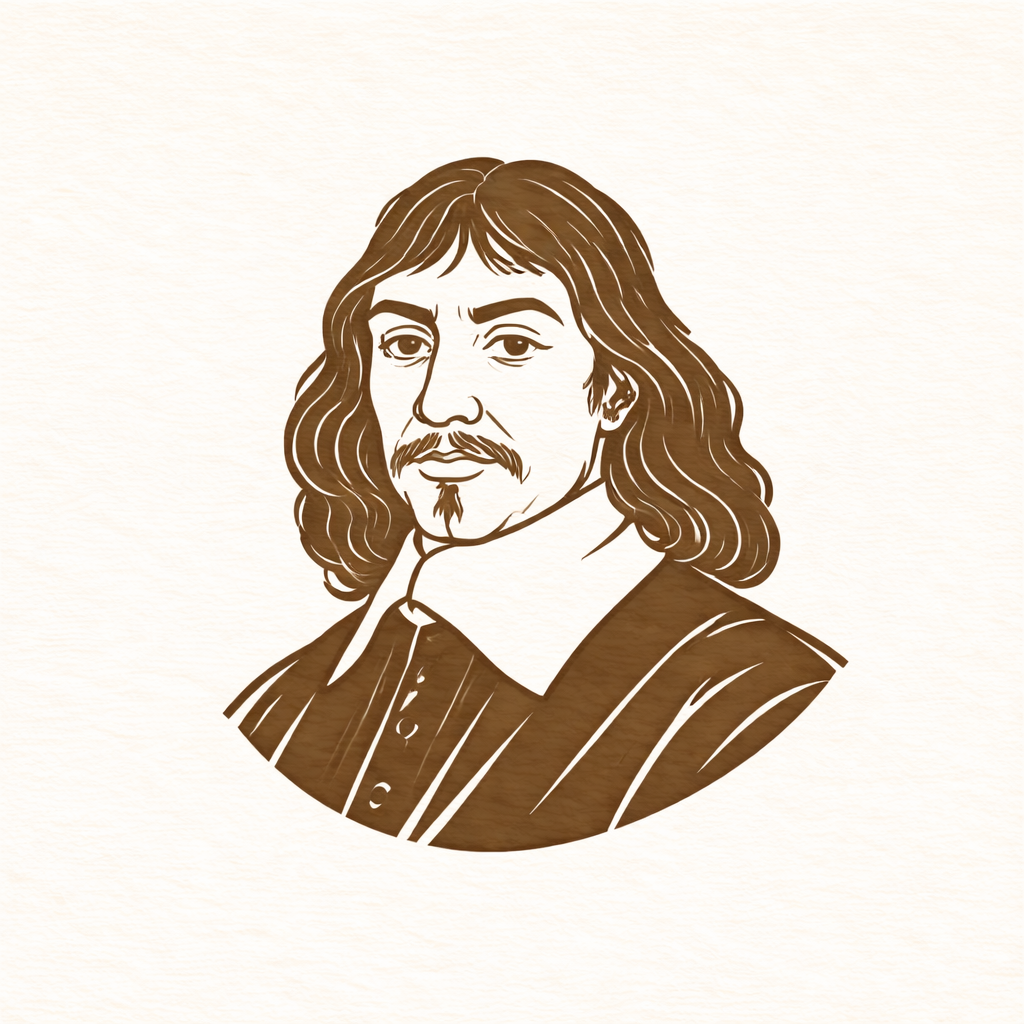
The Soldier Who Doubted Everything
On the night of November 10, 1619, a twenty-three-year-old French soldier, serving in the army of the Duke of Bavaria during the Thirty Years' War, shut himself inside a heated room in a small German town and had three dreams that would redirect the course of Western thought. Rene Descartes emerged from that night convinced that he had discovered the foundation of a new philosophy — one built not on tradition, authority, or the accumulated wisdom of the ages, but on the single, unshakeable certainty of his own thinking mind.
He had been restless from youth. Born in 1596 in La Haye en Touraine, educated by Jesuits at La Fleche — one of the finest schools in Europe — he found himself, upon graduating, dissatisfied with everything he had learned. "I found myself embarrassed with so many doubts and errors," he later wrote, "that it seemed to me that the effort to instruct myself had no effect other than the increasing discovery of my own ignorance." So he did what dissatisfied young men of means have always done: he traveled, enlisted in various armies, and sought experience in the world.
But the heated room in Germany changed everything. The method Descartes conceived was radical in its simplicity: doubt everything. Accept nothing that can be doubted. Strip away every belief — the evidence of the senses (which deceive), the truths of mathematics (which might be illusions planted by an evil demon), the existence of the external world (which might be a dream) — until you reach something that cannot be doubted, and build from there.
What survived the bonfire of doubt was a single certainty: Cogito ergo sum — I think, therefore I am. Even if everything else is illusion, the very act of doubting proves that there is a doubter. The thinking self exists. From this foundation, Descartes attempted to reconstruct the entire edifice of knowledge, proving the existence of God (as the guarantor of clear and distinct ideas), the reliability of reason, and the existence of the external world.
The most consequential — and most controversial — product of his philosophy was mind-body dualism. Descartes argued that the mind (res cogitans, the thinking thing) and the body (res extensa, the extended thing) are fundamentally different substances. The mind is immaterial, indivisible, and free; the body is material, divisible, and subject to mechanical laws. They interact — somehow — through the pineal gland in the brain.
This split would haunt Western thought for centuries. It gave rise to the "mind-body problem" that philosophers still debate. It also enabled the scientific revolution by treating the physical world as a machine that could be studied mathematically, without reference to souls or purposes — a move that made modern physics possible but also, critics argue, drained the natural world of meaning.
Descartes was also a formidable mathematician. He invented the Cartesian coordinate system — the x-y grid that connects algebra to geometry — which remains the foundation of analytic geometry. He made significant contributions to optics and developed a theory of planetary motion.
He spent most of his adult life in the Netherlands, seeking the intellectual freedom that France did not offer. He corresponded with the finest minds of Europe, published carefully (he suppressed one work after hearing of Galileo's condemnation), and lived quietly, rising late — he claimed to do his best thinking in bed in the morning.
In 1649, he accepted an invitation from Queen Christina of Sweden to tutor her in philosophy. It was a fatal mistake. Christina insisted on lessons at five in the morning, in an unheated library, in the Swedish winter. Descartes, accustomed to sleeping until noon, caught pneumonia and died on February 11, 1650, at fifty-three.
He left behind a revolution. Before Descartes, philosophy began with the world and asked how we can know it. After Descartes, philosophy began with the mind and asked how it can reach the world. This "epistemological turn" — the move from metaphysics to the theory of knowledge — defined modern philosophy and has never been fully reversed. Every time we ask how we can be sure of what we know, every time we wonder whether our experience is real, every time we feel the gap between our inner life and the outer world — we are living inside questions that a French soldier, huddled in a heated room on a winter night in Germany, was the first to ask with the full force of philosophical rigor.
He did what dissatisfied young men of means have always done: he traveled, enlisted in various armies, and sought experience in the world.
“I think, therefore I am.”
Key Ideas
Cogito ergo sum
Cartesian doubt
Mind-body dualism
Clear and distinct ideas
Key Works
- 01Meditations on First Philosophy
- 02Discourse on the Method
- 03Principles of Philosophy
- 04The Passions of the Soul
Intellectual Lineage
Influenced by
Rene
He influenced
Did you know
Descartes did his best thinking in bed. He rarely got up before noon and developed his entire philosophical system while lying under the covers. When Queen Christina of Sweden forced him to give her philosophy lessons at 5 AM, he caught pneumonia and died.