
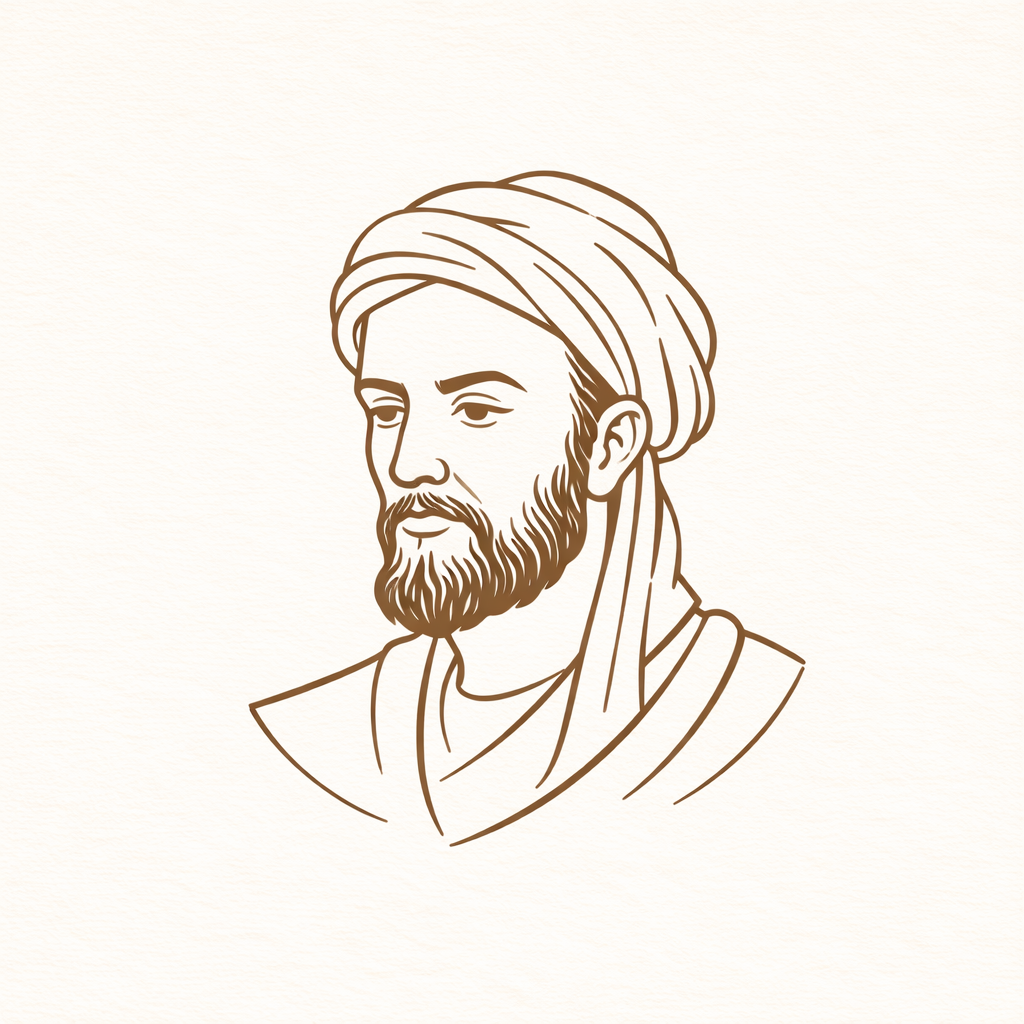
The Physician Who Healed Philosophy
By the age of ten he had memorized the entire Quran. By sixteen he was a practicing physician. By eighteen he had mastered every science available in the medieval Islamic world — logic, mathematics, astronomy, medicine, and philosophy — and had cured the Samanid sultan of Bukhara of an illness that had baffled every other doctor. The grateful sultan opened his royal library to the young prodigy, and Ibn Sina reportedly read through the entire collection. "I found there many books whose very titles are unknown to most people," he later wrote. He was not boasting. He was simply describing his reality.
Ibn Sina — known in the Latin West as Avicenna — was born in 980 CE near Bukhara, in what is now Uzbekistan, during the golden age of Islamic civilization. His father was a government official and an Ismaili sympathizer; the household was steeped in intellectual conversation. The boy's genius was apparent from the start, and by the time he reached adulthood he had already begun the two monumental works that would make him the most influential thinker between Aristotle and Thomas Aquinas.
The Canon of Medicine, written in Arabic, was a systematic encyclopedia of medical knowledge that synthesized Greek, Roman, Indian, and Islamic traditions into a single coherent framework. It classified diseases, described their causes and symptoms, prescribed treatments, and established principles of clinical trials and quarantine. For six centuries, it was the standard medical textbook in both the Islamic world and European universities. It was still being taught at Montpellier and Louvain in the seventeenth century.
But it was his philosophy that shook the foundations of thought. The Book of Healing — despite its name, a work of philosophy, not medicine — was an encyclopedic treatment of logic, physics, mathematics, and metaphysics that represented the most ambitious synthesis of Greek philosophy and Islamic theology ever attempted.
His most famous contribution was the distinction between essence and existence. For any contingent being — a tree, a horse, a human — its essence (what it is) is logically distinct from its existence (that it is). Nothing in the essence of a horse requires that horses exist. Therefore, every contingent being needs a cause for its existence, and this chain of causes must terminate in a Necessary Existent — a being whose essence is identical with its existence, who cannot not exist. This was God, understood not through revelation alone but through pure philosophical reasoning.
Equally revolutionary was the Flying Man thought experiment. Imagine, Ibn Sina proposed, a person created fully formed, floating in the void, with no sensory input whatsoever — no sight, no sound, no touch, no awareness of his own body. Would this person be aware of his own existence? Yes, Ibn Sina argued. The soul's self-awareness is immediate and independent of the body. Six centuries before Descartes wrote "I think, therefore I am," Ibn Sina had already established that self-consciousness is the one certainty that requires no sensory evidence.
His life was as turbulent as his intellect was serene. He served as court physician and political vizier to various rulers across Persia, was imprisoned at least once, escaped in disguise, and spent years on the move as empires rose and fell around him. He wrote much of his philosophy while traveling, often composing at night after a full day of administrative or medical duties, sustained, by his own admission, by generous quantities of wine.
He died in 1037 CE, at fifty-seven, of a digestive ailment he reportedly diagnosed himself but could not cure — the physician defeated by his own body. His last days were spent in prayer and acts of charity. He freed his slaves, distributed his possessions, and had the Quran recited to him until he passed.
His legacy is dual. In the Islamic world, he stands as the supreme philosopher-scientist, a demonstration that faith and reason are not enemies but partners. In the Latin West, his works arrived through translations in Toledo and Sicily and detonated in the medieval universities, forcing Christian thinkers — above all Thomas Aquinas — to grapple with the power of Aristotelian philosophy as filtered through a Muslim mind. The very structure of Scholastic philosophy — the careful distinction between essence and existence, the proofs for God's existence, the analysis of the soul — bears the fingerprints of a Persian physician who memorized the Quran at ten and rewrote the intellectual history of two civilizations.
Six centuries before Descartes wrote 'I think, therefore I am,' Ibn Sina had already established that self-consciousness requires no sensory evidence.
“The world is divided into men who have wit and no religion, and men who have religion and no wit.”
Key Ideas
The Flying Man thought experiment
Essence and existence
The Necessary Existent
Mind-body distinction
Key Works
- 01The Book of Healing (Kitab al-Shifa)
- 02The Canon of Medicine
- 03Book of Salvation
- 04The Floating Man
Intellectual Lineage
Did you know
Ibn Sina memorized the entire Quran by age ten and was a practicing physician by sixteen. He wrote over 450 works and his medical textbook was used in European universities for six hundred years. He also loved wine, which scandalized the pious.