
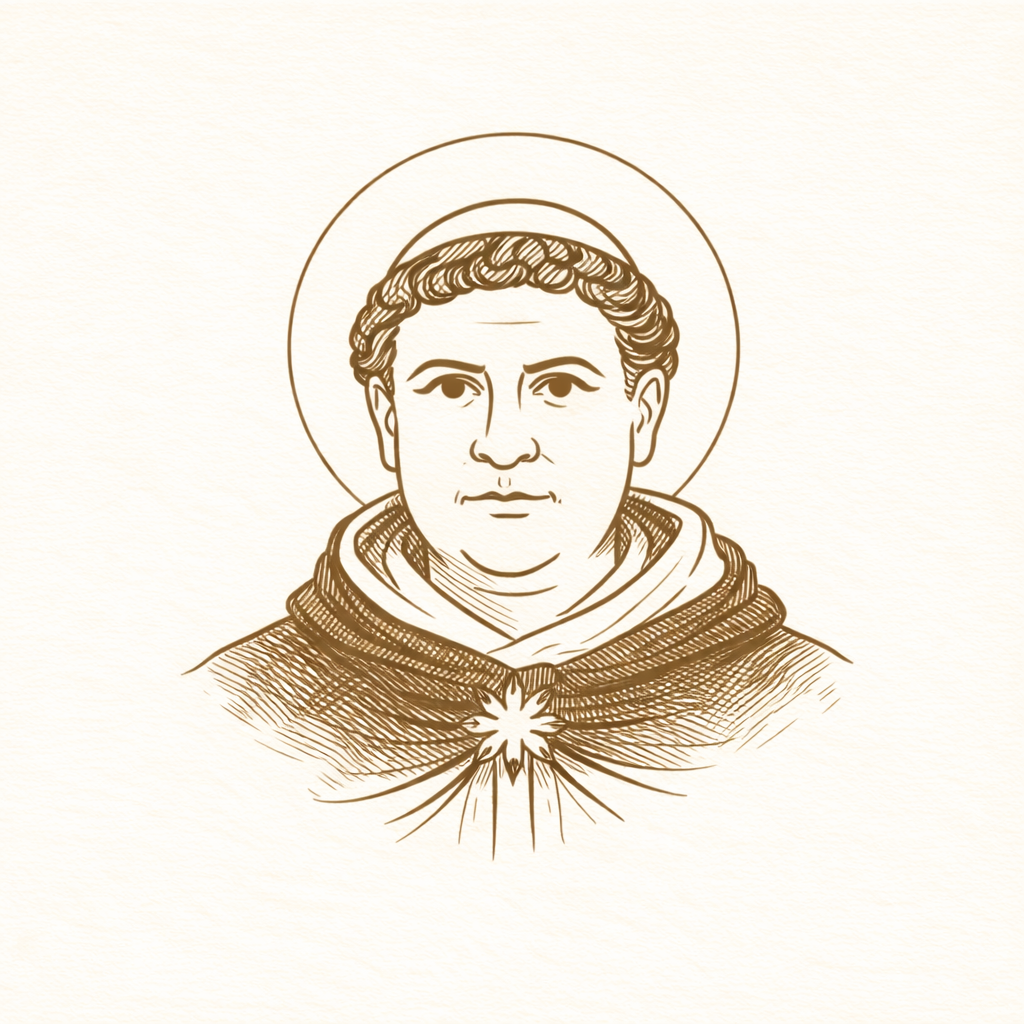
The Quiet Ox Who Shook the World
His classmates called him the Dumb Ox — a mocking nickname for the large, silent, slow-moving young man from southern Italy who sat in the back of the lecture hall at the University of Paris and said almost nothing. His teacher, Albertus Magnus, saw something the others did not. "You call him a dumb ox," Albertus reportedly said, "but I tell you that this ox will bellow so loud that his bellowing will fill the world." It was one of the most accurate predictions in the history of education.
Thomas Aquinas was born around 1225 in the castle of Roccasecca, near Naples, into a family of minor Italian nobility. His parents intended him for a comfortable career as a Benedictine abbot. When he insisted on joining the Dominican friars — a new order of mendicant preachers who embraced poverty — his family was horrified. His brothers kidnapped him and locked him in a tower for over a year. They even, reportedly, sent a prostitute to his room to tempt him from his vocation. Thomas drove her away with a flaming brand from the fireplace. His family eventually relented, and the Dumb Ox was free to change the world.
The problem he faced was titanic. In the thirteenth century, the works of Aristotle — lost to the Latin West for centuries — were flooding into European universities through Arabic translations, accompanied by the brilliant commentaries of Islamic philosophers, particularly Ibn Sina and Ibn Rushd (Averroes). Aristotle's philosophy was comprehensive, rigorous, and in many places apparently incompatible with Christian theology. The universe is eternal, Aristotle seemed to argue. The soul is not immortal. God does not know individual human beings.
The Church's first instinct was to ban Aristotle. Aquinas's audacious project was to baptize him — to show that reason and faith, Aristotle and Christ, philosophy and theology are not enemies but complementary paths to a single truth. The result was the Summa Theologica, the most ambitious intellectual construction of the Middle Ages: over 3,000 pages, 512 questions, 2,669 articles, each structured as a miniature debate — objections, counter-arguments, and Thomas's own resolution — covering everything from the existence of God to the ethics of just war to the nature of angels.
His Five Ways — five arguments for God's existence drawn from motion, causation, contingency, degrees of perfection, and design — remain the most discussed proofs in the history of philosophy. None of them rely on faith or scripture; they are purely philosophical arguments, built on Aristotelian premises, offered to anyone willing to reason.
His ethics of natural law — the idea that moral principles are grounded in human nature and accessible to reason — became the foundation of Catholic moral teaching and profoundly influenced the development of international law, human rights theory, and the Western legal tradition.
He worked at an almost inhuman pace, often dictating to three or four secretaries simultaneously on different subjects. His output was staggering — over eight million words in a career cut short at forty-nine. But the most remarkable fact about Aquinas is not the volume of his work but its tone. In an age of vicious intellectual combat, Thomas was unfailingly courteous. He stated his opponents' arguments more clearly than they had stated them themselves, conceded every point he could, and only then offered his own view. This was not weakness; it was the confidence of a mind so powerful it did not need to win by distortion.
On December 6, 1273, while celebrating Mass, something happened to him. He never spoke of it clearly, but he stopped writing. When his secretary urged him to continue the Summa, he replied: "I cannot. Everything I have written seems like straw to me." He died three months later, on his way to the Council of Lyon, at the age of forty-nine.
The Summa was left unfinished. It did not matter. What Thomas Aquinas built in those twenty-five years of furious intellectual labor was nothing less than the cathedral of the medieval mind — a structure so comprehensive, so carefully reasoned, so generous in its engagement with every rival system of thought, that it became the official philosophy of the Catholic Church and remains one of the most formidable intellectual achievements in human history. The Dumb Ox had bellowed, and the sound has never stopped.
His classmates called him the Dumb Ox. His teacher said this ox would bellow so loud his bellowing would fill the world.
“To one who has faith, no explanation is necessary. To one without faith, no explanation is possible.”
Key Ideas
Five Ways (proofs for God)
Natural law theory
Faith and reason harmony
Analogy of being
Key Works
- 01Summa Theologica
- 02Summa Contra Gentiles
- 03On Being and Essence
- 04Commentary on Aristotle's Metaphysics
Intellectual Lineage
Influenced by
Thomas
He influenced
Did you know
Thomas Aquinas was so large and quiet that his classmates called him the Dumb Ox. His teacher Albert the Great fired back: This ox will one day bellow so loud his voice will fill the world. He was right.