
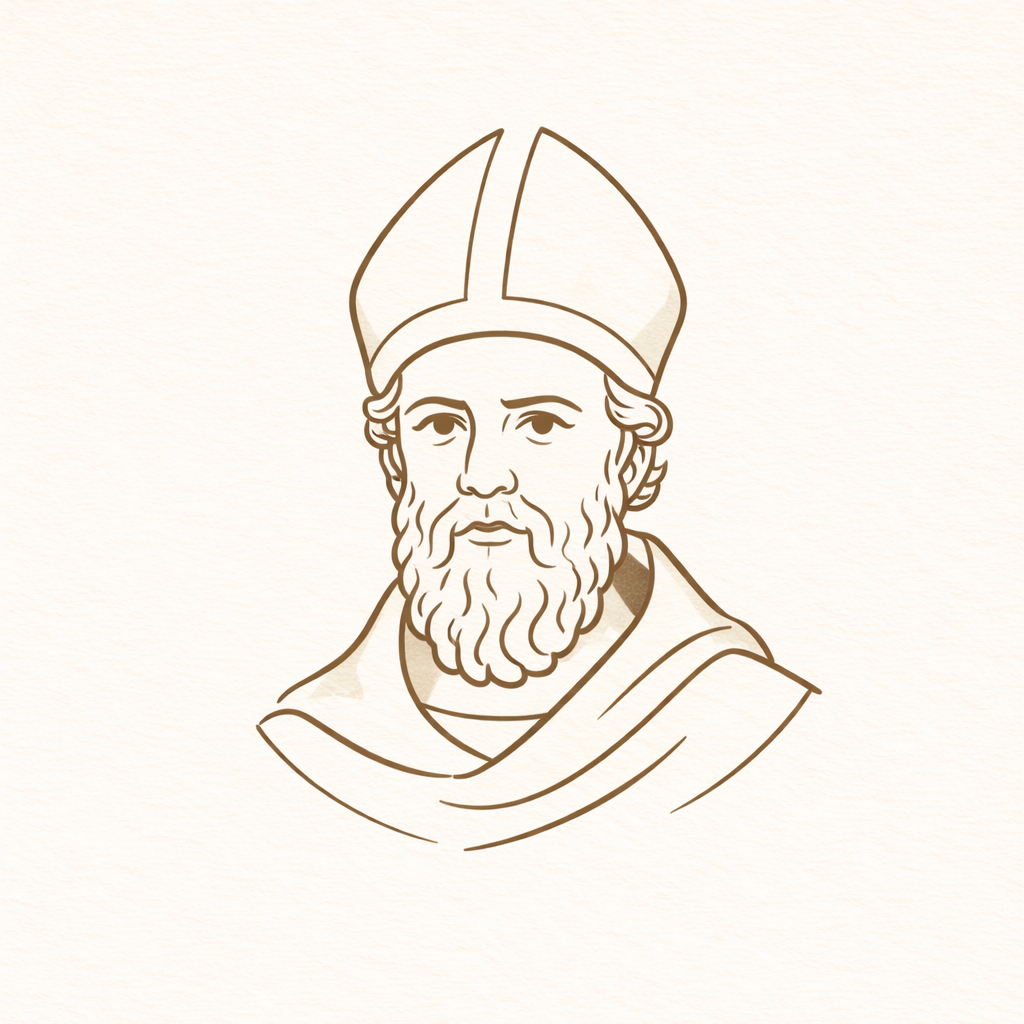
The Restless Heart
Before he became a saint, he was a sinner — and he wanted you to know about it in extraordinary detail. Augustine's Confessions, written around 397 CE, is the first true autobiography in Western literature, and it is a shocking document. Here is a bishop of the Church confessing to stealing pears as a boy not because he was hungry but for the sheer pleasure of doing wrong, describing his years-long sexual relationship with a woman he never names, agonizing over his inability to give up the pleasures of the flesh even as his intellect had already accepted Christianity. "Grant me chastity and continence," he famously prayed, "but not yet."
He was born in 354 CE in Thagaste, a small town in Roman North Africa (modern Algeria), to a pagan father and a fiercely Christian mother, Monica, whose relentless prayers and tears for her son's conversion would eventually make her a saint in her own right. Augustine was brilliant from childhood — a prodigy of rhetoric and Latin literature — and his mother's faith struck him as intellectually beneath him.
He spent his youth searching. He joined the Manichaeans, a dualist sect that divided the world into realms of light and darkness, and remained with them for nine years before their theology collapsed under his questions. He studied the Greek skeptics and despaired of finding truth. He read Cicero's Hortensius and felt the first stirrings of philosophical longing. He took a mistress, fathered a son, Adeodatus, and built a successful career teaching rhetoric in Carthage, Rome, and finally Milan.
It was in Milan that two forces converged to shatter him: the sermons of Bishop Ambrose, who showed him that Christianity could be intellectually rigorous, and the writings of the Neoplatonists, particularly Plotinus, who gave him a philosophical framework for understanding God as immaterial, infinite, and the source of all being. The intellectual barriers fell. Only the moral barrier remained — his will, divided against itself, unable to renounce the life he had built.
The moment of conversion, as he tells it, came in a garden in Milan in 386 CE. Weeping under a fig tree, tormented by his own weakness, he heard a child's voice chanting "Tolle lege" — "Take up and read." He opened Paul's Epistle to the Romans at random and read: "Not in rioting and drunkenness, not in chambering and wantonness, not in strife and envying; but put ye on the Lord Jesus Christ." The struggle was over.
What followed was one of the most productive intellectual lives in history. As Bishop of Hippo for thirty-five years, Augustine wrote over five million words — sermons, letters, treatises, and the two masterworks that shaped Western civilization. The Confessions invented the genre of spiritual autobiography and posed questions about memory, time, and consciousness that anticipate modern philosophy. His analysis of time in Book XI — "What then is time? If no one asks me, I know; if I wish to explain it to one that asks, I know not" — remains one of the most penetrating explorations of temporal experience ever written.
The City of God, written over thirteen years after the sack of Rome in 410 CE, reimagined human history as the story of two invisible cities — the City of God, oriented toward divine love, and the City of Man, oriented toward self-love — intertwined throughout time and only separated at the Last Judgment. It became the foundational text of Christian political theology and shaped European ideas about the relationship between church and state for a millennium.
His theology of original sin, grace, and predestination — forged in fierce debates with the Pelagians, who believed human beings could achieve salvation through their own efforts — would become the backbone of Western Christianity, embraced by Catholics and Protestants alike, and would trouble every subsequent generation with its dark insistence that the human will, unaided by God's grace, is incapable of choosing good.
He died in 430 CE, at seventy-five, as the Vandals besieged Hippo. The city fell shortly after, but his books survived. They crossed from Africa to Europe, from Latin to every European language, from monasteries to universities to the private libraries of everyone from Aquinas to Luther to Kierkegaard. Augustine's restless heart still beats in every honest confession of human weakness, every insistence that the intellect alone cannot save us, every recognition that we are divided creatures, longing for a wholeness we cannot achieve on our own.
Grant me chastity and continence — but not yet.
“You have made us for yourself, O Lord, and our hearts are restless until they rest in you.”
Key Ideas
Original sin
The City of God vs. City of Man
Free will and grace
The nature of time
Key Works
- 01Confessions
- 02The City of God
- 03On Free Choice of the Will
- 04On the Trinity
Intellectual Lineage
Augustine
He influenced
Did you know
Before becoming a saint, Augustine was a total party animal. He famously prayed: Lord, give me chastity — but not yet! He also stole pears as a teenager just for the thrill of it, then wrote an entire chapter analyzing why.