
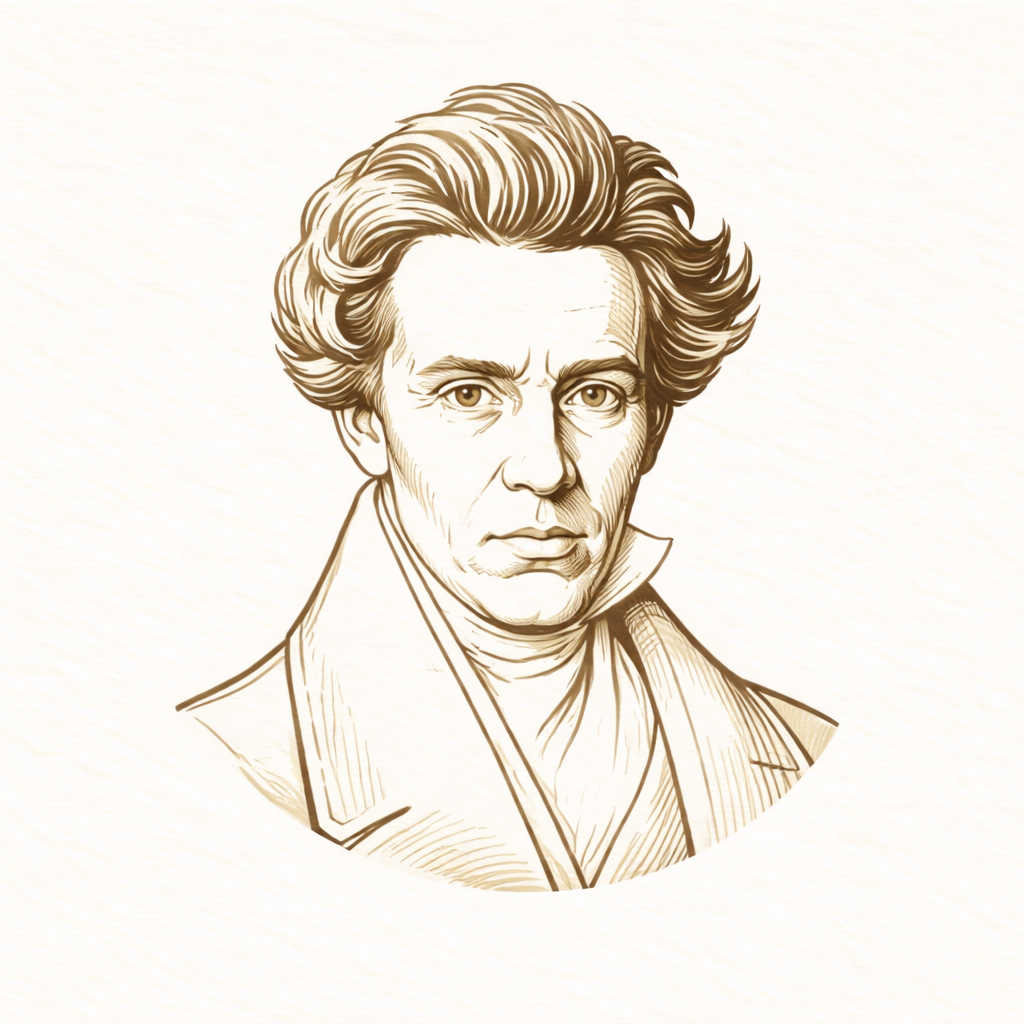
The Melancholy Dane Who Invented the Self
He walked the streets of Copenhagen so obsessively that every shopkeeper, servant, and street vendor knew him by sight. He was thin, slightly hunchbacked, with wild hair and trousers that were always too short, and he would stop anyone — a cabdriver, a professor, a child — and launch into conversation with a manic energy that was simultaneously charming and exhausting. Then he would go home to his rooms and write, sometimes for sixteen hours straight, producing in the space of eleven years one of the most extraordinary bodies of philosophical work in history — all of it driven by a single, anguished question: What does it mean to exist as a singular, irreducible human being?
Soren Kierkegaard was born in Copenhagen in 1813, the youngest of seven children. His father, a wealthy retired merchant, was a man of profound religious guilt who believed God had cursed his family. Five of Kierkegaard's siblings died before he reached twenty-one. The father's darkness — his conviction that joy itself was sinful — seeped into the son and never fully left.
At the University of Copenhagen, Kierkegaard studied theology, philosophy, and literature, but his real education was in the art of indirection. He became fascinated with irony, pseudonyms, and the idea that truth cannot be communicated directly — that the deepest truths of human existence must be approached obliquely, through stories, parables, and performances that force the reader to confront their own life rather than absorb someone else's system.
The great crisis of his personal life was his engagement to Regine Olsen. He loved her passionately, proposed, and then broke off the engagement in 1841 in circumstances that remain one of the great biographical mysteries. He may have believed his melancholy made him unfit for marriage. He may have believed that the religious vocation he felt called to was incompatible with domestic happiness. Whatever the reason, the loss haunted him for the rest of his life, and Regine became a figure in his philosophy — the symbol of everything that must be sacrificed when one chooses authenticity over comfort.
His philosophical project was a sustained assault on Hegel and the entire tradition of systematic philosophy. Hegel had constructed a grand system in which everything — history, nature, spirit, thought — was comprehended in a rational, dialectical totality. Kierkegaard found this obscene. Real human existence, he argued, is not a system. It is a concrete, particular, anguished, mortal experience that no abstract category can capture. You cannot think your way to the meaning of your life. You must choose it — and choice, real choice, is terrifying.
He described three stages of existence. The aesthetic stage is the life of pleasure, variety, and immediacy — the seducer who moves from experience to experience without commitment. The ethical stage is the life of duty, marriage, and social responsibility — the bourgeois citizen who fulfills his obligations. The religious stage is the life of absolute commitment to something beyond reason — the knight of faith who stands alone before God, willing to sacrifice everything, as Abraham was willing to sacrifice Isaac.
The movement between stages is not logical progress but a leap — a leap of faith that cannot be justified by reason because reason has already been exhausted. Fear and Trembling, his meditation on the story of Abraham and Isaac, is a terrifying exploration of what it means to obey a command that is, by every rational and ethical standard, monstrous. Abraham is not a hero; he is a paradox — a man who believes by virtue of the absurd, and whose faith makes him simultaneously the greatest of criminals and the greatest of saints.
Anxiety, for Kierkegaard, is not a disorder to be cured but the fundamental condition of freedom. We are anxious because we are free, and freedom means confronting infinite possibility with no guarantee of choosing correctly. "Anxiety is the dizziness of freedom," he wrote — the vertigo you feel when you look over the edge of your own existence and realize that nothing prevents you from jumping.
He died in 1855, at forty-two, collapsing in the street and spending his final weeks in a hospital, refusing communion from the state church he had spent his last years attacking with savage brilliance. He had published over forty books, most under pseudonyms, and was known in Copenhagen mainly as an eccentric and a nuisance.
His influence came later — and it was immense. Heidegger, Sartre, Camus, Tillich, Buber, Barth — the existentialist tradition in both philosophy and theology is essentially a series of footnotes to Kierkegaard. He had insisted, against the entire weight of the Western philosophical tradition, that the single individual — anxious, mortal, free, choosing — is more real than any system, more important than any abstract truth, and that the meaning of existence is not something you discover but something you create, in fear and trembling, with your whole life.
Anxiety is the dizziness of freedom — the vertigo you feel when you look over the edge of your own existence.
“Life can only be understood backwards; but it must be lived forwards.”
Key Ideas
The leap of faith
Anxiety as the dizziness of freedom
The three stages of existence
Subjectivity is truth
Key Works
- 01Either/Or
- 02Fear and Trembling
- 03The Concept of Anxiety
- 04The Sickness Unto Death
Intellectual Lineage
Influenced by
Soren
He influenced
Did you know
Kierkegaard broke off his engagement to the love of his life, Regine Olsen, then spent the next decade writing book after book basically processing the breakup. The most productive heartbreak in philosophical history.