
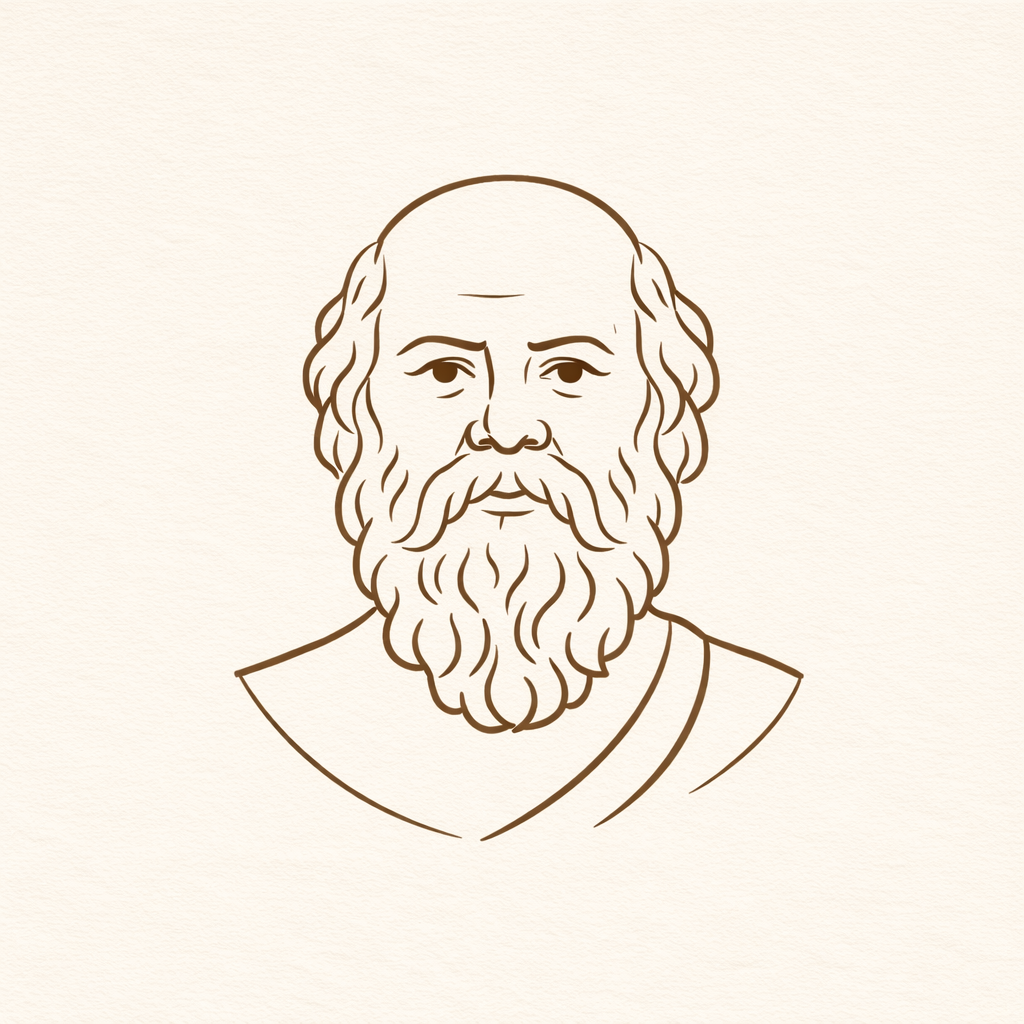
The Man Who Chose the Hemlock
He wrote nothing. Not a single word survives in his own hand. Everything we know about Socrates comes filtered through the minds of others — Plato, who loved him and made him immortal; Xenophon, who admired him and made him respectable; Aristophanes, who mocked him and made him ridiculous. The real Socrates stands somewhere behind these portraits, permanently out of reach, which is perhaps exactly as he would have wanted it. A man who insisted he knew nothing would hardly have presumed to write it down.
He was not what Athens expected of a philosopher. He was ugly — snub-nosed, thick-lipped, with bulging eyes that his friends compared to a satyr's. He walked barefoot through the streets in the same threadbare cloak winter and summer. He had been a stonemason, like his father, and a soldier of uncommon courage at Potidaea and Delium. He had a wife, Xanthippe, whose sharp tongue became proverbial, and three sons he seems to have largely neglected. He preferred the company of bright young men in the agora, where he would stop anyone — politician, poet, craftsman — and ask them questions.
The questions were the weapon. Socrates did not lecture. He asked: What is justice? What is courage? What is piety? And when his interlocutor offered a confident definition, Socrates would gently, relentlessly, almost playfully pull it apart, revealing contradictions the speaker had never noticed. The confident man would grow confused, then irritated, then — if he was honest — humbled. This was the elenchus, the Socratic method, and it was the most dangerous intellectual tool ever invented.
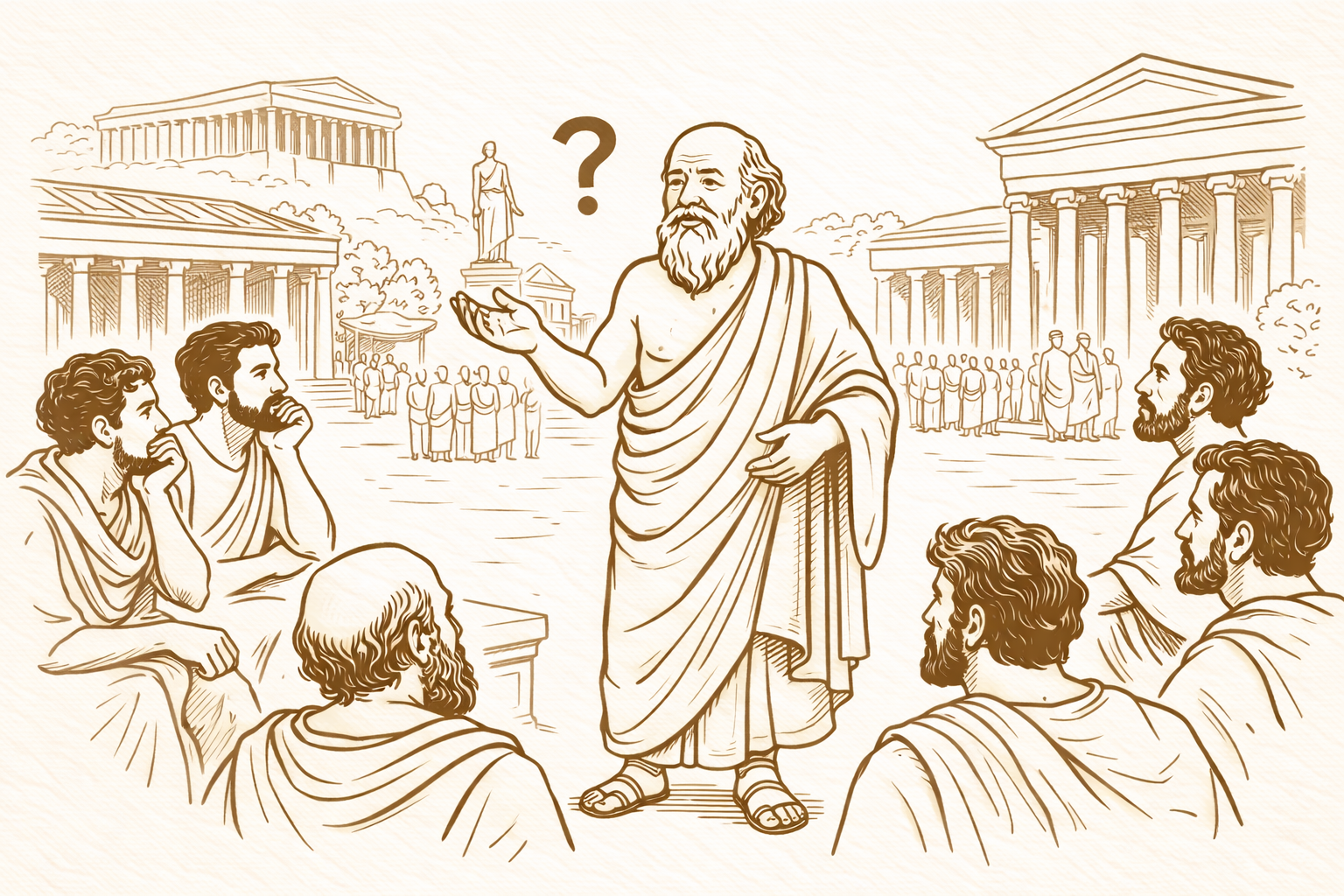
Dangerous because it exposed the emptiness behind authority. The politicians of Athens claimed to know what was good for the city; Socrates showed they could not define goodness. The poets claimed divine inspiration; Socrates showed they could not explain their own verses. The craftsmen knew their trades but assumed this gave them wisdom about everything else. In each case, Socrates demonstrated the same devastating truth: the people who were most certain they knew were the ones who understood least.
He called this his divine mission. A friend had asked the Oracle at Delphi whether anyone was wiser than Socrates, and the Oracle said no. Socrates, genuinely puzzled, interpreted this to mean that he was wise only in knowing that he did not know — and he spent the rest of his life proving that everyone else lacked even this modest self-awareness.
Athens did not thank him for it. In 399 BCE, when he was seventy years old, he was charged with impiety and corrupting the youth. The trial was political — the city was still raw from defeat in the Peloponnesian War and the tyranny of the Thirty — but the charges cut deeper. Socrates had made powerful men look foolish, and powerful men do not forget.
He could have fled. His friends arranged an escape. He refused. At the trial, instead of begging for mercy, he told the jury that he was the greatest benefactor Athens had ever known, a gadfly sent by the gods to sting a lazy horse into wakefulness. The jury voted to convict. When asked what penalty he deserved, he suggested free meals at the public dining hall. The jury voted for death.
He drank the hemlock in his prison cell, surrounded by weeping friends, and spent his last hours discussing the immortality of the soul. Plato, who may or may not have been present, wrote the scene in the Phaedo with a restraint that makes it one of the most moving passages in all of literature. Socrates died as he had lived: asking questions, trusting reason, and refusing to let fear dictate his choices.
His legacy is not a system of thought but a method of living. He taught that the first duty of a human being is self-examination — that to drift through life on inherited opinions, unquestioned assumptions, and comfortable certainties is not really to live at all. Twenty-four centuries later, every philosophy classroom in the world still begins where Socrates began: with a question, and the honest admission that we do not yet know the answer.
A man who insisted he knew nothing would hardly have presumed to write it down.
“The unexamined life is not worth living.”
Key Ideas
The Socratic Method
Know thyself
The examined life
Virtue is knowledge
Key Works
- 01No written works — known through Plato's Dialogues
- 02Apology (as recorded by Plato)
- 03Oral teachings in the Agora
Intellectual Lineage
Did you know
Socrates never wrote a single word! Everything we know about him comes from his students. He was also famously ugly — his friends compared his face to a satyr's — and he walked barefoot through Athens in the same ratty cloak year-round.