
The Architect of Invisible Worlds
He was born into Athenian aristocracy, destined for politics, and gifted with the kind of literary talent that could have made him the greatest dramatist of his age. Instead, he met Socrates, and everything changed. Plato was roughly twenty when he fell into the orbit of that barefoot questioner in the agora, and by the time Socrates drank the hemlock in 399 BCE, the young aristocrat had abandoned every ambition except one: to ensure that his teacher's death was not in vain.
What he built from that grief was nothing less than the foundation of Western philosophy. Plato's dialogues — over thirty survive — are simultaneously works of literature, drama, and rigorous argument. They feature Socrates as their protagonist, but the ideas increasingly belong to Plato himself, and those ideas are staggering in their ambition.
At the center stands the Theory of Forms. Plato argued that the physical world we perceive is not truly real — it is a flickering shadow of a higher realm of perfect, eternal, unchanging ideas. The beautiful things we see are beautiful because they participate in the Form of Beauty itself. The just acts we witness are just because they partake of the Form of Justice. The world of the senses is a cave, and we are prisoners watching shadows on the wall, mistaking them for reality.
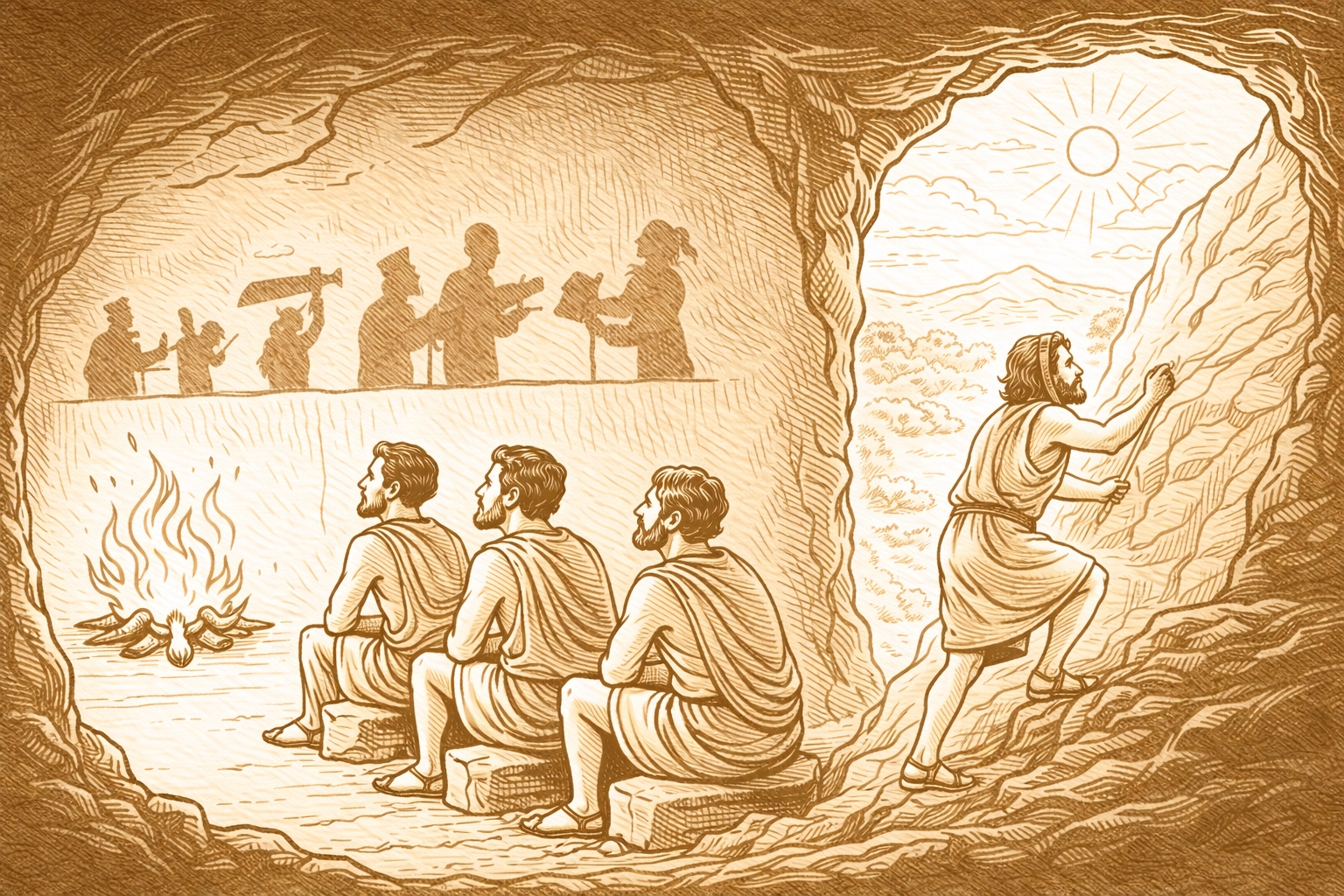
The Allegory of the Cave, presented in Book VII of The Republic, is perhaps the most famous philosophical image ever conceived. A prisoner breaks free, turns toward the fire that casts the shadows, and eventually climbs out of the cave into the blinding light of the sun — the Form of the Good, the highest reality. The pain of that ascent, the disorientation of seeing truth for the first time, the ridicule the freed prisoner faces when he returns to tell the others — this is the philosopher's journey, and Plato believed it was the only journey worth taking.
The Republic itself is a breathtaking work of political philosophy. Plato imagined an ideal city governed by philosopher-kings — rulers who had made the ascent out of the cave and could see reality as it truly is. Education, he argued, was everything: the careful cultivation of the soul through music, mathematics, and dialectic over decades of training. Only those who had mastered the highest form of knowledge — the vision of the Good itself — were fit to govern.
His psychology was equally revolutionary. He divided the soul into three parts: reason (the charioteer), spirit (the noble horse), and appetite (the unruly horse). The well-ordered soul, like the well-ordered city, requires reason to govern, spirit to enforce, and appetite to be restrained. This tripartite model would echo through millennia of thought, from Christian theology to Freud's id, ego, and superego.
In 387 BCE, Plato founded the Academy in Athens — the Western world's first institution of higher learning, which would endure for over nine hundred years. There he taught, wrote, and attracted the greatest minds of the Greek world, including a young man from Stagira named Aristotle, who would study there for twenty years before dismantling much of his teacher's philosophy.
Plato attempted, disastrously, to put his political ideas into practice in Syracuse, where he tried three times to educate the tyrant Dionysius II. Each attempt ended in humiliation or danger. The philosopher-king remained a dream.
He died around 348 BCE, reportedly at a wedding feast. He was eighty. The dialogues he left behind are not merely philosophical arguments — they are dramatic masterpieces in which ideas come alive through character, irony, myth, and a prose style of extraordinary beauty. Alfred North Whitehead famously remarked that all of Western philosophy is a series of footnotes to Plato. It was an exaggeration, but not by much. Every time we ask whether appearances deceive us, whether justice is more than convention, whether education can transform the soul, or whether the people who govern should be the people who know the most — we are still living inside questions that Plato asked first, in the shadow of the Acropolis, twenty-four centuries ago.
The world of the senses is a cave, and we are prisoners watching shadows on the wall, mistaking them for reality.
“We can easily forgive a child who is afraid of the dark; the real tragedy of life is when men are afraid of the light.”
Key Ideas
Theory of Forms
The Allegory of the Cave
Philosopher-Kings
The Tripartite Soul
Key Works
- 01The Republic
- 02Symposium
- 03Phaedrus
- 04Timaeus
Intellectual Lineage
Did you know
Plato wasn't his real name! He was born Aristocles — Plato was a nickname meaning broad, possibly referring to his wrestler's shoulders. Before philosophy, he was a competitive wrestler and even competed at the Isthmian Games.