
The Man Who Catalogued Everything
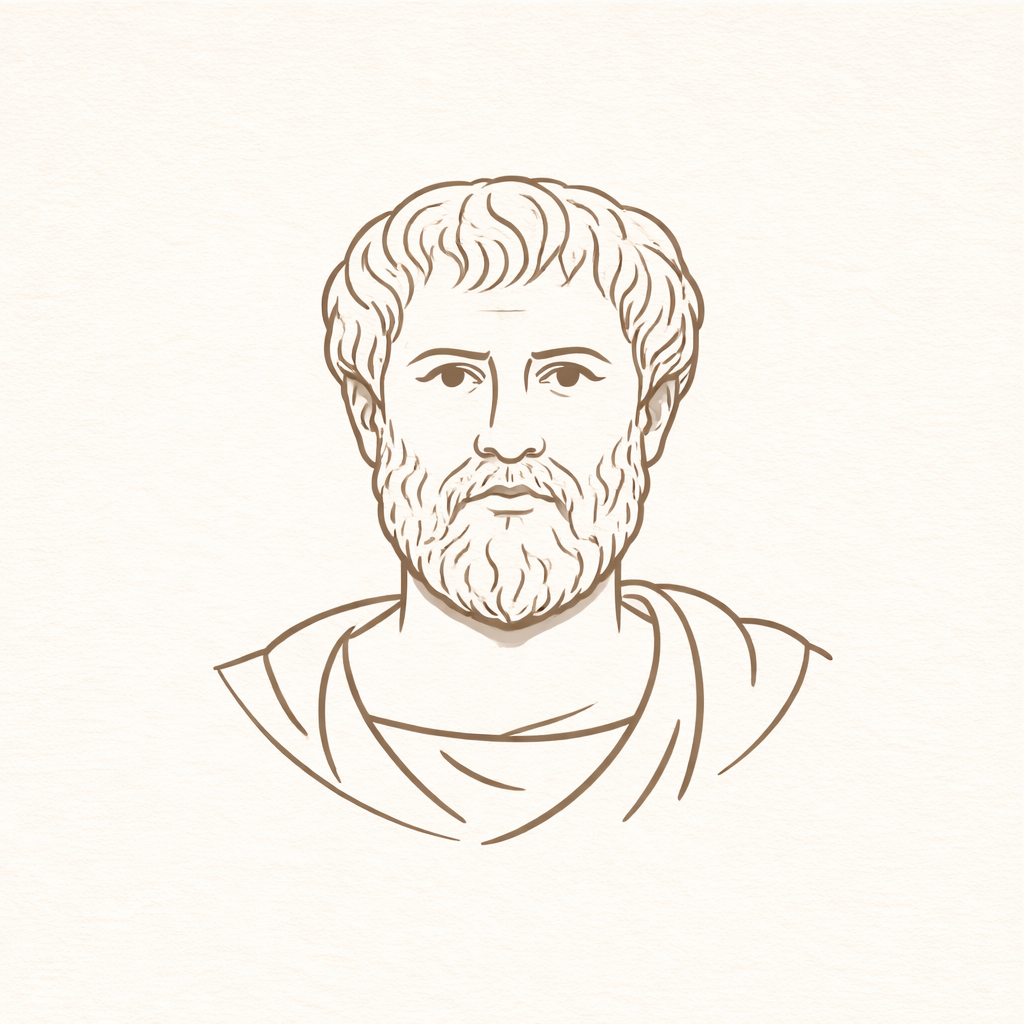
If Plato looked upward toward the eternal Forms, Aristotle looked around him — at animals and constitutions, at the structure of arguments and the organs of cuttlefish, at the way tragedy moves an audience and the way a city organizes itself. He was the most comprehensive mind the ancient world produced, and possibly the most comprehensive mind that has ever existed.
He came from Stagira, a small Greek colony in the north, the son of a physician to the Macedonian king. At seventeen he traveled to Athens and enrolled in Plato's Academy, where he remained for twenty years — first as student, then as colleague. Plato reportedly called him "the mind of the school." But Aristotle's mind worked differently from his teacher's. Where Plato soared into abstraction, Aristotle demanded evidence. Where Plato distrusted the senses, Aristotle trusted observation. "Plato is dear to me," he reportedly said, "but dearer still is truth."
After Plato's death, Aristotle left Athens. He spent years traveling, studying marine biology on the island of Lesbos — his observations of sea creatures are astonishingly precise even by modern standards — and was eventually summoned to Macedon to tutor a thirteen-year-old prince named Alexander. What the philosopher taught the future conqueror of the known world is largely a matter of speculation, but Alexander carried a copy of Homer annotated by Aristotle on every campaign.
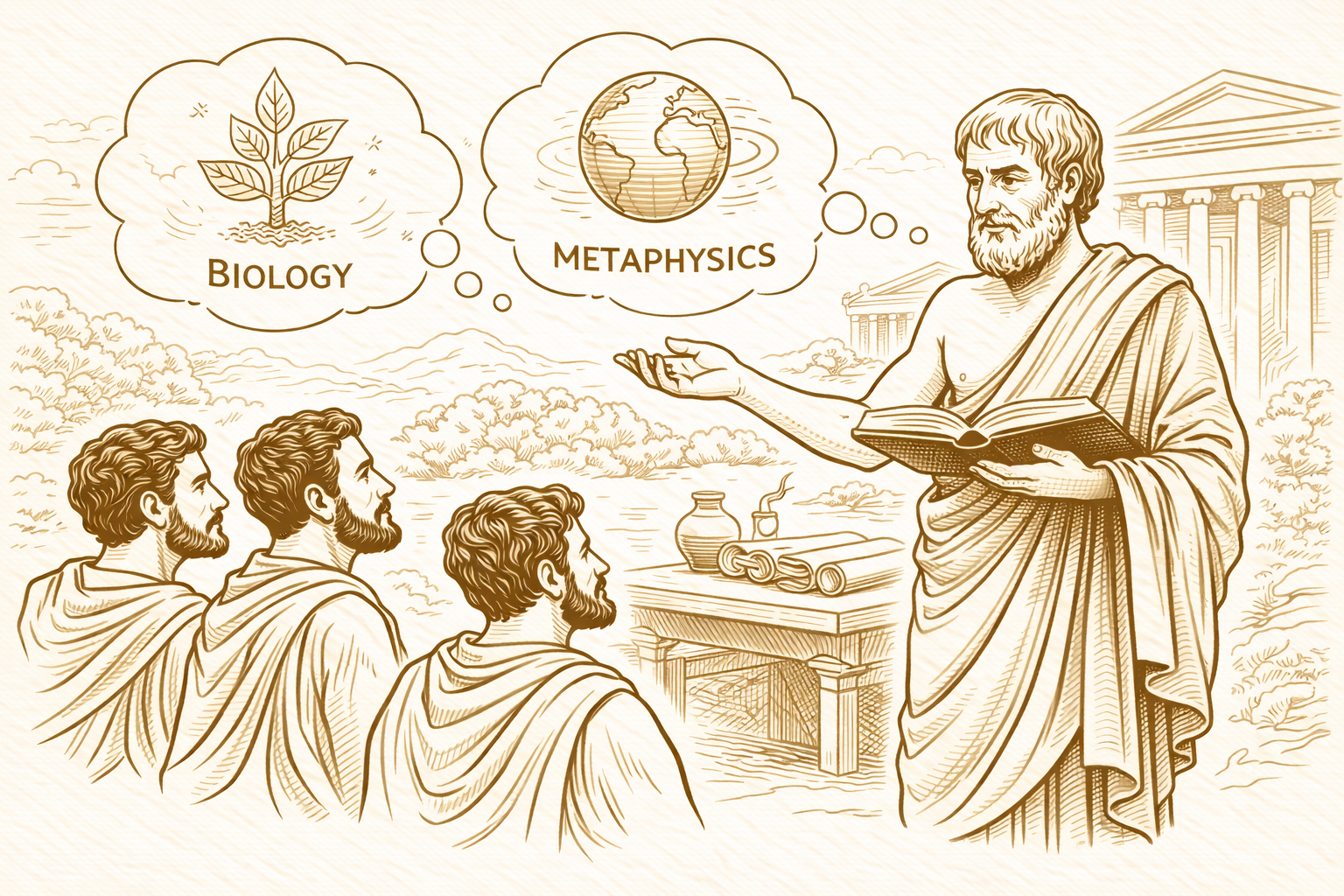
In 335 BCE, Aristotle returned to Athens and founded his own school, the Lyceum, where he taught while walking the colonnaded paths — hence the name "Peripatetic" for his followers. There he produced a body of work so vast and so systematic that it reads like one man's attempt to understand everything.
His logic, codified in the Organon, invented the formal study of valid reasoning. The syllogism — if all men are mortal, and Socrates is a man, then Socrates is mortal — was Aristotle's creation, and it remained the foundation of logic for over two thousand years, until Frege and Russell in the late nineteenth century.
His Metaphysics — named simply because the ancient editors placed it "after the Physics" — asked the deepest question philosophy can pose: What is being? What does it mean for something to exist? His answer involved a sophisticated theory of substance, form, matter, and the four causes (material, formal, efficient, and final) that shaped scientific and philosophical thinking for millennia.
But it is his ethics that speak most directly to how we live. The Nicomachean Ethics, likely named for his son Nicomachus, argues that the goal of human life is eudaimonia — often translated as "happiness" but better understood as "flourishing" or "living well." This is not pleasure, not wealth, not honor, but the active exercise of the soul's faculties in accordance with virtue, over a complete life. Virtue, for Aristotle, is a habit, not a feeling — the golden mean between excess and deficiency, found through practice and practical wisdom.
Courage is the mean between cowardice and recklessness. Generosity is the mean between stinginess and extravagance. This is not a rule book but a way of thinking about character: the good person is the one who has trained themselves, through years of practice, to feel the right emotions in the right circumstances to the right degree. It is, in essence, an ethics of maturity.
His Politics catalogued 158 constitutions of Greek city-states and argued that human beings are by nature political animals — that we can only flourish within a well-ordered community. His Poetics analyzed Greek tragedy and gave us the concepts of catharsis, the tragic flaw, and the unity of action that still shape how we tell stories.
When Alexander died in 323 BCE, anti-Macedonian sentiment surged in Athens. Aristotle, mindful of what Athens had done to Socrates, fled, saying he would not allow the city to "sin twice against philosophy." He died the following year on the island of Euboea, at sixty-two.
His works were lost for centuries, rediscovered in a damp cellar, edited, and transmitted through Arabic scholars to medieval Europe, where they became the intellectual bedrock of the university system. Thomas Aquinas called him simply "The Philosopher," as though there were no need to specify which one. In a sense, there was not. Aristotle did not merely contribute to knowledge; he organized the very categories through which the Western world would think for the next two thousand years.
Where Plato soared into abstraction, Aristotle demanded evidence. Where Plato distrusted the senses, Aristotle trusted observation.
“We are what we repeatedly do. Excellence, then, is not an act, but a habit.”
Key Ideas
Logic & Syllogism
The Golden Mean
Eudaimonia (Flourishing)
Four Causes
Key Works
- 01Nicomachean Ethics
- 02Politics
- 03Metaphysics
- 04Poetics
Intellectual Lineage
Influenced by
Aristotle
Did you know
Aristotle was basically the world's first encyclopedia writer. He classified everything from animals to constitutions. He also tutored a teenager named Alexander — who went on to conquer most of the known world.