
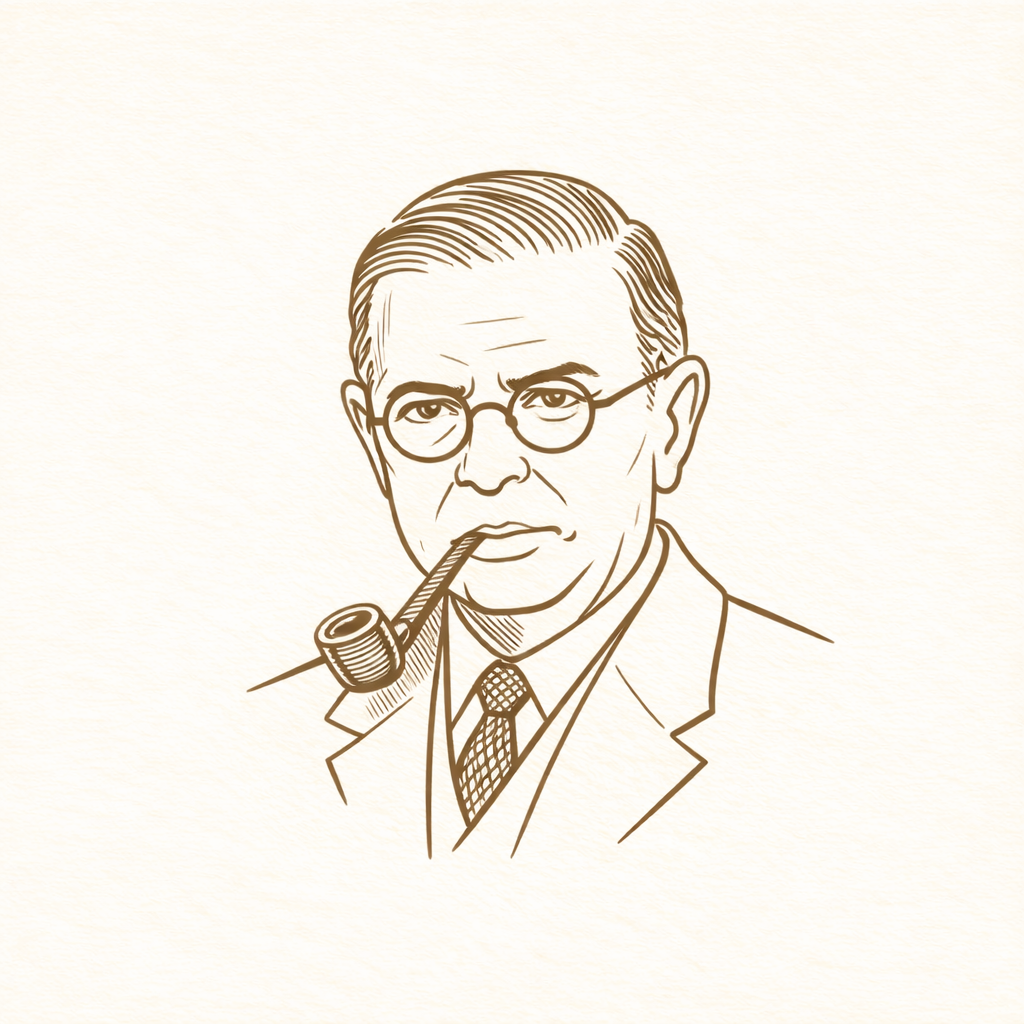
The Philosopher Who Refused to Look Away
On a cold October day in 1964, the Swedish Academy announced that Jean-Paul Sartre had been awarded the Nobel Prize in Literature. He refused it. He had refused the Legion d'Honneur twenty years earlier. He would have refused any official recognition, because to accept an honor from any institution was, in his view, to allow that institution to define you — and Sartre had built his entire philosophy on the principle that no one and nothing defines you except your own choices.
He was born in Paris in 1905, the son of a naval officer who died when Sartre was fifteen months old. Raised by his mother and his grandfather — Charles Schweitzer, uncle of Albert Schweitzer — he grew up in a household of books and words. He was cross-eyed from childhood, short, and considered himself ugly, a self-assessment he turned into a philosophical asset: since the world would not value him for his appearance, he would value himself for his freedom.
He studied at the Ecole Normale Superieure, where he met Beauvoir, and spent a year in Berlin studying Husserl's phenomenology. The encounter was transformative. From Husserl he took the idea that consciousness is always directed toward something; from Heidegger he took the idea that human existence is fundamentally different from the existence of things. But what he made of these ideas was entirely his own.
Being and Nothingness (1943), written in the cafes of occupied Paris, is the foundational text of existentialism. Its central claim is stark: existence precedes essence. A paper knife has an essence — a purpose for which it was designed — before it exists. A human being is the opposite: we exist first and create our essence through our choices. There is no human nature, no predetermined purpose, no God who designed us for a function. We are, as Sartre put it, "condemned to be free."
This freedom is absolute and inescapable. Even in the most constrained circumstances — a prison cell, an occupied country — we remain free to choose our attitude, our response, our meaning. We can pretend otherwise. We can tell ourselves that we "had no choice," that circumstances forced our hand, that our character or upbringing determined our actions. Sartre called this self-deception mauvaise foi — bad faith — and he considered it the fundamental form of human dishonesty.
The waiter who performs his role with exaggerated precision, as though "being a waiter" were a fixed identity rather than a freely chosen performance. The woman on a date who pretends not to notice that her companion is holding her hand, treating her own body as an inert object rather than acknowledging the situation and choosing how to respond. The collaborator who claims he was "just following orders." All are in bad faith — fleeing from the anguish of freedom into the comfort of pre-made identities.
But freedom is not solitary. Other people are both necessary and threatening. In his famous play No Exit (1944), three dead souls are locked in a room together for eternity. There is no torture, no fire, no physical punishment. The punishment is simply that they cannot escape each other's gaze. "Hell is other people" — not because others are evil, but because the look of the Other objectifies us, reduces our fluid freedom to a fixed identity. When someone looks at me, I become an object in their world — a coward, a hero, a fool — and I can never fully control how they see me.
During the war, Sartre was a prisoner of war, then a member of the Resistance — though the extent of his resistance activities has been debated. After liberation, he became the most famous intellectual in France, perhaps in the world. He wrote plays, novels, essays, biographies, political journalism, and philosophical treatises at a pace that suggests either genius or amphetamines (it was both). He championed Third World liberation movements, opposed the Vietnam War, supported the Algerian revolution, and visited Castro, Guevara, and Mao.
His political judgments were often disastrous. He excused Soviet atrocities for years before breaking with communism. He idealized revolutionary violence. He was better at diagnosing bad faith in individuals than in political movements.
He went blind in his later years and could no longer write. He died on April 15, 1980, in Paris. Fifty thousand people spontaneously followed his funeral procession through the streets — the largest such gathering since the death of Victor Hugo. He had refused every honor the establishment offered, but the people came anyway, because Sartre had given them something no prize could equal: the terrifying, exhilarating idea that they were free, that nothing determined them, and that the meaning of their lives was entirely in their own hands.
He refused the Nobel Prize, because to accept an honor from any institution was to allow that institution to define you.
“Man is condemned to be free; because once thrown into the world, he is responsible for everything he does.”
Key Ideas
Existence precedes essence
Radical freedom
Bad faith (mauvaise foi)
Hell is other people
Key Works
- 01Being and Nothingness
- 02Nausea
- 03No Exit
- 04Existentialism Is a Humanism
Intellectual Lineage
Jean-Paul
He influenced
Did you know
Jean-Paul Sartre was offered the Nobel Prize in Literature in 1964 and turned it down — the only person to voluntarily refuse it. He said he didn't want to be institutionalized. He also had a legendary cross-eyed stare.