
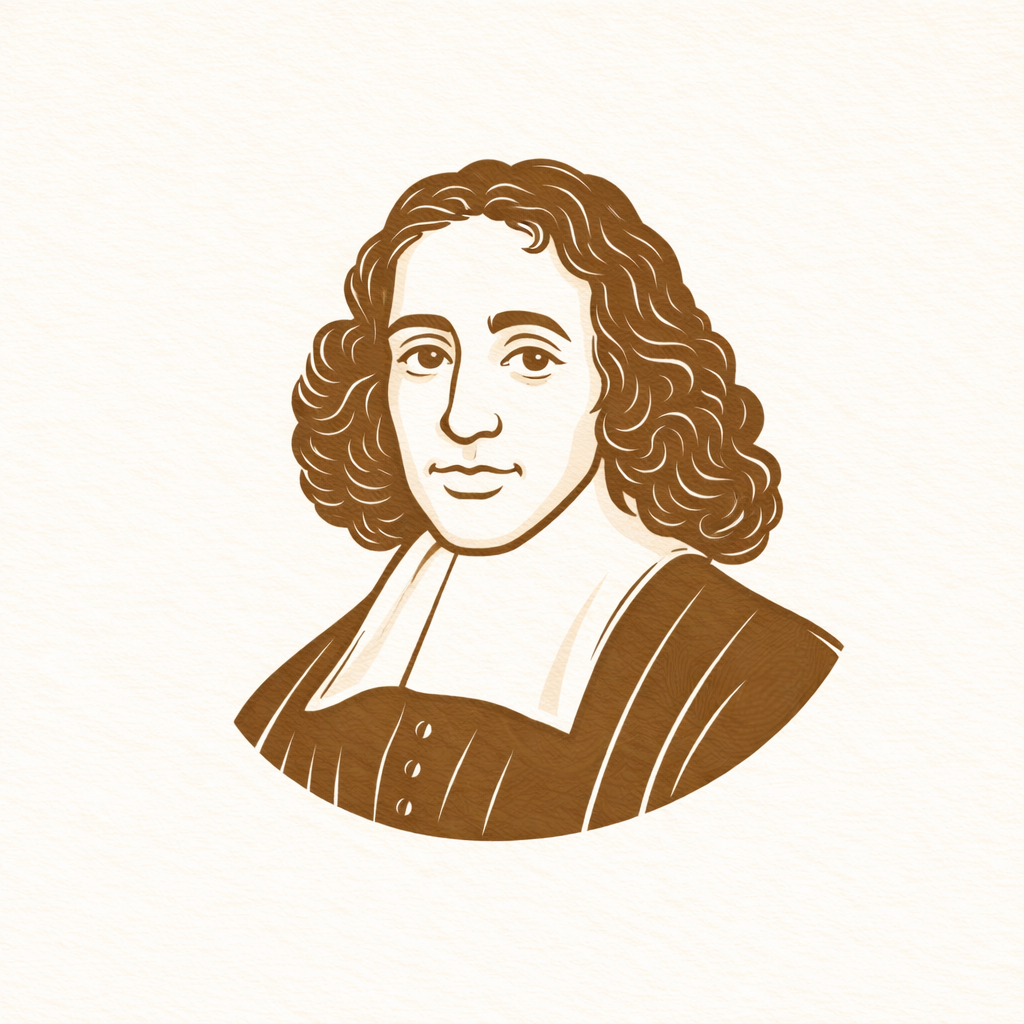
The Lens-Grinder Who Saw God in Everything
On July 27, 1656, the Portuguese-Jewish community of Amsterdam gathered in their synagogue and pronounced one of the most terrifying sentences in their tradition. Baruch Spinoza, twenty-three years old, was excommunicated with a herem of extraordinary ferocity. The document cursed him "by day and by night, in his sleeping and in his waking, in his going out and in his coming in." No member of the community was to speak to him, do business with him, read anything he had written, or come within four cubits of him. He was, in the language of the ban, to be "cut off from the nation of Israel."
What had he done? He had thought. He had read Descartes and the new science. He had asked questions about the Bible — whether Moses really wrote the Pentateuch, whether miracles were possible, whether God had a body — that the community's rabbis could not answer and could not tolerate. The young man they expelled would become, over the next twenty-one years, the most radical philosopher of the seventeenth century and one of the most important thinkers in the history of the West.
After the excommunication, Spinoza withdrew from public life. He changed his first name from the Hebrew Baruch to the Latin Benedictus — both mean "blessed" — and earned a modest living grinding lenses for microscopes and telescopes, a trade that slowly destroyed his lungs with glass dust. He lived in rented rooms in various Dutch towns, owned almost nothing, refused a professorship at Heidelberg because it might compromise his intellectual freedom, and devoted himself entirely to the work that would become his masterpiece: the Ethics.
The Ethics is one of the strangest and most beautiful books ever written. It is structured like a geometry textbook — definitions, axioms, propositions, demonstrations, corollaries — as though Spinoza were trying to prove the nature of God, the human mind, and the path to freedom with the same rigor that Euclid proved the properties of triangles. And in a sense he was.
His central claim is breathtaking: God and Nature are one and the same. There is only one substance in the universe, and that substance is infinite, self-caused, and identical with the totality of everything that exists. God is not a person who created the world from outside; God is the world, understood from the perspective of eternity. Every rock, every thought, every human being is a mode — a particular expression — of this single infinite substance.
This was not atheism, though his enemies called it that. It was a radical mysticism. If God is everything, then everything is sacred. There is no dualism between creator and creation, mind and body, spirit and matter. The mind and the body are not two different things but two different ways of understanding the same thing — the way a circle can be understood through geometry or through algebra.
Human freedom, for Spinoza, does not consist in free will — which he denied — but in understanding. We are unfree insofar as we are driven by passions we do not comprehend. We become free insofar as we understand the causes of our emotions and see them sub specie aeternitatis — under the aspect of eternity. The highest form of knowledge is what Spinoza called the intellectual love of God: the serene comprehension of our place in the infinite whole.
He died on February 21, 1677, at forty-four, of a lung disease likely caused by years of inhaling glass dust from his lenses. His friends published the Ethics posthumously. It was immediately condemned by virtually every religious authority in Europe — Protestant, Catholic, and Jewish. For over a century, "Spinozism" was the most dangerous accusation that could be leveled against a thinker.
But the ideas would not die. Goethe called Spinoza the most "theistic" and "Christian" of philosophers. Hegel called the Ethics the beginning of all modern philosophy. Einstein, when asked if he believed in God, replied: "I believe in Spinoza's God." The lens-grinder who was cursed by his community, who lived in poverty and obscurity, who ground glass until it killed him, had seen something so clearly that three centuries of philosophy have not been able to look away.
God is not a person who created the world from outside; God is the world, understood from the perspective of eternity.
“I have striven not to laugh at human actions, not to weep at them, nor to hate them, but to understand them.”
Key Ideas
God or Nature (Deus sive Natura)
Substance monism
Conatus (striving to persist)
Freedom through understanding
Key Works
- 01Ethics
- 02Theological-Political Treatise
- 03Treatise on the Improvement of the Understanding
Intellectual Lineage
Influenced by
Baruch
He influenced
Did you know
Spinoza was excommunicated from the Jewish community at age 23 with one of the harshest bans ever written. He made his living grinding lenses — the glass dust likely contributed to his early death at 44. He turned down a university professorship to keep his freedom.