
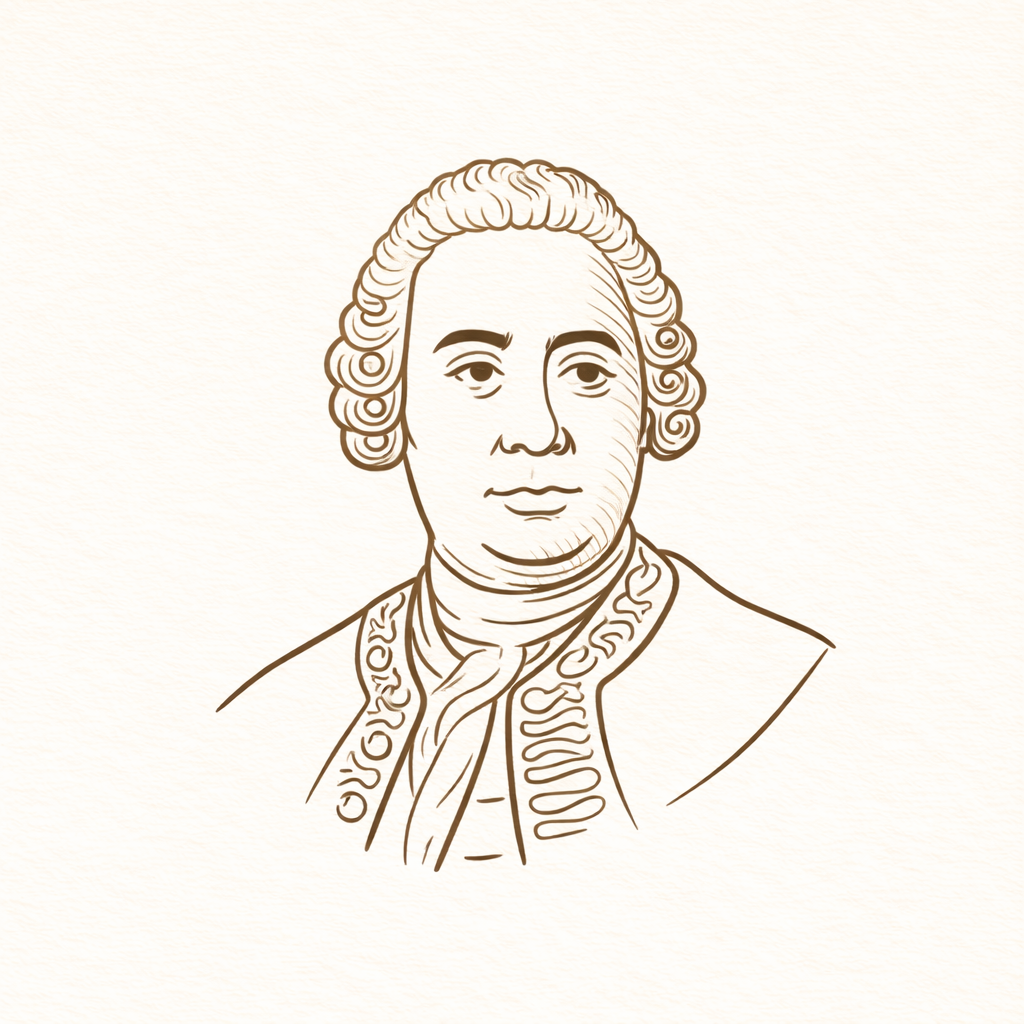
The Cheerful Skeptic
He published the most important philosophical work in the English language at the age of twenty-eight, and it fell, as he later wrote, "dead-born from the press, without reaching such distinction as even to excite a murmur among the zealots." A Treatise of Human Nature, which dismantled the foundations of causation, personal identity, and rational morality with devastating precision, was almost entirely ignored. David Hume, who would eventually be recognized as the greatest philosopher to write in English, went home to Scotland and became, for a time, a librarian.
He was born in Edinburgh in 1711, the younger son of a minor Scottish landowner. He was intellectually precocious but not a prodigy — he attended the University of Edinburgh without distinction, tried and abandoned the law, and suffered a nervous breakdown at eighteen while pursuing an independent course of philosophical reading so intense it nearly destroyed his health. He recovered by eating well, riding horses, and deciding that philosophy should not make you miserable.
This decision — that thinking should not come at the cost of living — would define his entire career. Hume was that rarest of philosophical creatures: a radical skeptic who was also a genuinely happy man. Plump, sociable, fond of good food and better conversation, he was adored by almost everyone who knew him. His friends called him "le bon David." Even his philosophical enemies admitted he was the most agreeable man in Europe.
The philosophy, however, was not agreeable at all. Hume's central insight was simple and devastating: all human knowledge comes from experience, and experience gives us much less than we think. We believe that the future will resemble the past — that the sun will rise tomorrow because it has always risen — but this belief cannot be justified by reason. We have simply observed a pattern and formed a habit of expectation. Causation, the glue that holds our understanding of the world together, is not something we observe in nature. We see one billiard ball strike another and the second ball move, but we never see the "cause" — we only see the sequence. Cause and effect is a habit of the mind, not a feature of reality.
This "problem of induction" has never been solved. Every attempt to justify inductive reasoning ultimately relies on induction itself, which is circular. Hume did not lose sleep over this. His skepticism was therapeutic, not nihilistic. We cannot help forming habits of expectation — nature has built this into us — and those habits work well enough for practical life. The point is not to abandon belief but to hold it with humility.
His moral philosophy was equally revolutionary. Hume argued that reason alone cannot motivate action — it can tell us what is true, but not what to do. Morality is grounded not in rational principles but in sentiment, in our natural capacity for sympathy and our shared emotional responses to human actions. "Reason is, and ought only to be the slave of the passions." This claim, scandalous in its time, anticipated the modern understanding that moral judgments are fundamentally emotional before they are rational.
He also identified what philosophers now call the is-ought problem: you cannot derive a moral conclusion (what ought to be) from a factual premise (what is) without smuggling in an additional moral premise. This simple observation — often overlooked by moralists who claim to derive ethics from nature or science — remains one of the most important insights in ethical theory.
And then there was the self. When Hume looked inward, he could not find a self — only a bundle of perceptions, sensations, and memories in constant flux, with no permanent observer behind them. "I always stumble on some particular perception or other," he wrote, "of heat or cold, light or shade, love or hatred, pain or pleasure. I never can catch myself at any time without a perception." The self is not a thing but a story the mind tells about its own continuity.
He died in 1776, the same year America declared independence and Adam Smith — his closest friend — published The Wealth of Nations. He faced death with the same cheerful equanimity he had brought to everything else. When Boswell visited him on his deathbed and asked whether the prospect of annihilation did not trouble him, Hume reportedly replied that it troubled him no more than the thought of not having existed before he was born.
Immanuel Kant, the greatest philosopher of the next generation, wrote that Hume had awakened him from his "dogmatic slumber." It is the highest compliment philosophy can pay. Hume showed that our deepest convictions — about cause and effect, about the self, about morality — rest not on reason but on something deeper, older, and more human: habit, feeling, and the practical necessities of life. He did not find this tragic. He found it liberating.
He published the most important philosophical work in the English language at twenty-eight, and it fell, as he wrote, 'dead-born from the press.'
“Reason is, and ought only to be the slave of the passions.”
Key Ideas
The problem of induction
The is-ought problem
Bundle theory of the self
Causation as habit
Key Works
- 01A Treatise of Human Nature
- 02An Enquiry Concerning Human Understanding
- 03Dialogues Concerning Natural Religion
- 04An Enquiry Concerning the Principles of Morals
Intellectual Lineage
Did you know
David Hume was so fat and jolly that the French called him le bon David. He was also so skeptical that he doubted whether the sun would rise tomorrow — then calmly went to dinner, because philosophy should never ruin a good meal.