
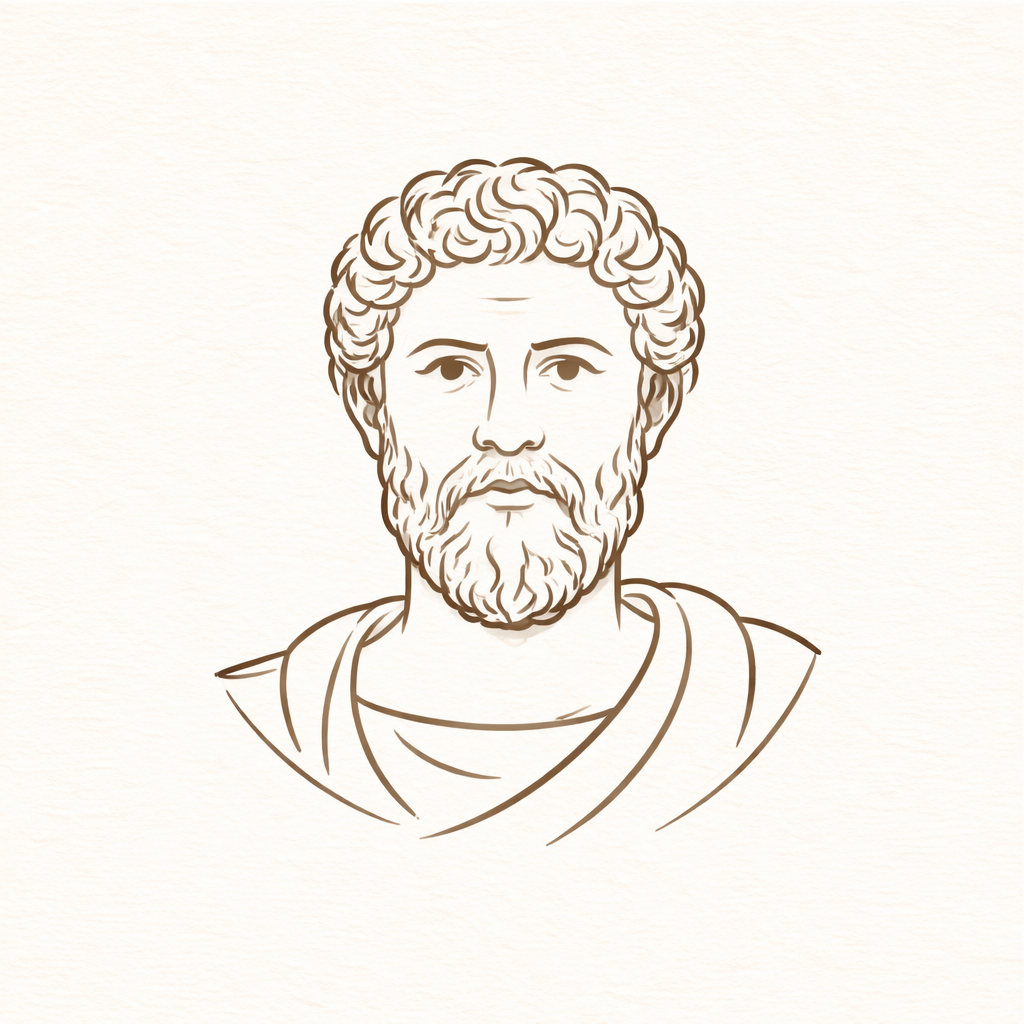
The Emperor Who Argued with Himself
The Meditations were never meant to be read. They are the private journal of the most powerful man in the world, written in Greek during military campaigns along the frozen Danube frontier, by candlelight in a tent, while the Roman Empire crumbled at its edges and plague ravaged its interior. Marcus Aurelius was not writing philosophy for posterity. He was writing it to survive his own life.
He was born in 121 CE into one of Rome's most distinguished families, adopted by the Emperor Antoninus Pius, and groomed for power from childhood. When he ascended the throne in 161 CE, at the age of forty, he was already the best-educated man in the empire — trained in rhetoric, law, and philosophy, particularly the Stoicism of Epictetus, whose teachings would become the bedrock of his inner life.
The empire he inherited was beset. The Parthians attacked from the east. Germanic tribes pressed from the north. A devastating plague — probably smallpox — swept through the legions and the cities, killing millions. Marcus spent most of his reign not in the marble halls of Rome but in military camps on the frontier, commanding armies he had never trained to command, making decisions of life and death with the philosophical temperament of a man who would rather have been reading.
The Meditations, written during these campaigns, are not a systematic treatise. They are fragments — notes to himself, arguments with his own weakness, reminders of principles he feared he was forgetting. They repeat themselves, circle back, contradict, and begin again. This is what makes them so powerful. We are not reading a philosopher's polished conclusions; we are watching a man think in real time, struggling to live up to his own ideals under impossible pressure.
The central teaching is Stoic: the only thing you control is your own mind. External events — war, plague, betrayal, death — are neither good nor evil. They simply are. What matters is how you respond. "You have power over your mind — not outside events," he wrote. "Realize this, and you will find strength." This is not indifference; it is the radical discipline of choosing your response to suffering rather than being enslaved by it.
He reminded himself constantly of impermanence. Alexander the Great and his mule driver were both reduced to the same dust. The fame of emperors fades; the cities they built fall into ruin; even memory itself is eventually forgotten. "Soon you will have forgotten everything," he wrote. "Soon everything will have forgotten you." This was not nihilism — it was liberation. If nothing lasts, then the anxious grasping after fame, wealth, and power is absurd. What remains is duty: doing the right thing, in this moment, because it is right.
He was not a perfect emperor. He persecuted Christians, probably out of political necessity rather than personal conviction. He failed to choose a competent successor — his son Commodus would become one of Rome's worst rulers. But he tried, with extraordinary sincerity, to govern justly, to treat enemies with clemency, to subordinate his own desires to the public good.
He died in 180 CE, probably of the plague, at a military camp near modern Vienna. He was fifty-eight. The Meditations survived by accident — copied and preserved through the Byzantine centuries, translated into Latin during the Renaissance, and discovered by generation after generation of readers who found in this emperor's private anguish a mirror for their own.
What makes the Meditations endure is not the philosophy — Stoicism was already old when Marcus practiced it — but the humanity. Here is a man with absolute power reminding himself to be patient, to be kind, to forgive the people who annoy him, to get out of bed in the morning and do his duty even when he does not want to. The most powerful man in the world, arguing with himself about how to be good. That is a sight that never loses its power to move.
We are watching a man think in real time, struggling to live up to his own ideals under impossible pressure.
“You have power over your mind — not outside events. Realize this, and you will find strength.”
Key Ideas
Inner citadel of reason
Memento mori
Duty and virtue
The impermanence of all things
Key Works
- 01Meditations
Intellectual Lineage
Did you know
Marcus Aurelius was the most powerful man in the world and spent his evenings writing a private diary telling himself to be humble. His Meditations were never meant to be published — they're literally his personal therapy journal.